
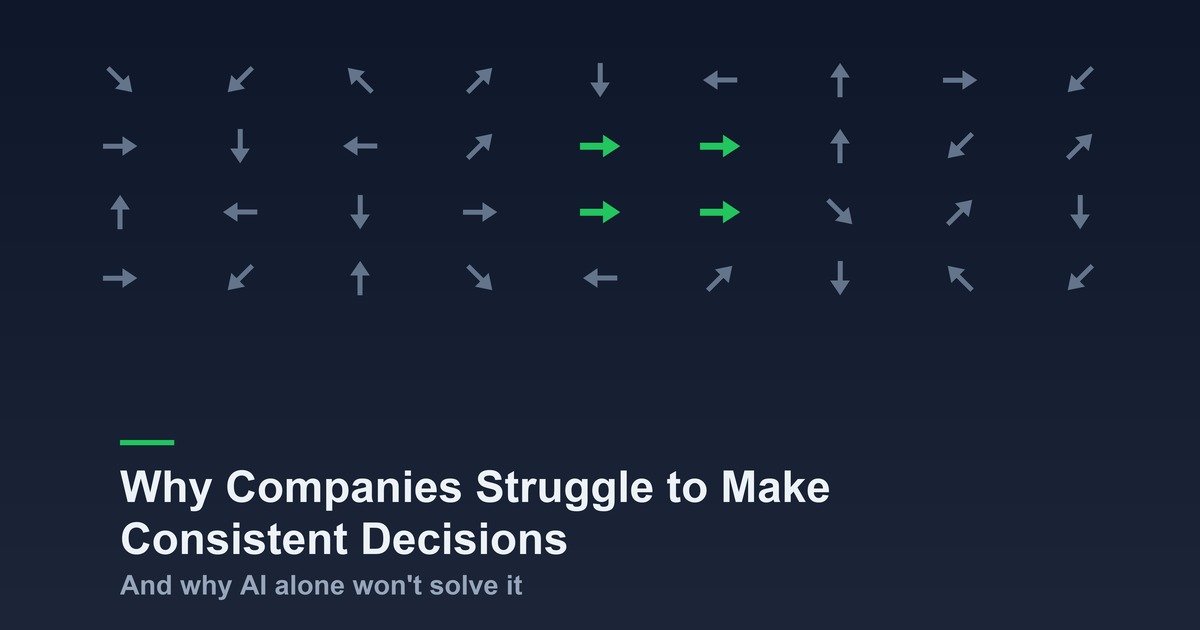
Organizations today have access to more data, automation, and artificial intelligence than at any other point in history.
Yet despite increasingly sophisticated systems, many companies continue struggling with fragmented decisions, unstable execution, and constant strategic realignment.
This presents one of the biggest contradictions in modern business.
Organizations have never had greater access to information, analytical capability, or operational technology. In many cases, they have become remarkably efficient. Teams operate with real-time dashboards, AI-driven reporting, predictive analytics, and increasingly advanced automation tools.
However, decision inconsistency remains surprisingly common.
Different teams continue interpreting priorities differently. Departments react to context in different ways. Strategic initiatives lose alignment over time despite having access to the same information and the same organizational objectives.
This raises an important question:
Why do organizations with more information than ever still struggle to make coherent decisions?
Based on my work exploring decision systems architecture, I believe the answer lies in a layer that many organizations still leave largely unstructured: the decision layer itself.
While most companies invest heavily in improving execution, far less attention is given to how decisions are continuously formed, interpreted, validated, and sustained across complex environments.
As a result, organizations often become more efficient without necessarily becoming more coherent.
The challenge is not a lack of intelligence, technology, or capability.
The challenge is that decision-making frequently remains fragmented, implicit, and highly dependent on local interpretation, particularly as complexity increases.
Understanding this distinction is becoming increasingly important as organizations attempt to integrate artificial intelligence, scale operations, and adapt to rapidly changing environments.
More Information Does Not Automatically Create Better Decisions
One of the most common assumptions in modern organizations is that better information naturally leads to better decisions.
At first glance, this seems reasonable. Organizations today have access to unprecedented levels of data, analytics, reporting capabilities, and AI-generated insights. Information is available in real time, performance can be monitored continuously, and operational visibility is greater than ever before.
Yet decision inconsistency remains remarkably common.
In many organizations, different teams continue interpreting priorities differently, responding to similar situations in different ways, and pursuing partially disconnected objectives despite operating within the same strategic framework.
This suggests that information alone does not create decision coherence.
I have observed this pattern repeatedly across commercial and operational environments.
In one commercial operation involving multiple prospecting teams, managers had access to the same CRM data, performance dashboards, and operational targets. Despite working with identical information, teams consistently prioritized opportunities differently and responded to comparable situations in different ways.
The problem was not a lack of activity. Execution levels were high.
The challenge was that decision criteria remained largely implicit, forcing teams to rely on local interpretation rather than a shared decision structure.
As the organization grew, these small differences accumulated into larger inconsistencies. Alignment discussions became more frequent, duplicated efforts increased, and performance fluctuated despite standardized processes and universal access to the same information.
What this illustrates is an important distinction:
The issue is often not information availability.
The issue is the absence of structures capable of creating consistency in how information is interpreted and translated into decisions.
For decades, organizations have invested heavily in optimizing execution. Much less attention has been given to how decisions themselves are formed, interpreted, and validated across the organization.
As complexity increases, that imbalance becomes increasingly difficult to ignore.
The Execution Trap
When organizations experience instability, the most common response is to focus on execution.
Leaders typically introduce new processes, increase reporting requirements, schedule additional alignment meetings, deploy new dashboards, expand automation initiatives, or increase operational oversight.
These actions often generate short-term improvements. Activity increases, visibility improves, and teams become more responsive.
However, many organizations eventually discover that instability persists.
The reason is simple: execution can only amplify the quality of the decisions it is built upon.
A well-executed misaligned decision still produces misalignment — only faster and at greater scale.
I have observed this pattern in environments where execution metrics appeared healthy on the surface.
In one operation, teams consistently met activity targets, followed established workflows, and maintained high productivity levels. From a purely operational perspective, performance appeared strong.
Yet leadership continued facing recurring instability, frequent strategic adjustments, and inconsistent outcomes across teams.
A closer examination revealed that the issue was not execution quality.
Different teams were interpreting prospect qualification, opportunity prioritization, and escalation criteria differently, despite operating under the same formal process.
As a result, execution remained efficient while outcomes became increasingly inconsistent.
What initially appeared to be an execution problem was actually a decision interpretation problem.
Once decision criteria became more explicit and contextual validation mechanisms were introduced, the organization observed greater consistency in execution outcomes without significantly changing operational processes themselves.
This experience reinforced an important lesson.
Organizations often attempt to solve decision problems through execution improvements when the root cause exists before execution even begins.
This is why many organizations today feel operationally intense but strategically unstable at the same time.
Execution is usually highly structured.
Decision-making often remains implicit.
Different teams may execute exceptionally well while operating from different interpretations of context, priorities, and objectives.
The challenge is not choosing between execution and decision-making.
The challenge is recognizing that execution becomes significantly more effective when the decision layer itself becomes structurally coherent.
Decision Architecture: The Missing Organizational Layer
Most organizations already possess operational systems.
They have processes, workflows, KPIs, reporting structures, governance mechanisms, and increasingly sophisticated technologies designed to support execution.
What often remains unstructured is the layer connecting information, interpretation, and action.
This becomes particularly visible in commercial and customer-facing environments where teams are required to make dozens of contextual decisions every day.
In one operational setting, managers initially believed they were facing an execution problem because team members frequently required clarification regarding priorities, lead handling, and next-step actions.
Processes existed. Workflows were documented. Performance expectations were clear.
Yet clarification requests continued occurring at a surprising frequency.
A closer examination revealed that the underlying issue was not process compliance.
Team members were interpreting context differently and applying different decision criteria when evaluating similar situations.
Rather than introducing additional controls, new procedures, or tighter supervision, the organization focused on making decision criteria more explicit and creating mechanisms for contextual validation before action was taken.
Over time, the number of clarification cycles decreased. Alignment discussions became more productive. Teams demonstrated greater consistency when responding to comparable operational scenarios.
What changed was not the execution system itself.
What changed was the structure supporting how decisions were formed before execution occurred.
This distinction is critical.
Organizations rarely define explicitly:
how context should influence decisions
how interpretation should adapt across changing environments
how decision criteria remain consistent over time
how organizations validate whether decisions continue making sense as conditions evolve
As a result, decision-making often depends heavily on isolated interpretation, local pressures, or implicit assumptions.
Decision architecture seeks to address this gap.
Rather than creating rigid frameworks, its purpose is to establish structural continuity between information, interpretation, and action.
The objective is not to eliminate human judgment.
The objective is to reduce fragmentation.
As organizational complexity increases, this layer becomes increasingly important because the challenge is no longer simply executing tasks efficiently.
The challenge is ensuring that decisions remain coherent as information, context, and operational conditions continuously evolve.
AI Is Accelerating Execution — But Not Necessarily Coherence
Artificial intelligence is already transforming how organizations operate.
Across industries, AI is being used to automate workflows, accelerate analysis, generate predictions, optimize operations, and improve responsiveness. In many cases, these applications have produced meaningful gains in efficiency and scalability.
But they address only part of the challenge.
AI can process information faster than humans. It can identify patterns across enormous datasets, generate recommendations in real time, and surface insights that would previously have required hours of manual effort.
What AI does not automatically provide is a shared structure for interpreting those insights consistently across an organization.
This distinction is becoming increasingly important.
In practical business environments, sales teams can now receive AI-generated prospect research, recommended outreach strategies, lead prioritization suggestions, and contextual insights almost instantly.
Customer-facing operations can identify behavioral patterns across thousands of interactions, while managers can access predictive indicators that help anticipate risks and opportunities before they become visible through traditional reporting.
Yet one recurring observation remains surprisingly consistent.
Faster access to information does not automatically produce better decisions.
In several sales and customer-facing environments, AI-generated recommendations were available to everyone involved, yet teams continued reaching different conclusions because the criteria used to interpret those recommendations remained inconsistent.
The limitation was not the quality of the AI output.
The limitation was the absence of a shared decision structure governing how those insights should be evaluated and applied.
This is where I believe the conversation around AI is beginning to evolve.
The next challenge is no longer simply generating more information, more recommendations, or more automation.
The challenge is creating organizational environments capable of transforming AI-supported insights into coherent decisions across multiple teams, functions, and contexts.
In that sense, AI becomes most valuable not only when it accelerates execution, but when it strengthens the infrastructure that supports interpretation, validation, and decision consistency.
Organizations may become faster through AI.
But speed alone does not guarantee coherence.
And as complexity continues to grow, coherence may become one of the most important factors determining whether AI creates sustainable advantage or simply accelerates existing fragmentation.
What Changes When Decision Structures Become Explicit
One of the first changes organizations experience is an increase in coherence.
In many environments, teams operate with partially different assumptions about priorities, context, and objectives despite working within the same organization. These differences are often subtle, but their effects accumulate over time.
When decision structures become more explicit, alignment improves naturally because interpretation itself becomes more consistent.
One of the earliest observable effects is a reduction in clarification cycles.
In several operational environments, managers reported spending a significant amount of time repeatedly explaining priorities, validating interpretations, and resolving inconsistencies between teams that were technically following the same process.
As decision criteria became more explicit and contextual interpretation received greater structure, these clarification loops began occurring less frequently.
Teams became more capable of responding consistently to similar situations without requiring constant intervention.
Another important observation involved the speed at which operational misalignment could be identified.
In many organizations, problems become visible only after execution outcomes begin to deteriorate. By that point, considerable time and resources may already have been lost.
When decision formation becomes more structured, the source of inconsistency becomes easier to identify because interpretation itself is no longer hidden.
Organizations gain visibility into how decisions are being formed before execution amplifies their consequences.
While results naturally vary across environments, recurring observations have included:
fewer alignment meetings dedicated to resolving interpretation conflicts
reduced operational rework caused by conflicting assumptions
faster identification of decision bottlenecks
greater consistency in priority management across teams
Importantly, these improvements were often achieved without increasing supervision, adding management layers, or introducing significant procedural complexity.
This led to one of the most valuable lessons I have observed:
Consistency often improves not because organizations control execution more aggressively, but because they structure decision formation more effectively.
Over time, this creates additional benefits.
Organizations become less dependent on isolated expertise, informal interpretation, or localized experience. Adaptation becomes easier because teams spend less energy correcting internally generated fragmentation.
Contrary to what many leaders initially assume, more explicit decision structures do not necessarily make organizations more rigid.
In many cases, they make organizations more adaptive.
The reason is simple.
When coherence increases, organizations gain the ability to respond to changing conditions without continuously losing alignment in the process.
Why This Shift Is Already Emerging
The need for more structured decision-making is no longer theoretical.
It is emerging as a practical response to limitations that many organizations are already experiencing.
Over the last decade, companies have invested heavily in analytics platforms, automation systems, AI technologies, and operational optimization initiatives. These investments have dramatically increased the ability to process information, automate activities, and scale execution.
Yet many leadership teams continue reporting recurring challenges involving cross-functional alignment, conflicting priorities, inconsistent responses to changing conditions, and difficulties maintaining coherence as organizations grow.
What makes these challenges particularly interesting is that they often persist even when operational performance metrics improve.
Organizations are becoming increasingly capable of processing information.
They are not necessarily becoming equally capable of maintaining consistent interpretation across teams, departments, and decision layers.
Across conversations with executives, commercial leaders, and operational managers, a recurring theme continues to emerge:
Complexity is growing faster than traditional decision structures were designed to handle.
This helps explain why topics such as contextual intelligence, AI governance, adaptive systems, decision frameworks, and organizational alignment are receiving increasing attention across industries.
Although these conversations often originate from different disciplines, they are frequently responding to the same underlying challenge:
How can organizations sustain coherent decisions in environments where information, context, and conditions change continuously?
From my perspective, the shift is already underway.
Organizations are increasingly recognizing that execution efficiency alone is not solving many of the inconsistencies they face internally.
The growing interest in contextual intelligence, adaptive systems, and decision governance reflects a broader realization that coherence itself is becoming a strategic capability.
Artificial intelligence is accelerating this realization.
As AI makes information more accessible and execution more scalable, it exposes an important distinction:
Scaling execution is relatively straightforward.
Scaling coherent interpretation is significantly more difficult.
And it is precisely this challenge that may define the next stage of organizational evolution.
The organizations that adapt most successfully will likely not be those that simply execute faster.
They will be those capable of sustaining decision coherence as complexity continues to expand.
The Real Challenge Ahead
Organizations today possess extraordinary capabilities.
They have access to advanced technologies, sophisticated analytics, artificial intelligence, automation platforms, and operational systems that previous generations could scarcely imagine.
The challenge is no longer a lack of information.
Nor is it primarily a lack of execution capacity.
In many of the environments I have studied and worked with, the most persistent difficulties emerged from a different source: the inability to maintain coherent decision-making as complexity increased.
When performance becomes unstable, organizations often respond by intensifying execution.
They add more meetings, more reporting, more controls, more processes, and more initiatives designed to improve alignment.
Sometimes these actions help temporarily.
But they frequently address the visible symptoms rather than the underlying cause.
The deeper challenge is that organizations can spend years optimizing execution while leaving the decision layer largely implicit.
As a result, they enter recurring cycles of activity, correction, and realignment that consume significant organizational energy without fully resolving the fragmentation that created the instability in the first place.
This is why I believe the next stage of organizational evolution will be defined less by how efficiently companies execute and more by how coherently they decide.
The question facing leaders is no longer simply:
“How do we execute faster?”
Increasingly, the more important question is:
“How do we ensure that decisions remain coherent as complexity grows?”
Organizations that begin addressing this question often discover something surprising.
Many execution challenges become easier to solve once decision formation itself becomes more structured.
In that sense, the future may not belong to the organizations that process the most information or deploy the most technology.
It may belong to those that are able to transform information into coherent decisions consistently, adaptively, and at scale.
Final Reflection
Artificial intelligence will continue transforming how organizations operate.
Automation will continue accelerating execution.
Data will continue becoming more abundant and accessible.
But none of these developments automatically create coherence.
As complexity grows, the ability to sustain consistent interpretation, align decisions across distributed environments, and adapt without losing direction may become one of the defining capabilities of successful organizations.
The future challenge is not simply executing more efficiently.
It is deciding more coherently.
And that may prove to be the most important organizational advantage of all.
About the Author
Aquiles Casabona is a business strategist, researcher, and founder of ASB Marketing. His work explores how organizations make decisions in complex environments, with a particular focus on decision systems architecture, organizational coherence, and artificial intelligence. He is the creator of the Continuous Intelligent Decision System (CIDS) and regularly writes about the future of decision-making, adaptive organizations, and AI-supported business transformation.