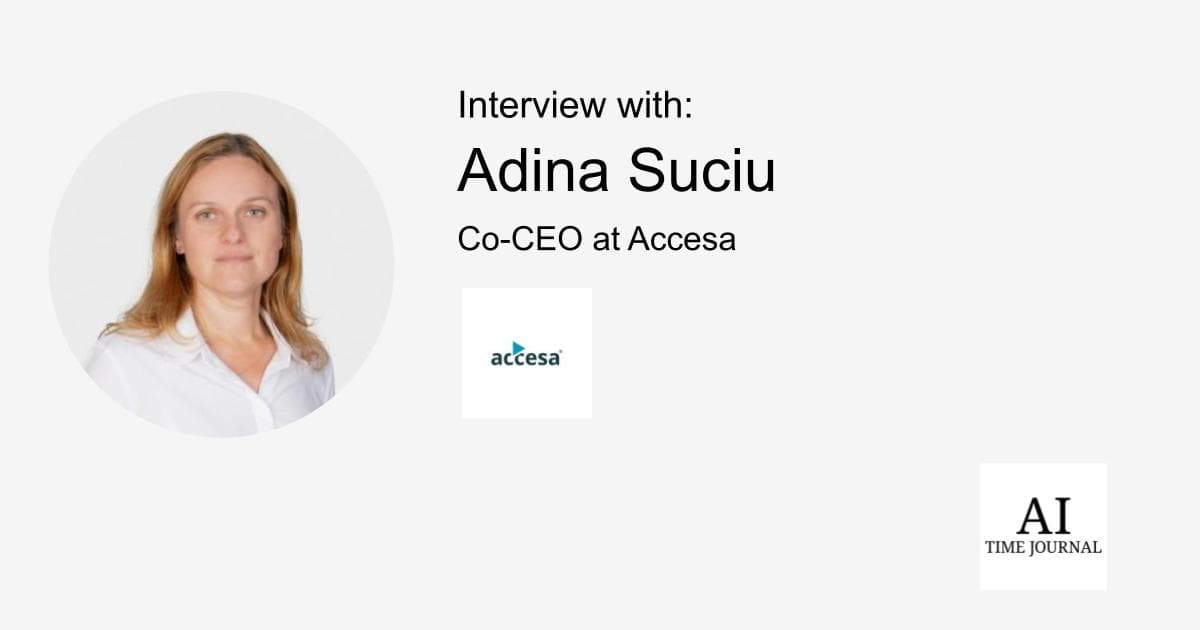
In this interview, we speak with Adina Suciu, Co-CEO at Accesa, a technology company helping businesses navigate complex digital transformations. Adina shares how her background in financial services shapes her leadership in IT, and why adaptability, empathy, and cross-functional collaboration are vital in today’s fast-changing environment. From rethinking organizational models to embracing open innovation, she offers insights that challenge conventional thinking on leadership and strategy. Dive into the conversation for a closer look at how digital transformation and human-centric leadership intersect in the modern enterprise.
Explore more interviews here: Niraz Buhari, CEO at City & Commercial Insurance Group — Risk Management Evolution, AI in Claims, Regulatory Innovation, Leadership, Customer Strategies, Reinsurance Trends, Insurance Disruption
How has your background in financial services influenced your approach to leading digital transformation in the IT sector?
Since I was young, I knew that I wanted to work in financial services. That was more than two decades ago. What were the reasons behind this choice? Looking in retrospect, I know that it had to do with my affinity for data, logic, and making sense of numbers, combined with my fascination with understanding the mechanism behind running a company. All these determined me to work for more than 20 years directly or indirectly in or with the financial services industry. As someone active in this business domain for such a long time, I learned a few things that I consider to be extremely relevant for the present, but also the future. First and foremost, technology is and will be one of the DNA components of any business.
Another component that I find crucial is that for every problem, there is always a solution, and it all depends on the ability to break it down into smaller and manageable parts. This “analytical thinking” capability I consolidated through years working in financial services and proved to be relevant nowadays, in the context of digital transformation and adoption of technologies into organizations. Considering the specifics of the latter (e.g., transformation of organizations’ structure, enablement of new ways to create value, industries’ evolution, etc.), such projects are defined by high complexity, but they also involve integration and processing of data into logical reasoning and problem solving. Hence, my data affinity and analytical correlation abilities came in handy when leading and driving organizational transformation projects.
What personal leadership philosophy guides your decision-making, and how has it evolved throughout your career?
I always followed the principle that “respect is earned, not given,” and this is something that consistently guided me along my career as a leader. Coupled with the motto “lead by example”, these are the two key components of my leadership philosophy that have not changed over the years throughout the experiences and learnings I have had. Also, I believe that, as leaders, we always need to maintain our integrity and ethics on all occasions and in all the decisions we make. There is one quote related to this that I personally really like. It belongs to Warren Buffett, and it says: “When looking for people to hire, look for three qualities – integrity, intelligence, and energy. And if they do not have the first one, the other two will kill you.”
Naturally, throughout my professional journey, my leadership style has evolved. Early in my career, I was extremely focused on achieving the targets, exceeding the defined metrics, and demonstrating ultimately my team’s performance. I prioritized efficiency and short-term goals vs. long-term vision and strategy execution. Once I gained more experience, I started seeing things from a different angle and enhanced my approach to leadership. I started to rely more and more on my team and their capabilities. I elevated the level of delegation, thereby empowering them to take higher ownership and implicitly enhancing their skills and competencies. With this, I was able to create more development opportunities for my team members and increase their engagement level.
Today, after more than 15 years of managing diverse teams from multiple geographies, generations, cultures and personalities, I learned that there is no “one-size-fits-all” approach to leadership. You need to adapt the leadership style to the different circumstances and individuals, you need to be comfortable in admitting when you do not know something or when you need help. All these foster a culture of continuous learning within the team, build trust, and consolidate collaboration. One final remark from my side for the leaders everywhere: lead with empathy, be genuine in everything you do and keep your authenticity. This way, not only do you build trust, but you also inspire your team to become loyal and to bring their best selves to work every day.
What emerging trends do you believe will define the next generation of organizations, and how should leaders prepare for them?
This is a topic that I am currently deeply engaged with. Today, as opposed to the last century, the pace is fundamentally different. Organizations are shifting focus from efficiency to growth and value-chain reinvention to tackle complex challenges at unprecedented speeds. Nowadays, we are discussing changes that happen from one year to another, or even from one day to the other, especially when it comes to technological advancements. It seems like the business environment and the organizations today are under siege, and they need to find ways to adapt and remain relevant for the future. In this context, I see two dimensions related to the next generation of organizations that leaders should focus on: the organizational model and the strategy approach.
Specifically, to the first one:
The structure will become flat and flexible, less hierarchical, to enable adaptability and allow fast response to context changes.
The capabilities will be at the core of designing the operating model, while roles and functions will become secondary. Derived from this, the concept of “cross-functional teams” will emerge in relation to any initiative or project that the organization might want to conduct. In this case, the assembly of teams will be done predominantly based on capabilities, rather than the roles of each individual team member. This will always enable “bringing the right people to the table” to ensure a successful result. Additionally, silos or borders among teams will disappear, as the overarching principle would be skills and competencies, not roles, functions, managers or office locations.
Related to the strategy dimension, the key element will be how the organization will define its approach to value creation. If, in the past, this was determined exclusively in the context of the industry in which the organization was operating, for the future, I think this will change to the ecosystem that an organization is part of. Hence, the value delivered to customers will be done in a constellation of partners interacting with each other, not individually.
Another aspect to consider related to strategy definition will be technology. This will no longer take the backseat, but it will become embedded into the life of the organization. Technology will be overarching in industries and organizations. By using it, domain expertise will be accelerated, and new or enhanced business models will be available at an extremely fast pace. Technology will be like a superpower of organizations, and because of this, a new approach towards innovation will emerge. Opposed to the past when innovation had as its main driver the “insides” of the organization, for the future, innovation will also be outsourced to the external environment. What does this mean? It means that when organizations want to innovate, they will use both “Subject Matter Experts” from within, but also from outside. The rationale for involving external stakeholders in the innovation process will be to incorporate as many views as possible, without biases, to leverage external expertise and to accelerate the potential implementation of any new ideas. This approach is extremely cost-effective vs. the traditional one, while the associated risks definitely outweigh the benefits.
As “change is the name of the game” in today's and future business landscape, the leaders today will need to become accustomed to constantly seeking different perspectives from a multitude of stakeholders to get that necessary broader view for finding the right solutions. A fundamental shift from siloed thinking to a collaborative one becomes essential and paramount for the success of the organizations.
What are the key qualities that define next-generation leadership, and how do you cultivate them within your organization?
Some months ago, I had the opportunity to listen to a true inspirational speech from Indra Nooyi on leadership and its future, and there was one sentence that stuck with me: “Performance with a purpose, purpose with performance.” I think this captures very well the approach that leaders will need to take in the future to be able to adapt to the new business reality, characterized by a strong focus on the generation of fast results. In my view, there are five traits necessary for future leaders to be successful:
Creativity & Curiosity – this will enable faster innovation and a continuous learning mindset among employees. Leaders can cultivate these by actively promoting a culture where it is safe to try out new things, failure is not punished, but instead people are encouraged to analyse what went wrong and learn from their mistakes. I like to call this a “circle of trust” approach, when people are comfortable with sharing genuinely what their views are, without any consequences. By following this approach, I really believe that better ideas can come to life and employees’ learning is enabled with optimized investment.
Empathy & Adaptive Communication – this involves knowing how and when to adjust both your behaviour and leadership style to fit the context and the audience. Even though many leaders consider empathy as a secondary skill, I think that failure in demonstrating it in certain circumstances could lead to low morale, limited engagement and promotion of a culture where people withhold their ideas and concerns. If you aim for better performance of both your employees and organization, then use empathy occasionally as part of how you lead. Listen more, speak less and recognize the emotional landscape of your team. You will be surprised by the results. This is what I learned in my years of experience as a leader.
Perspective seeking – being open to new perspectives or less conventional ones and embracing ambiguity are aspects that, in my view, become critical in the future, with a business reality constantly changing. Also, acknowledging and actively listening to experts from your team will not only lead to better and more creative solutions, but it will also consolidate your position as a leader.
Strategic disruption capabilities – challenging the “status quo” becomes imperative for the future, especially as the focus will be more and more on generating predictions on what the future would look like. Organizations will no longer focus that much on solving problems, but rather on how their future business should be in three to five years from now, by using innovation at any scale, to get there. This will implicitly mean questioning the long-standing practices and anticipating the future and afterwards, defining ways to solve it. It is about leaders solving the future rather than today’s problems.
Resilience and strong adaptability to change – the business landscape is and will be characterized by perpetual change. Consequently, leaders need to find creative ways to adapt and keep their “cool”. In my view, this can be achieved by promoting a growth mindset (looking at changes and challenges as opportunities to learn and grow) and flexible thinking on adjusting plans as soon as circumstances change. This can be achieved only through practice and exposure to such situations.
Developing these five key leadership capabilities is not just about your personal growth, it is about shaping the future of your organization and inspiring those around you. Two final recommendations for future leaders: “Lead with purpose!” and “Innovate, learn, and adapt. Repeat.”
In your experience, what are the biggest challenges companies face when undergoing large-scale digital transformation, and how can they be overcome?
During my career, I was part of three large transformation programs and can say that the process or the journey followed more or less the same sequential approach. It all started from a market context, then derived from this, the mission, vision, and company strategy were adjusted, and afterwards, the transformation process was kicked off. This approach is very lengthy in time, it allows limited flexibility on changing requirements, it is a very top-down approach, and does not incorporate many insights from within the organization. Also, the natural tendency in traditional transformations is to focus more on functions, roles, processes, and the associated changes, on solving problems either internally or coming from customers, and it does not fully cover a constantly changing business environment.
From my point of view, this traditional approach to any kind of transformation is no longer adequate. Why? Because the pace now is accelerated, the changes no longer take years; they happen on many occasions from one day to the next. In this context, I think that organizations need to look at transformation through different lenses. Transformations should become the “new norm” and will follow a modular and iterative approach with multiple triggers – e.g., strategy or business model change, increase of operational efficiency and effectiveness, roll-out of new technologies, etc. This way, organizations are more adaptable and able to respond extremely fast to any business and contextual changes. This translates into two types of transformations – large and small.
The first is initiated when there is a need to create a new value proposition or transform the existing one – a reinvention of the existing business or operating model is required. The small transformations will become “Business as Usual,” and they will be kicked off either by internal operational flows, deployment of new technologies, changes in the service offerings, etc. Even though these might seem like minor adjustments, usually, these are high-potential areas, and if performed at scale, they can translate into significant benefits for the organization.
No matter the transformation type or the journey, the approach I am suggesting should be similar to “launching a new product on the market”. You start with a “Proof of Concept” or “Minimum Viable Product”, then you test it out, obtain feedback, and incorporate learnings into the newer version before scaling up. This way, you can adapt along the way, calibrate, and increase the chances of success.
How do you balance strategic vision with operational execution while driving business growth in a rapidly changing digital landscape?
Finding an equilibrium point between strategic vision and operations is always hard, I do not want to say close to impossible. The temptation is always to focus on the immediate future, the committed objectives for the next two to three years and this is usually in the detriment of the so-called “North Star” of the organization. From my experience so far, I learned that there are three aspects that one should consider:
Adaptability – always create a structure or framework within the organization that allows fast responses to the business reality
Focus – limit your focus only on a few strategic goals and once decided, keep them for the long run. There is a nice quote from Jim Collins that captures this point extremely well: “If you have more than three priorities, you don’t have any.”
Constant feedback loop between strategy and operations – this allows a recurrent calibration and implementation of any adjustments in a proactive manner on both short and long-term objectives.
Additionally, what was always important for me as a senior leader responsible for both strategy and operations was not to lose connection with the organization’s “everyday reality”. This allowed me to incorporate internal insights promptly in the strategy formulation and its translation into executable and realistic roadmaps. Also, this enabled buy-in and empowerment of the teams at an operational level. I believe that it is a real art to translate vision, strategic concepts, and frameworks into reality. Once you gain experience on how to do this, the value generated is exponentially higher for the organization.
What role does collaboration play in fostering innovation, and how do you create an environment that encourages it?
I see that innovation does not belong to one function or role within the organization. If this is how it was in the past, it will no longer be the case in the future. Nowadays, technological advancements are becoming visible almost daily, and organizations need to be able to integrate them extremely quickly into their business landscape. This can be done only through collaboration, teamwork, and “thinking outside of the box”. I consider these as the three key ingredients for nurturing creativity and enabling innovation. Additionally, as leaders, we also set the tone. If we are active supporters of collaboration within and outside the organization, promoters of open communication, and enablers for partnerships internally and externally, then innovation and creativity come naturally, without any constraints.
Besides leading by example, I mentioned in one of the earlier responses that innovation means looking inside the organization, but also outside. It is something that should not have any boundaries, it should be open. For the future, I believe that organizations will no longer have the luxury of keeping innovation behind closed doors. They will need to find smart ways to maximize experts’ knowledge and experience, agnostic of where they are located or part of. The key thing to consider should be speed to market, as the definition of time has gotten another dimension vs. a couple of centuries ago. As a result, I see two concepts emerging: internal open innovation – the already known innovation frameworks and external open innovation – leveraging external expertise to accelerate the pace of innovation. So, digital transformation can become a catalyst for sustainability and open innovations, while leaders will need a new, modern leadership toolkit to harness the opportunities these shifts present.