
Banks, insurers, and government agencies are still running COBOL that predates the internet. The programmers who wrote it are retiring, and very few young developers want to learn a language built for punch cards. That's why so many companies are now looking for AI to convert COBOL to Java instead of hiring a small army of COBOL specialists for a multi-year rewrite.
A lot of "AI-powered" migration tools on the market don't actually use a language model under the hood. Plenty are decades-old rule engines with a fresh coat of marketing paint. Below are five tools that genuinely rely on AI, mostly large language models paired with static code analysis, to move COBOL applications into Java. After that, there's a look at a well-known migration tool that takes a completely different, non-AI approach, in case that's a better fit for your project.
1. IBM watsonx Code Assistant for Z
IBM built this specifically for mainframe shops running IBM Z, and it's probably the most mature AI to convert COBOL to Java option on the market. The tool doesn't just throw code at a language model. It first analyzes the COBOL data divisions and control-flow graphs to work out a sensible Java structure, then uses an LLM to translate the procedural logic that goes inside it.
Runs on IBM's Granite code model, trained on more than 1.6 trillion tokens of code and fine-tuned on thousands of matched COBOL-Java program pairs.
Generates Java classes, hierarchies, and method signatures from the COBOL data divisions before translating any logic.
IBM reports this hybrid approach beats plain ChatGPT-style translation on COBOL code.
Also handles code explanation, refactoring suggestions, and automated test generation, so you can check the new Java behaves the same as the original COBOL.
Runs inside VS Code and can be deployed on-premises for organizations that don't want their code leaving the building.
2. AWS Transform for Mainframe
AWS markets this as the first agentic AI service for mainframe modernization. Instead of a single prompt-and-response tool, it runs a chain of AI agents that work through the whole migration, with a review-and-approve step at each stage rather than running unsupervised.
Agents handle codebase analysis, business-logic extraction, documentation generation, and domain decomposition, then propose a wave-by-wave migration plan.
Carries out the actual COBOL-to-Java refactoring once you approve the plan.
Grew out of the AWS Blu Age technology AWS has used for years, now folded into Amazon Q Developer's transformation tooling.
Handles both COBOL and PL/1.
Core assessment and transformation features are free to try, so testing AI to convert COBOL to Java doesn't require a big license commitment upfront.
3. CLPS's AI-driven intelligent migration solution
CLPS is a Hong Kong company with two decades of core-banking experience, and its migration tool is built for that world specifically.
Combines LLM-based semantic conversion with static analysis and dynamic tracing.
Adds knowledge-graph reconstruction: mapping how COBOL programs and copybooks relate to each other before anything gets rewritten.
Ran a proof-of-concept with a major Hong Kong bank and reported a stable, working conversion.
Smaller player than IBM or AWS, but tuned specifically for core-banking and payments code rather than general mainframe applications.
4. GenAI migration pipelines from systems integrators
Infosys, TCS, Accenture, and Deloitte don't always sell a single named product. Instead, they build migration pipelines around commercial LLMs combined with their own static-analysis tooling and testing frameworks.
Pipeline usually starts with an LLM generating documentation and business-rule catalogs from COBOL and JCL code.
A second pass of generative AI handles the actual code translation and test generation.
Models like GPT-5 and Claude sit behind the pipeline and can be swapped out as better ones become available.
Sold as a managed service, which suits large enterprises that want the migration run for them rather than a license to operate in-house.
5. General-purpose LLMs in DIY migration workflows
Some companies skip specialized products entirely and use GPT-5, Claude, or GitHub Copilot directly.
COBOL modules get fed into the model with carefully engineered prompts, and the Java output gets reviewed by hand.
IBM's own researchers benchmarked this exact approach (plain ChatGPT-based translation) as the baseline when testing watsonx Code Assistant for Z.
Cheapest way to get started, since there's no license fee beyond API or subscription costs.
Chunking large programs, tracking dependencies, and validating output all land on the engineering staff instead of being handled by the tool.
CodeWays by Ispirer: a non-AI way to convert COBOL to Java
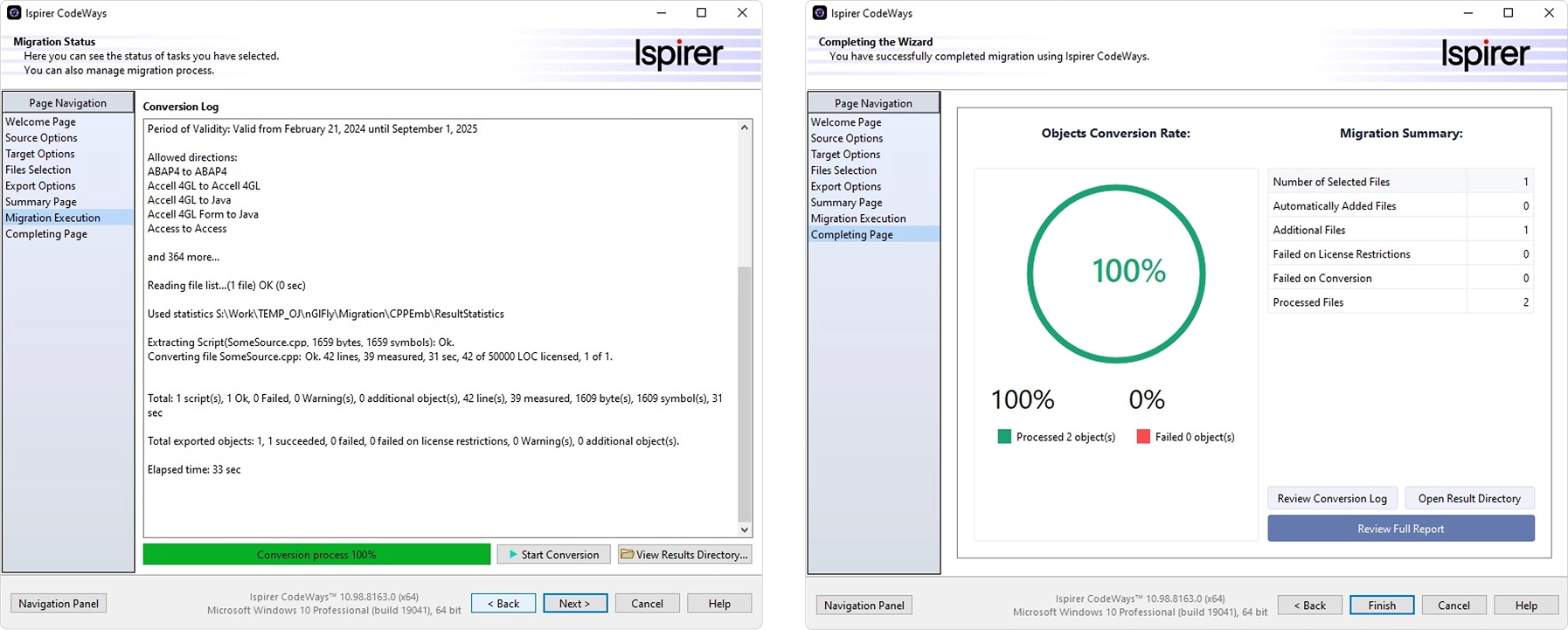
CodeWays by Ispirer shows that a solid migration tool doesn't need a language model at all. It's part of the Ispirer Toolkit and works as an automated, rule-based conversion engine. It uses a proprietary system that analyzes data types, relationships between objects, reserved words, and code structures that don't have a direct equivalent in the target language, then applies conversion rules built for that specific migration path.
Source: Ispirer
A few things stand out:
It covers more than COBOL. It also supports Delphi, Oracle Forms, Progress 4GL, PowerBuilder, C/C++, RPG, and Informix 4GL as source technologies, and it can change an application's architecture too, for example turning a desktop app into a web application.
It's customizable per project. The Ispirer team adjusts conversion rules and the tool's underlying logic to match a client's specific coding conventions, rather than forcing every project through the same template.
The productivity numbers are concrete. Ispirer states that manual COBOL conversion runs at roughly 300 to 400 lines of code per developer per day, while CodeWays pushes that to 3,000 to 5,000 lines per day.
It doesn't touch your live system. The tool works with read-only access and doesn't transfer data to third parties. Ispirer also holds ISO/IEC 27001:2022 certification for its information security management.
It has a real COBOL-to-Java track record. The University of Maryland used CodeWays to convert over 200 COBOL programs (more than 100,000 lines of code) into Java, cutting six months off the project timeline. A separate automotive-supplier project converted 400,000 lines of COBOL to Java over 12 months, cutting the migration effort roughly in half.
If you want to convert COBOL to Java with Ispirer, the process starts with a free assessment. Their Metrics tool scans your codebase and gives you a complexity estimate, a rough implementation timeline, and a cost figure before you commit to anything. Pricing itself is license-based and scales with project size and duration, so it's worth running that assessment before comparing it against any of the AI-based options above.
Which one should you actually pick?
There's no single right answer here. If your COBOL runs on an IBM Z mainframe and you want deep integration with existing IBM tooling, watsonx Code Assistant for Z is the obvious starting point. If you're already on AWS or want a largely self-driving migration process, AWS Transform is worth a serious look. If predictable, rule-based conversion with a long track record matters more to you than AI branding, CodeWays is a solid alternative that doesn't require trusting a model with your production logic. Whichever path you take, run a proof-of-concept on a real chunk of your codebase before signing anything.