
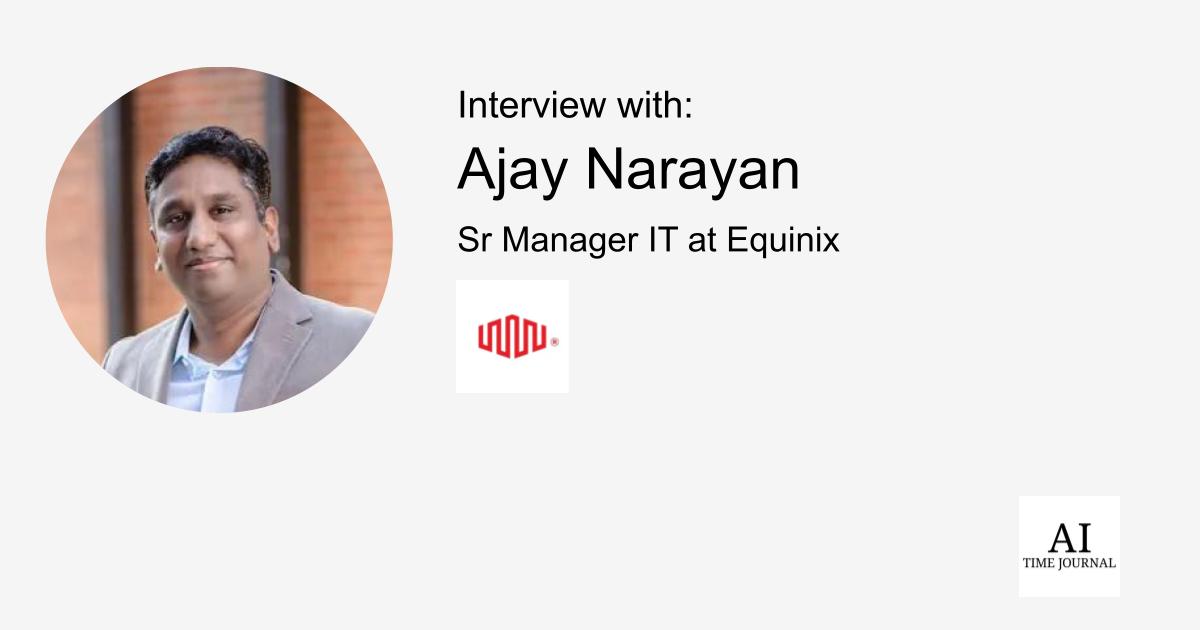
Ajay Narayan, Sr. Manager IT at Equinix, leads innovation in cloud integration solutions for one of the world’s leading technology companies. With a deep understanding of AI, automation, and cloud migration, Ajay is at the forefront of transforming how enterprises connect and scale their operations. In this interview, we explore key industry trends such as AI-driven cloud integration, edge computing, and procurement acceleration. Ajay also shares insights on overcoming cloud migration challenges and cultivating a culture of innovation within his team. Dive into this conversation for valuable perspectives on the future of cloud technologies.
Learn more about similar interviews here: Brij Kishore Pandey, Principal Software Engineer at ADP — AI’s Role in Software Development, Handling Petabyte-Scale Data, & AI Integration Ethics
You have led the development of several cloud accelerators and differentiators in the Oracle Cloud space. What do you see as the next big innovation in cloud integrations, and how is your team preparing for it?
While I was fortunate to lead some great teams or participate in the development of accelerators and differentiators in the Oracle Cloud space directly, I can certainly help you think through the next big innovations in cloud integrations based on current trends and emerging technologies.
The cloud space is evolving rapidly, and some key innovations that could shape the future of cloud integrations include:
- AI-Driven Cloud Integration
- The integration of AI with cloud platforms will become a major differentiator. Cloud services are already leveraging AI for tasks like predictive analytics, automated decision-making, and dynamic resource allocation. As AI becomes more sophisticated, cloud integration will allow systems to "learn" from data more effectively, optimizing cloud environments automatically.
- The team is fully focused on developing AI-powered integration tools that automate workflows, optimize performance, and enhance build processes.
- Event-Driven Integration
- Cloud computing continues to gain traction as it allows businesses to avoid managing infrastructure while still taking full advantage of cloud services. This trend is closely related to event-driven integration where functions are triggered by specific events without needing dedicated resources running continuously. Cloud platforms will offer more advanced event-driven integration frameworks, reducing the overhead for managing infrastructure and scaling applications seamlessly.
- Cloud development teams are exploring the intricacies of building integrations that support this paradigm. This might include focusing on event-driven design patterns and using tools like Azure Functions, or Oracle’s Autonomous Database.
- Edge Computing and IoT Cloud Integration
- With the rise of the Internet of Things (IoT) and edge computing, integrating these devices and systems with the cloud is crucial. This allows for real-time processing of data on the edge, while still maintaining cloud synchronization for deeper analytics. Cloud services will integrate more effectively with distributed cloud technologies and enable smarter decision-making closer to the source.
- Cloud integration teams are approaching more hybrid models where they manage both edge and cloud processing. They work on developing and deploying edge solutions that minimize latency while ensuring data is synced efficiently with the cloud.
With AI and automation becoming central to enterprise cloud solutions, how do you see these technologies reshaping Oracle Cloud Integrations over the next five years?
The rise of AI and automation is transforming the way enterprises approach cloud solutions, and over the next five years, these technologies will have a significant impact on Oracle Cloud Integrations. Here's how I see them reshaping the landscape:
1. Intelligent Automation of Cloud Integrations
- Automation is increasingly central to reducing the complexity and cost of cloud integrations. Oracle Cloud will likely use AI-driven automation to streamline processes such as data migration, system configuration, and deployment.
- AI-powered automation will drive self-healing systems and smarter workflows, significantly improving operational efficiency. For instance, Oracle’s cloud integration tools like Oracle Integration Cloud and Oracle Cloud Infrastructure (OCI) will likely adopt machine learning models to automatically detect bottlenecks, predict potential failures, and trigger corrective actions without manual intervention.
2. AI-Powered Data Integration
- AI will enhance the way data is integrated across Oracle Cloud applications, reducing the need for manual intervention in data mapping, transformations, and clean-up.
- AI algorithms could automatically detect data anomalies during integration, offering recommendations for improvements and ensuring that data flows smoothly between systems like Oracle ERP, CRM, and HCM. This would allow businesses to make more data-driven decisions faster and with fewer errors.
3. Natural Language Processing (NLP) for Easier Integrations
- Natural Language Processing (NLP) will allow developers and business users to interact with cloud integrations using natural language commands, rather than relying on complex scripts and coding languages.
- Oracle may incorporate NLP into its integration tools to enable users to easily configure integrations and workflows through conversational interfaces. This will reduce the technical barrier to cloud integrations, enabling non-technical teams (e.g., business analysts) to automate and manage workflows.
4. Proactive Monitoring
- Oracle Cloud will leverage predictive analytics to foresee potential issues before they occur, minimizing downtime and ensuring seamless integrations.
- Predictive models will analyze cloud infrastructure and data integration performance in real-time, automatically identifying and resolving issues related to system outages, security breaches, or integration failures.
5. Cloud Integration as a Service (IaaS) and Low-Code Development
- Low-code and no-code platforms are becoming more popular as businesses look for faster ways to deploy applications and integrations without requiring deep technical expertise.
- Oracle could further integrate AI and automation into its low-code Oracle Integration Cloud platform, making it even easier for users to develop and manage integrations without writing complex code. AI could assist by automatically suggesting workflows, pre-built connectors, and integration templates based on user inputs.
As AI and automation continue to evolve, Oracle Cloud Integrations will likely become more intuitive, efficient, and proactive. Over the next five years, AI-driven automation will redefine how enterprises connect and manage their cloud environments—reducing the need for manual intervention, enhancing system reliability, and providing businesses with deeper insights and smarter workflows.
You’ve worked closely with Oracle’s product development team on key industry solutions. Can you share a behind-the-scenes look at how your Industry Procurement Accelerator was conceptualized and what makes it a game-changer?
While I had direct experience working with Oracle's product development team or hands-on involvement in specific solutions, I can walk you through a conceptual approach based on how industry solutions like a Procurement Accelerator might be developed and what makes such tools transformative.
Here’s a behind-the-scenes look at how a Procurement Accelerator could be conceptualized and why it’s considered a game-changer in the context of Oracle’s cloud offerings:
1. Identifying Key Industry Pain Points
The first step in conceptualizing a Procurement Accelerator was working closely with stakeholders to understand the challenges in complex procurement like Manual Processes, lack of Visibility where Procurement teams often struggle with end-to-end visibility into the supply chain, Complex Supplier Relationships and Data Silos
2. Defining the Accelerator's Core Features
Once pain points were identified, the Oracle Procurement Accelerator was conceptualized as a solution that:
- Automates Workflows
- Provides End-to-End Visibility
- Integrates Data Silos
- Improves Supplier Collaboration
3. Leveraging Oracle’s Cloud Infrastructure & Advanced Technologies
The Procurement Accelerator leveraged Oracle's cloud-native technologies, such as Oracle Cloud ERP, Oracle Integration Cloud to offer scalable, secure, and intelligent solutions
4. User-Centric Design & Industry Customization
Understanding that procurement processes differ across industries, the solution would be designed to be highly configurable, allowing businesses to tailor workflows and integrations to their specific needs:
- Industry-Specific Templates
- Intuitive Dashboards
5. Collaborative Development with Industry Experts
Behind the scenes, my development team would collaborate closely with Oracle’s product development team to iterate on the solution. This ensures that the accelerator not only meets the technical requirements but also aligns with real-world use cases and challenges.
What made It a Game-Changer?
- End-to-End Automation: By automating the entire procurement cycle, from requisition to payment, the accelerator reduces operational costs, speeds up procurement cycles, and minimizes errors due to manual processes.
- Seamless Integration: Leveraging Oracle Integration Cloud, the accelerator integrates easily with existing enterprise systems making it easier for businesses to adopt without overhauling their entire infrastructure.
- Scalability and Flexibility: Since it’s built on Oracle Cloud’s scalable infrastructure, the accelerator can grow with the business. It’s highly customizable to meet the specific needs of different industries
As a leader managing a team of over 40 professionals, how do you cultivate a culture of innovation and continuous learning in such a fast-evolving technological landscape?
Managing a large team of over 40 professionals in a rapidly evolving technological landscape presents a unique set of challenges, but also incredible opportunities to drive innovation and foster a culture of continuous learning. Here's how I would approach cultivating such a culture:
1. Lead by Example
- As a leader, demonstrating a passion for continuous learning and innovation is key. I would make it a priority to stay updated on emerging technologies and share new insights with the team.
- I would foster an environment where it's okay to try new things and learn from mistakes. Innovation often involves taking risks, so it's important to create a safe space for experimentation.
2. Encourage Ownership
- Innovation thrives when people feel a sense of ownership over their work. I would encourage team members to take initiative and lead projects where they can implement new ideas or approaches. Empowering people to make decisions gives them the confidence to think outside the box.
3. Cross-Functional Collaboration
- I’d encourage cross-functional collaboration, bringing diverse perspectives to problem-solving and idea generation. These varied insights often spark the most creative innovations.
- Organizing internal hackathons, innovation challenges, or brainstorming sessions can bring people together and spark creativity.
4. Learning and Development
- In a fast-evolving tech landscape, ongoing education is critical. I would make sure to provide resources for my team to attend relevant workshops, online courses, or conferences, and encourage certifications in cutting-edge technologies.
5. Data-Driven Decision Making
- Encouraging the team to leverage data in their decision-making process is critical. By making data-driven decisions, teams can more accurately assess the success of their innovations and iterate on them.
- I would make sure the team has the tools and infrastructure they need to test out new ideas, gather feedback, and measure the impact of those ideas. Using platforms like Oracle Cloud for testing new workflows or prototypes would provide the flexibility to innovate rapidly.
6. Continuous Feedback Loop
- Providing regular, constructive feedback ensures that innovations are refined and improved. I would ensure that feedback is not just top-down but also from peers and other departments. Peer feedback can lead to improved collaboration and better ideas.
Cultivating a culture of innovation and continuous learning in a large team requires intentional leadership, a clear vision, and the right balance of autonomy and collaboration. By fostering a growth mindset, encouraging cross-functional interaction, and continuously providing learning opportunities, teams can stay agile and adapt to the ever-evolving technological landscape.
Many organizations struggle with cloud migration due to complexity and risk. What are the biggest pitfalls companies face when moving to Oracle Cloud, and how do you help them navigate these challenges?
Cloud migration is a critical and often challenging process for many organizations. The process can be complex due to various factors such as legacy systems, data security, and integration issues. However, with proper planning and execution, these challenges can be navigated successfully. Here are some of the biggest pitfalls companies face during cloud migration to Oracle Cloud, and how I would help them overcome them:
1. Clear Strategy and Planning
- Many organizations jump into cloud migration without a well-defined strategy or roadmap. This can lead to confusion, missed objectives, and unexpected costs.
- The first step in a successful migration is developing a comprehensive cloud migration strategy. I would advise organizations to begin by clearly defining their business goals for migrating to Oracle Cloud. This involves identifying key drivers such as reducing costs, improving scalability, or enhancing security. From there, I would work with the team to:
- Perform a thorough assessment of the current IT infrastructure and identify what should move to the cloud and what should remain on-premises (e.g., hybrid approach).
- Define migration phases: Develop a phased migration plan that starts with low-risk applications or workloads and gradually expands to more complex systems.
- Set measurable goals: Establish clear success criteria and metrics for each stage of the migration.
2. Proper Understanding of Cloud Architecture and Tools
- Oracle Cloud offers a broad range of services and tools, and many organizations struggle to understand the full potential of these offerings. Not leveraging the right services can result in inefficient use of resources or missed opportunities for optimization.
- To address this, I would:
- Conduct training sessions for the team to get acquainted with Oracle Cloud's architecture, services (e.g., Oracle Cloud Infrastructure (OCI), Oracle Autonomous Database, Oracle Integration Cloud), and best practices.
- Guide the selection of appropriate tools: Help teams choose the right Oracle Cloud services based on their specific needs. For example, for a database-heavy organization, migrating to Oracle's Autonomous Database would be a game-changer.
3. Data Migration Challenges
- Migrating large volumes of data to the cloud is often one of the most daunting tasks. Issues related to data integrity, security, and downtime can complicate the process.
- To avoid data migration pitfalls, I would:
- Develop a robust data migration plan that ensures minimal downtime.
- Ensure data validation and testing: Before migrating large datasets, it’s critical to run data validation tests and perform parallel runs to ensure that the data is intact and accessible in the new cloud environment.
- Prioritize security: Data security is paramount during migration. I would advise implementing encryption for data in transit and at rest, and ensuring compliance with regulatory standards
4. Integration with Legacy Systems
- Many organizations face challenges when integrating their legacy on-premises systems with the new cloud environment. This can result in poor user experiences, broken workflows, or disruptions to ongoing business operations.
- To mitigate this, I would recommend:
- Start by identifying critical integration points and migrating those first. Use Oracle Integration Cloud (OIC) to simplify the integration of on-premise systems with Oracle Cloud services, whether it's connecting ERP, CRM, or other third-party applications.
- API-led integration: Use Oracle’s API management tools to ensure smooth data flow between cloud and legacy systems, enabling real-time synchronization.
5. Cost Overruns and Underestimated Budgets
- Cloud migration often leads to unexpected costs, especially if the organization doesn’t have a clear understanding of the pricing models or underestimates resource usage.
- To avoid cost overruns, I would work with the organization to:
- Implement efficient resource management: Ensure that resources are sized correctly to avoid over-provisioning. Using Oracle Cloud’s auto-scaling features can help reduce unnecessary expenses by scaling resources up or down as needed.
- Cost Optimization: Once in the cloud, continue to review usage and performance. I would recommend regularly conducting cost optimization reviews to ensure the cloud environment is running as efficiently as possible.
6. Change Management and Employee Resistance
- One of the biggest challenges during migration is managing change within the organization. Employees may be resistant to adopting new technologies or changing how they work.
- To overcome this resistance, I would:
- Communicate the benefits of Oracle Cloud migration clearly to all stakeholders, showing how it aligns with business goals (e.g., faster performance, reduced costs, better scalability).
- Involve key stakeholders early: Bring in department leaders and champions from each area of the business to participate in the planning and decision-making processes, so they feel invested in the success of the migration.
- Provide ongoing training and support: I would ensure that employees have access to training resources and documentation to help them adapt to the new tools. Oracle offers a range of training options, including Oracle University, to ensure that teams are well-equipped to leverage Oracle Cloud’s capabilities.
- Offer post-migration support: After migration, having dedicated support for troubleshooting and addressing any user concerns is vital. This could involve using Oracle’s support services or setting up an internal helpdesk.
7. Performance and Scalability Issues Post-Migration
- After migration, organizations sometimes face performance issues, such as slow applications or inefficient resource use.
- To address this, I would:
- Conduct performance testing: Before fully migrating, it’s critical to perform stress and load tests on the Oracle Cloud environment to ensure it can handle peak workloads.
- Optimize workloads
- Scale dynamically: Oracle’s Auto Scaling and Elastic Load Balancing features allow businesses to scale their cloud resources automatically based on demand, ensuring they don’t face performance bottleneck
Having conducted webinars and roadshows on cloud migration strategies, what is the most common misconception you’ve encountered, and how do you address it?
One of the most common misconceptions I encounter when conducting webinars and roadshows on cloud migration strategies is the idea that "cloud migration is simply about moving data and applications from on-premises to the cloud". While it may sound straightforward, this oversimplification ignores the deeper complexities involved in cloud migration. Many organizations mistakenly believe that once the data is moved, they can immediately start reaping the full benefits of the cloud, such as improved scalability, performance, and cost optimization.
The Misconception: "Cloud Migration is Just About Moving Data"
Many organizations approach cloud migration with the mindset that it’s merely about transferring their data and applications from their on-premises infrastructure to the cloud environment. They often underestimate the need for:
- Re-architecting Applications: Not all applications are built for the cloud out of the box. Legacy applications may need to be refactored or re-architected to take full advantage of cloud-native capabilities, such as auto-scaling, elasticity, or microservices.
- Integration and Interoperability: Moving to the cloud isn’t just about shifting workloads; it involves ensuring that cloud systems integrate seamlessly with existing on-premise systems or other cloud-based applications. This often requires robust APIs, middleware, or hybrid cloud setups.
- Optimization and Cost Management: After migration, organizations need to continually optimize their use of cloud resources to ensure that they’re not overspending or underutilizing their cloud infrastructure. Cloud migration isn’t a one-time effort; it requires ongoing monitoring and adjustment.
To address this misconception, I take a few key approaches during webinars and roadshows:
- Educate on Cloud Adoption Models: I emphasize that cloud migration involves more than just a “lift and shift” approach. It's critical to understand the different cloud adoption models and each of these models comes with its own set of challenges, costs, and timelines. By explaining these options in detail, I help organizations align their migration strategy with their business goals.
- Highlight the Importance of Cloud Readiness: I stress the need for an in-depth readiness assessment. A successful migration isn’t just about shifting workloads, but ensuring that the organization is prepared to use cloud technology effectively. This includes:
- Understanding cloud architecture
- Skills and training
- Emphasize the Importance of a Phased Approach: I often address the misconception that cloud migration is an all-or-nothing switch. I advise organizations to adopt a phased migration approach:
- Start with non-critical workloads or departments, so the organization can learn and adjust before migrating mission-critical applications.
- Pilot programs help identify potential challenges and enable the organization to fine-tune processes.
- Real-World Examples and Case Studies: I share practical, real-world case studies of companies that have successfully migrated to the cloud using a comprehensive, well-planned strategy.
With your extensive experience in ERP and cloud hybrid systems, what advice would you give to CIOs and IT leaders looking to modernize their legacy systems without disrupting business operations?
Modernizing legacy systems is a critical yet delicate task for CIOs and IT leaders, especially when there’s a need to maintain business continuity while transitioning to more modern, agile solutions. The goal is to upgrade systems without causing disruptions that affect business performance or user experience. With my experience in ERP systems and cloud hybrid architectures, here’s the advice I would give to help CIOs and IT leaders navigate this complex process:
1. Develop a Clear, Phased Roadmap
- Start with a Comprehensive Assessment: Begin by conducting a thorough assessment of the existing systems, processes, and technologies. Understand what is working, what’s outdated, and what’s inefficient. Identify the pain points and prioritize which systems need modernization the most. This could involve ERP systems, data management tools, or business applications that are hindering growth or agility.
- Create a Phased Migration Plan: Avoid the “big bang” approach where everything is changed at once. Instead, break down the migration into phases. Start with non-critical, less complex systems to build confidence and ensure the team has time to refine processes before tackling core systems.
- Set Clear Milestones and Goals: Establish clear milestones for each phase—whether it’s completing the migration of a specific module, integrating cloud capabilities, or automating a particular workflow. Each phase should have measurable goals and metrics to ensure you’re on track.
2. Embrace a Hybrid Approach to Minimize Disruption
- Blend Legacy with Cloud: In most cases, it’s not practical to completely replace all legacy systems overnight. Instead, leverage a hybrid model—where core legacy systems coexist with cloud solutions for a period of time.
- Cloud for New Workloads: Begin by migrating new workloads or departments to the cloud, where there’s flexibility and agility without disrupting existing operations.
- Gradual Integration: Implement cloud-based systems in a way that integrates seamlessly with legacy systems. For example, Oracle Integration Cloud (OIC) can help bridge the gap between on-premise legacy systems and cloud applications, enabling data flow and system interoperability without needing to replace everything at once.
- Use APIs to Link Systems: For smoother integration, utilize API-led integration to allow cloud and legacy systems to communicate effectively. This ensures you can modernize portions of your infrastructure without ripping out entire systems.
3. Focus on Data Migration and Governance
- Data Strategy is Key: Legacy systems often have fragmented data, making it hard to migrate efficiently. Establish a strong data migration strategy that ensures data is cleansed, validated, and mapped correctly before moving to the new system.
- Implement Strong Data Governance: This is critical in cloud migrations. With cloud-native solutions like Oracle Autonomous Database, data governance is streamlined, but you need clear policies on data quality, security, compliance, and access controls.
4. Maintain User Involvement and Buy-In
- Engage Stakeholders Early: Involve key business stakeholders early in the process to ensure the system aligns with their needs and expectations. This not only helps in identifying priorities but also secures commitment to the project.
- Provide Ongoing Training: When modernizing legacy systems, it’s crucial to train users on the new system’s capabilities. Ensure that employees are comfortable with the changes through continuous learning and support. Tools like Oracle Cloud’s learning modules can facilitate training programs.
- Monitor User Feedback: After each phase of migration, actively collect feedback from users to identify any issues or concerns they may have with the new system. This can help you make adjustments before moving to the next phase.
5. Leverage Automation for Efficiency
- Automate as Much as Possible: As part of the modernization process, I highly recommend incorporating automation wherever possible—whether it’s for data migration, application updates, or system monitoring. Oracle’s Autonomous Database and Oracle Cloud Infrastructure (OCI) provide powerful automation capabilities that reduce manual intervention, improve efficiency, and reduce human error.
- Automated Testing and Monitoring: Utilize automated testing tools to ensure that the migration process runs smoothly. This will help detect issues early and ensure that business operations continue seamlessly during the transition.
6. Plan for Scalability and Flexibility
- Design with Scalability in Mind: One of the key advantages of modernizing legacy systems with a cloud hybrid approach is scalability. Make sure that the new architecture supports not only the current workload but also allows for growth. Oracle’s cloud solutions provide flexible scaling options that grow with the business.
7. Test and Validate at Every Stage
- Frequent Testing: As each phase of the migration is implemented, conduct extensive testing to ensure the system performs as expected. Test data integrity, system performance, and integration capabilities between the cloud and legacy systems.
- Run Parallel Systems: During migration, it’s advisable to run legacy and new systems in parallel until confidence in the cloud system is built. This minimizes risks and allows the organization to revert to the legacy system if any issues arise during the migration process.
Oracle Cloud continues to expand its capabilities with automation, AI, and data analytics. How should enterprises be thinking about their cloud strategy to maximize ROI and agility?
As Oracle Cloud continues to enhance its capabilities with automation, AI, and data analytics, enterprises need to carefully craft a cloud strategy that allows them to leverage these advancements in a way that maximizes ROI and agility. Here's how organizations should think about their cloud strategy in order to stay competitive and extract maximum value from their Oracle Cloud investments:
1. Adopt a Cloud-Native, AI-Driven Strategy
- Leverage Oracle’s AI and Automation Tools: The increasing integration of AI and automation into Oracle Cloud—such as Oracle Autonomous Database, Oracle AI Platform, and Oracle Cloud Infrastructure (OCI)—can significantly boost both agility and efficiency. Enterprises should start by integrating AI-driven processes into their core operations to optimize data analysis, decision-making, and resource management.
- For example, Oracle Autonomous Database automates routine database management tasks such as patching, tuning, and backups, freeing up IT teams to focus on strategic initiatives.
- Use Oracle AI and Machine Learning tools to implement predictive analytics, real-time data insights, and personalization to improve business processes and customer experiences.
2. Scalability and Flexibility
- As organizations increasingly adopt cloud-first strategies, ensuring scalability becomes critical. With Oracle Cloud Infrastructure (OCI), enterprises can scale resources up or down depending on business needs without needing to over-provision or overspend. The ability to scale on demand helps maximize ROI by aligning resource costs with actual consumption.
3. Optimize Cost Management and Resource Allocation
- Cloud Cost Optimization: One of the key drivers of cloud migration is cost savings, but organizations can quickly lose track of their cloud spend if they’re not careful. Oracle Cloud Cost Management tools, along with OCI's flexibility in resource provisioning, allow enterprises to track, forecast, and manage costs more effectively.
- Rightsizing: Continuously monitor workloads and adjust resource allocation to avoid over-provisioning. Oracle’s Autonomous Cloud services can help adjust resources dynamically based on usage patterns.
- Resource Efficiency: Take advantage of Oracle Cloud’s auto-scaling and serverless computing features to dynamically adjust resources to meet demand, ensuring you're only paying for what you need when you need it.
4. Ensure Continuous Learning and Adaptation
- Train Teams on New Cloud Capabilities: The pace of innovation in cloud technologies means that enterprises must continuously invest in upskilling their workforce. Encourage IT teams, developers, and business users to take advantage of Oracle University and other training programs to stay updated on the latest cloud developments.
- Iterate and Improve: As new capabilities and services are added to Oracle Cloud, organizations should continuously assess and iterate on their cloud strategy to take advantage of these innovations. This approach helps businesses stay ahead of the competition while ensuring their cloud environment evolves to meet changing business needs.
To maximize ROI and agility with Oracle Cloud, enterprises should think about their cloud strategy as an ongoing, evolving journey that integrates automation, AI, and data analytics at its core. By aligning cloud capabilities with business objectives, embracing flexibility, optimizing costs, and fostering a culture of innovation, organizations can leverage Oracle Cloud not just as a technology platform but as a driver of business transformation and growth.
Ultimately, a successful cloud strategy is one that’s not just about moving to the cloud but about optimizing cloud resources to deliver smarter insights, more efficient operations, and superior customer experiences—all while continuously adapting to emerging technologies and market demands.
As someone deeply involved in pre-sales and project delivery, how do you balance technical feasibility with business expectations when pitching Oracle Cloud solutions to clients?
Balancing technical feasibility with business expectations when pitching Oracle Cloud solutions to clients is one of the most critical aspects of pre-sales and project delivery. As someone deeply involved in both of these areas, I focus on finding a sweet spot where the client’s business goals and the capabilities of Oracle Cloud align seamlessly while ensuring realistic project delivery. Here’s how I approach this balance:
1. Understand the Client’s Business Objectives First
- Begin with Business Needs: The first step in any engagement is to fully understand the client’s business objectives. Whether they’re looking to reduce costs, improve operational efficiency, enhance customer experiences, or support growth, it’s essential to grasp the core business drivers. This helps in crafting a solution that not only meets technical requirements but also delivers value aligned with the client’s strategic goals.
2. Evaluate Technical Feasibility and Fit
- Assess Oracle Cloud’s Capabilities: Oracle Cloud offers a wide range of services across computing, storage, data analytics, AI/ML, integration, and security. I assess which of these services best meets the business needs identified while also evaluating the technical feasibility based on the client's current infrastructure, existing systems, and technical maturity.
- Workload and Architecture Design: Every client has a unique environment. For instance, when designing cloud solutions for a client transitioning from on-premise to the cloud, I ensure the solution accounts for their specific requirements, such as hybrid cloud integration, security requirements, or data residency. I also determine if any existing applications need refactoring or if a "lift-and-shift" approach is feasible. This ensures the solution will be technically sound and scalable.
3. Align with the Client’s Budget and Timeline
- Realistic Timelines and Budgeting: One of the critical areas where business expectations and technical feasibility often collide is in timelines and budgets. Oracle Cloud offers a range of powerful tools, but their implementation can sometimes be complex and require a phased approach. I always aim to provide a solution that balances the client’s urgency to get results with the time required for proper design, testing, and deployment.
- Scalable Solutions for Different Budgets: I ensure that the proposed solution fits within the client’s budget, providing them with options that allow for flexibility. This includes cost estimates based on resource usage, deployment models (e.g., cloud-native or hybrid), and ongoing operational expenses.
4. Communicate Technical Challenges Transparently
- Set Realistic Expectations: When pitching Oracle Cloud solutions, I make it a point to discuss any potential technical challenges upfront. For example, if there are certain integrations with legacy systems that could be more complex or if data migration might take longer than expected, I communicate these challenges transparently.
- Solution-Oriented Approach: While identifying challenges, I also provide solutions. For instance, if there are integration complexities with existing systems, I’ll highlight how Oracle’s Integration Cloud can help connect disparate applications or propose a staged approach where the client migrates certain processes over time, ensuring minimal disruption.
5. Leverage Real-World Case Studies
- Share Relevant Success Stories: To bridge the gap between technical feasibility and business expectations, I share real-world case studies of other clients who have successfully implemented Oracle Cloud solutions with similar goals. By showing how other organizations in the same industry or with similar challenges have benefited, clients can better visualize the potential outcomes.
- Highlight Measurable Results: Case studies with clear, quantifiable results—like improvements in efficiency, cost reductions, or revenue growth—help clients see the real business impact of Oracle Cloud beyond the technical specifications.
6. Collaborate with Stakeholders Throughout the Process
- Engage with Business and IT Stakeholders: Throughout the sales and delivery process, I ensure consistent collaboration between the business and IT teams. While the business team is focused on outcomes like cost savings and revenue generation, the IT team is concerned with system stability and technical feasibility. Bridging these two perspectives ensures the solution is both viable and aligned with business goals.
- Iterative Feedback: I encourage an iterative feedback loop where both the business and technical teams are continuously involved in refining the solution. This ensures that the proposed solution evolves as new requirements are uncovered or priorities shift.
The key to balancing technical feasibility with business expectations when pitching Oracle Cloud solutions is to align technical capabilities with business outcomes. This involves:
- Understanding the client’s strategic objectives and ensuring the solution meets those goals.
- Setting realistic expectations around both technical requirements and business outcomes.
- Offering flexible, scalable solutions that can adapt to changing needs.
- Communicating transparently about challenges, risks, and potential trade-offs.
- Providing measurable results from past implementations to build trust and confidence.
By focusing on both the technical and business sides, I ensure that the proposed Oracle Cloud solution is not only feasible but also a strategic enabler that delivers long-term value to the client.
You’ve authored multiple whitepapers and spoken at various forums on key cloud technologies. What’s a topic or trend that you feel is still under-discussed in the industry but deserves more attention?
One trend that I feel is under-discussed but deserves more attention in the industry is Cloud Sustainability—specifically, the environmental impact of cloud computing and the role cloud providers, including Oracle, can play in reducing carbon footprints. While cloud computing has been widely recognized for its business advantages in terms of scalability, cost-efficiency, and agility, its environmental impact, particularly in the energy consumption of data centers and the carbon footprint of cloud services, hasn’t been explored deeply enough.
Why is Cloud Sustainability Important?
Cloud adoption has surged across industries, but as the demand for cloud resources grows, so too does the energy consumption required to power massive data centers. According to some studies, data centers worldwide account for nearly 1% of global energy consumption. As cloud providers continue to expand their infrastructure globally, the environmental consequences of maintaining these data centers—especially in regions where energy is sourced from non-renewable resources—become increasingly significant.
Key Aspects of Cloud Sustainability:
- Energy-Efficient Data Centers:
- Cloud providers like Oracle Cloud are increasingly focused on improving the energy efficiency of their data centers. For example, Oracle has made strides toward using renewable energy sources like solar and wind to power its data centers. However, energy efficiency and green IT practices (such as optimizing cooling systems, reducing data storage footprints, and upgrading hardware to lower power consumption) should be more prominently discussed and implemented across the board. This includes increasing AI-driven automation in data center management to dynamically adjust power usage based on real-time workloads.
- Cloud providers like Oracle Cloud are increasingly focused on improving the energy efficiency of their data centers. For example, Oracle has made strides toward using renewable energy sources like solar and wind to power its data centers. However, energy efficiency and green IT practices (such as optimizing cooling systems, reducing data storage footprints, and upgrading hardware to lower power consumption) should be more prominently discussed and implemented across the board. This includes increasing AI-driven automation in data center management to dynamically adjust power usage based on real-time workloads.
- Carbon Neutrality and Green Certifications:
- Many cloud providers, including Oracle, have made commitments to carbon neutrality. For example, Oracle has announced its goal of achieving 100% renewable energy across its global cloud infrastructure. This is crucial, but many enterprises still don’t fully understand the long-term implications of these initiatives or how they can align their cloud strategies with sustainability goals. Green certifications and sustainable cloud practices should be core discussion points when considering cloud providers.
- As businesses become more environmentally conscious, carbon footprint calculators for cloud services (which some providers already offer) should be more widely adopted, enabling businesses to make more sustainable choices when it comes to cloud consumption.
- Sustainability in Cloud Services and Architecture:
- While cloud services themselves offer greater energy efficiency than traditional on-premise infrastructure, how organizations architect their cloud solutions can also have an impact on sustainability. For example:
- Serverless computing (such as Oracle Functions) allows organizations to run code without provisioning or managing servers, reducing the overall footprint of cloud resources.
- By leveraging multi-cloud or hybrid-cloud models, companies can optimize workloads and ensure they are running on the most energy-efficient infrastructure available, reducing waste and lowering energy consumption.
- There should be more awareness about designing sustainable cloud architectures that minimize environmental impact through thoughtful resource management and workload distribution.
- While cloud services themselves offer greater energy efficiency than traditional on-premise infrastructure, how organizations architect their cloud solutions can also have an impact on sustainability. For example:
- Sustainability Metrics and Reporting:
- There's a lack of standardized sustainability metrics across the cloud industry. While some cloud providers, including Oracle, have reporting features for energy use and carbon emissions, the metrics can vary, and there’s no common standard that businesses can use to track sustainability in the cloud. Standardizing these metrics and reporting systems could help enterprises make informed decisions about which cloud solutions align with their own sustainability goals.
- There's a lack of standardized sustainability metrics across the cloud industry. While some cloud providers, including Oracle, have reporting features for energy use and carbon emissions, the metrics can vary, and there’s no common standard that businesses can use to track sustainability in the cloud. Standardizing these metrics and reporting systems could help enterprises make informed decisions about which cloud solutions align with their own sustainability goals.
While cloud computing continues to revolutionize the business world by offering scalability, flexibility, and cost savings, the environmental impact of this shift is an area that still requires more focus. Cloud sustainability needs to become a primary consideration for both cloud providers and their clients. With Oracle Cloud and others continuing to innovate in this space, we’re starting to see promising developments, but there is still much work to be done in terms of awareness, adoption, and integration of sustainable practices into everyday cloud operations.
As the industry moves forward, cloud sustainability—from energy-efficient data centers to reducing the carbon footprint of cloud services—must become a central focus of both technological innovation and business strategy. This will not only help the planet but also lead to more cost-effective, efficient, and long-term scalable solutions for organizations looking to leverage the cloud responsibly.