
Commuters currently face numerous transportation inefficiencies. The average American loses 99 hours annually due to traffic, aggregating to an missed opportunity cost of about $100 billion. In addition, almost 1.5 million people die in collisions yearly, with up to 50 million others suffering from non-fatal injuries. Looking at it from a macro standpoint, car crashes account for an economic loss of almost $1 trillion every year.
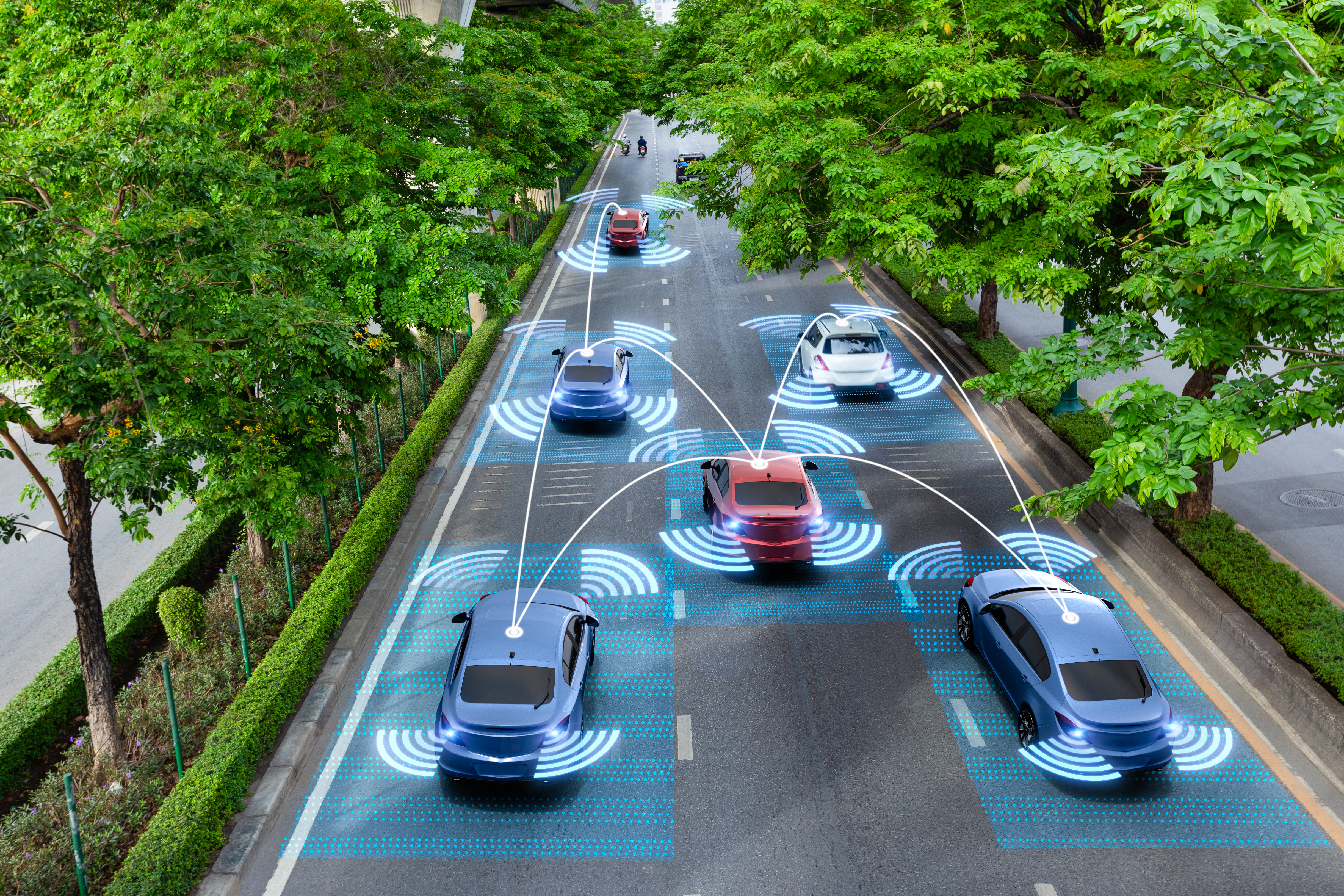
The auto industry is undergoing a shift to vehicle autonomy. Concurrently, recent advancements have been made in car connectivity, a frontier that will (eventually) involve a system of autonomous vehicles (AV) that communicate with each other. With driving processes becoming automated and linked, transportation efficiency will increase and the issues above will be mitigated.
A system of connected AVs involves vehicle-to-vehicle (V2V) communication across a network. A key point of emphasis is that, for the maximum benefit, all the vehicles in the system must be fully autonomous. Subsequently, the interactions between self-driving cars will bring a plethora of positive outcomes.
Congestion can drastically be alleviated through V2V communication. Connected AVs can send traffic updates, detours, and make maneuvers quicker and safer than humans can. In fact, a group of self-driving cars working in conjunction can reduce traffic by up to 35%.
In addition, with a system of connected cars, the number of accidents can be significantly reduced. According to the NHTSA, V2V communication can be counted on to mitigate ~80% of car crashes. Combining this with the collision protection that comes with AVs (check out former posts related to accident prevention on our blog), self-driving cars in collaboration has potential to yield tremendous safety benefits.
For the positives of a system of linked cars to be reaped, vehicles must operate on their own without any human intervention - human error is the main factor in transportation inefficiency. As a result, a fully autonomous connected system truly has the potential to solve all the problems stated earlier.
When humans drive, our brains process the plethora of surrounding visual cues in real-time with almost 100 billion neurons, producing a data center level of compute while consuming less power than a lightbulb. To mimic these capabilities, an AV must be equipped with a platform that can generate a minimum of 75 Tera-Operations-Per-Second (TOPS) of compute for every watt of power consumption. This unsolved optimization problem is known as the visual perception problem.
Unfortunately, systems in cars today can only enable partial autonomy. These platforms are based on legacy technology and are not purpose-built to solve the visual perception problem. A novel, unique solution must be brought to the market that can enable fully autonomous vehicles.
We @ Recogni are developing such a solution. Through leveraging key innovations in math, ASIC architecture, and AI, our platform generates 100 TOPS of compute for every watt of power consumption, clearly solving the visual perception problem outlined above. Because of these capabilities, our product is indispensable for full autonomy. OEMs must horizontally integrate our solution into their vehicles to allow society to experience the plethora of benefits that come with connected AVs.
To learn more about Recogni, check out www.recogni.com
By Sidhart Krishnamurthi, Product Management @ Recogni