
Data is everywhere today. Every time someone visits a website, uses a mobile app, makes an online purchase, or interacts with a connected device, new data is created. Businesses are surrounded by this information such as customer behavior, transactions, operations, and market trends.
But having data and using data effectively are two very different things.
According to Statista, the total amount of data created worldwide is expected to grow to hundreds of zettabytes in the coming years. That number is almost impossible to imagine, but it highlights one simple reality. Organizations now have access to more information than ever before.
The challenge is turning that information into something useful.
Many companies collect huge datasets but struggle to extract real value from them. Data may be scattered across multiple systems, inconsistent in quality, or simply too large to analyze efficiently. Without a clear plan, organizations often invest heavily in data initiatives that fail to deliver meaningful results.
This is exactly where big data development becomes important.
Big data development focuses on building the systems, processes, and strategies that allow organizations to collect, manage, process, and analyze large volumes of information. When done correctly, it helps businesses understand customer behavior, optimize operations, detect trends, and make smarter decisions.
However, success with big data rarely comes from technology alone. It requires clear goals, reliable data, the right team, and a company culture that values evidence based decisions.
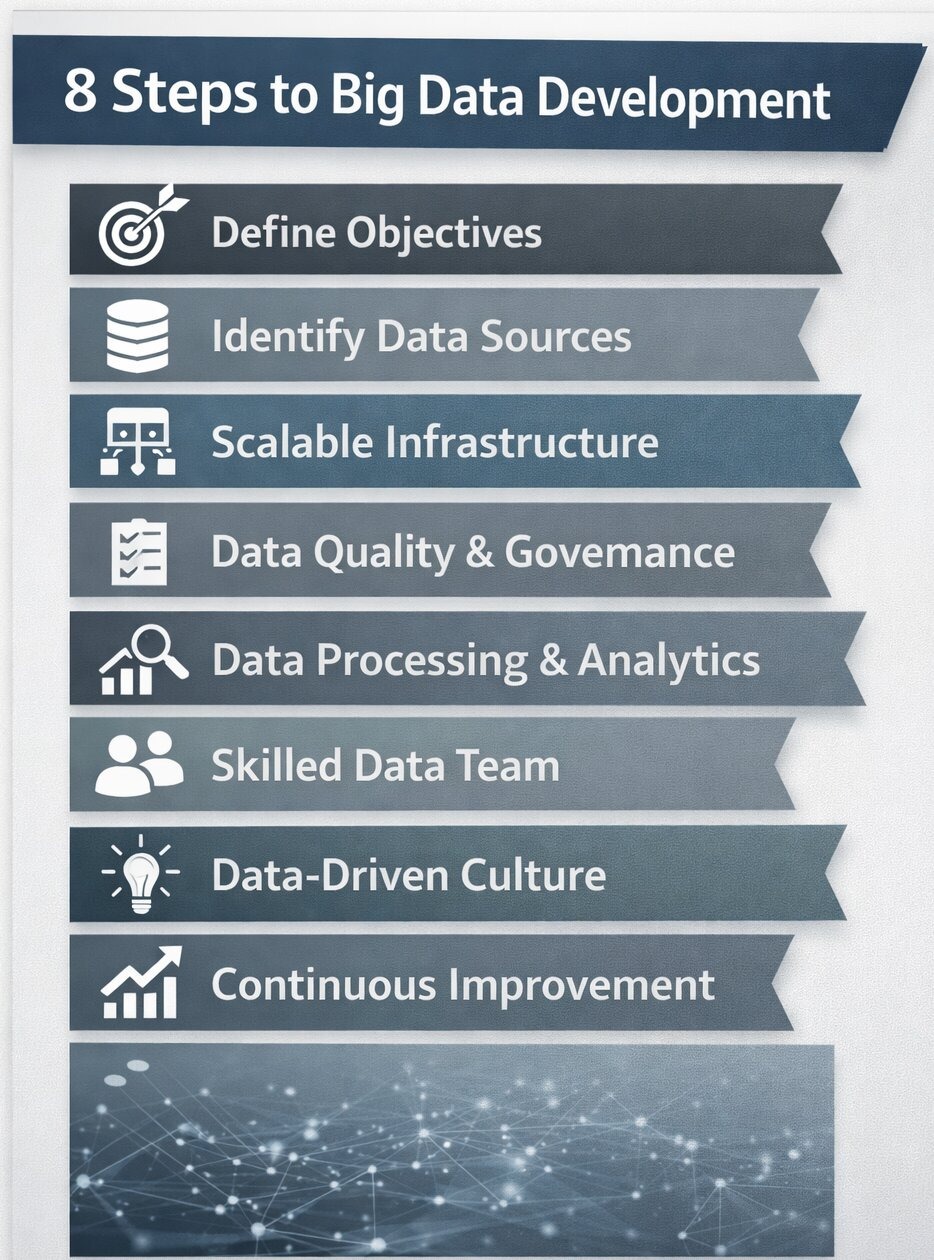
Below are eight practical steps that organizations can follow to build a successful big data development strategy.
Step 1: Start With Clear Business Goals
The biggest mistake companies make with big data is starting with the data instead of starting with the problem.
It might sound logical to collect as much data as possible and analyze it later. But in reality, this approach often leads to expensive projects that generate little value.
Successful big data development begins with one simple question.
What business problem are we trying to solve?
For example, an organization might want to:
- Improve customer retention
- Increase sales conversions
- Reduce operational costs
- Detect fraud or security risks
- Optimize supply chain performance
Once the objective is clear, the data strategy becomes much easier to design.
The next step is defining measurable success metrics, often called Key Performance Indicators or KPIs. These indicators help organizations evaluate whether their data initiatives are actually working.
For example:
- Customer retention rate
- Sales growth
- Website conversion rates
- Operational efficiency metrics
When companies connect data projects directly to business outcomes, big data development stops being a technical experiment and becomes a strategic tool.
Another useful practice is involving teams from different departments when defining goals. Marketing, operations, finance, customer support, and IT all interact with data in different ways. Their insights help ensure that the data strategy solves real operational challenges.
In simple terms, the clearer the business objective, the more valuable the data becomes.
Step 2: Find the Data That Actually Matters
Once the business goals are defined, the next step is identifying the data needed to achieve those goals.
Most organizations already have access to more data than they realize. Information is generated across many systems including:
- Customer databases
- Sales transactions
- marketing platforms
- website analytics
- customer support tools
- operational systems
In addition, companies often use external data such as market research, industry statistics, or partner data.
The problem is that this information is usually scattered across different systems.
Marketing teams might have campaign data, sales teams track purchases, and customer support teams maintain service records. When these datasets remain isolated, it becomes difficult to see the full picture.
This situation is known as data fragmentation.
One of the core tasks in big data development is bringing these datasets together into a unified environment. When data from multiple sources is integrated, businesses can better understand the entire customer journey from the first interaction to the final purchase and beyond.
However, it is important to remember that not all data is equally useful.
The goal is not to collect everything. The goal is to collect the right data.
For example:
- Customer behavior data helps improve marketing performance
- Operational data helps optimize production or logistics
- financial data supports forecasting and budgeting
By focusing on the datasets that directly support business goals, organizations create a much stronger foundation for analytics.
Step 3: Build Infrastructure That Can Grow With Your Data
Data does not stay the same size for long.
As companies grow, launch new products, expand digital services, or adopt connected devices, the amount of data they generate increases dramatically.
If the underlying infrastructure is not built to handle this growth, problems quickly appear such as slow analytics, system overload, and unreliable insights.
This is why scalability is a critical part of big data development.
A scalable data infrastructure allows organizations to store and process increasing amounts of information without sacrificing performance. Instead of relying on a single system, many modern data environments distribute workloads across multiple systems. This approach improves efficiency and allows businesses to process large datasets more quickly.
Another key goal of infrastructure design is eliminating data silos.
When data remains locked inside isolated systems, different teams may end up working with incomplete or outdated information. A unified data environment ensures that analysts, managers, and decision makers are all working from the same reliable data.
Security is also an essential part of the infrastructure.
Organizations must protect sensitive data using strong access controls, encryption, and monitoring systems. These safeguards help maintain trust and ensure compliance with privacy regulations.
Think of infrastructure as the foundation of a building. If the foundation is strong and scalable, everything built on top of it becomes more stable and reliable.
Step 4: Make Data Quality a Priority
Even the most advanced analytics systems are useless if the data itself is unreliable.
Poor data quality is one of the most common reasons big data projects fail. Duplicate records, missing values, outdated information, and inconsistent formats can easily distort analysis results.
Imagine trying to understand customer behavior when half the customer records are incomplete or duplicated. The insights produced from such data will likely be misleading.
This is why data quality management is a critical part of big data development.
The process usually begins with data cleansing, which involves identifying and correcting errors within datasets. This might include removing duplicates, filling missing values, standardizing formats, or validating records.
But data quality is not only about fixing problems. It is also about preventing them. Organizations often implement data governance frameworks to ensure consistent data management practices. Governance policies define how data should be collected, stored, accessed, and updated across the organization.
Another helpful practice is maintaining metadata. This is information that explains where data comes from, how it was collected, and how it should be used. This context helps analysts interpret datasets more accurately.
When businesses invest in high quality data, they create a reliable foundation for analytics and decision making.
In simple terms, better data leads to better decisions.
Step 5: Turn Data Into Insights Through Processing and Analytics
After collecting high quality data, the next step is turning that information into insights that people can actually use.
Raw data rarely provides value on its own. Most datasets contain millions or even billions of records. Without proper processing, it is extremely difficult to understand what the data is really saying.
This is why data processing plays such an important role in big data development.
Processing involves organizing and transforming raw information so it becomes easier to analyze. During this stage, businesses may filter irrelevant records, combine datasets from different sources, or restructure information into formats that are easier to interpret.
Once the data is prepared, organizations can begin analyzing it to discover patterns and trends.
For example, companies might analyze customer purchasing behavior to understand which products sell together. Retailers often study seasonal sales patterns to prepare inventory in advance. Customer support teams may analyze service data to identify recurring issues that need improvement.
Another important part of analytics is data visualization.
Charts, dashboards, and reports help transform complex datasets into clear visual insights. When decision makers can quickly understand what the data shows, they can respond faster and make better decisions.
The faster an organization can move from raw data to useful insights, the more competitive it becomes.
Step 6: Build the Right Team and Skills
Even the best technology cannot create value without the right people behind it.
Successful big data development requires a combination of technical skills and business knowledge. This usually involves building a team with several different types of expertise.
For example:
Data engineers design and maintain the systems that collect and process large datasets.
Data analysts examine information and identify patterns that reveal useful insights.
Business specialists connect those insights to real business problems and strategic goals.
When these roles work together, organizations can turn data into decisions that improve performance.
However, many companies face a shortage of experienced data professionals. Demand for skilled analysts, engineers, and data specialists continues to grow as more organizations adopt data driven strategies.
To address this challenge, businesses often invest in training programs that help existing employees develop data skills. Others collaborate with external experts who specialize in large scale data initiatives.
Working with experienced providers that offer big data development services can help organizations design scalable data systems, improve analytics capabilities, and accelerate implementation.
Regardless of the approach, the goal remains the same. Build a team that understands both the technology and the business problems the data is meant to solve.
Step 7: Create a Data Driven Culture
Technology and teams are important, but they are only part of the equation.
For big data development to succeed, organizations must create a culture where decisions are guided by data rather than assumptions.
This cultural shift often begins with leadership. When executives consistently rely on analytics to guide strategy, employees are more likely to follow the same approach.
Research highlighted by Forbes shows that organizations using data driven decision making often achieve better operational performance and adapt more quickly to changing market conditions.
Another key factor is accessibility.
Employees across different departments should have access to relevant insights that help them perform their work more effectively. Dashboards and reporting tools make it easier for teams to track performance metrics and identify opportunities for improvement.
Education is also essential. Many employees may not feel comfortable interpreting complex datasets at first. Training programs and internal knowledge sharing can help teams build confidence and learn how to apply analytics in practical ways.
When data becomes part of everyday decision making, organizations unlock far more value from their analytics investments.
Step 8: Continuously Improve and Scale Data Initiatives
Big data development is not a one time project.
Data environments evolve constantly as organizations grow, launch new services, and collect information from new sources. Because of this, successful data strategies require continuous improvement.
Organizations should regularly review how their data systems are performing and measure results against business goals. If certain analytics initiatives are not delivering value, adjustments may be necessary.
Scalability is also important.
As data volumes increase, infrastructure must be capable of handling larger workloads without slowing down analysis or decision making. Businesses should periodically evaluate whether their systems can support future growth.
Another opportunity for improvement comes from expanding data capabilities. New data sources, advanced analytics techniques, and improved governance practices can all enhance the value of existing data environments.
Companies that treat big data development as an ongoing process are far more likely to achieve long term success.
Conclusion
Data has become one of the most powerful resources available to modern organizations. Businesses that understand how to collect, process, and analyze information can gain valuable insights into customer behavior, operational performance, and emerging market trends.
However, success with big data does not happen automatically.
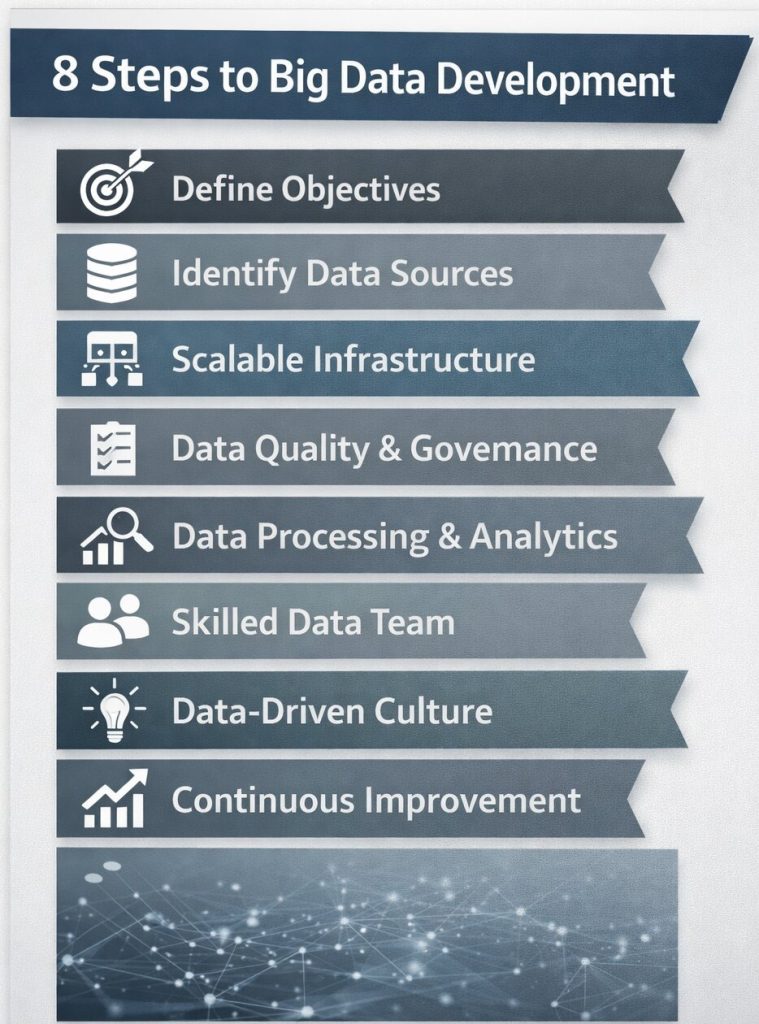
Organizations must begin with clear business objectives, identify the most relevant data sources, and build infrastructure that can support large scale analytics. Maintaining high quality data, developing skilled teams, and encouraging data driven decision making are equally important.
When these elements work together, big data development becomes far more than a technical project. It becomes a strategic capability that helps organizations innovate, improve efficiency, and make smarter decisions.
Companies that follow a structured approach to big data development will be better prepared to navigate the increasingly data driven economy and unlock the full value hidden inside their information.