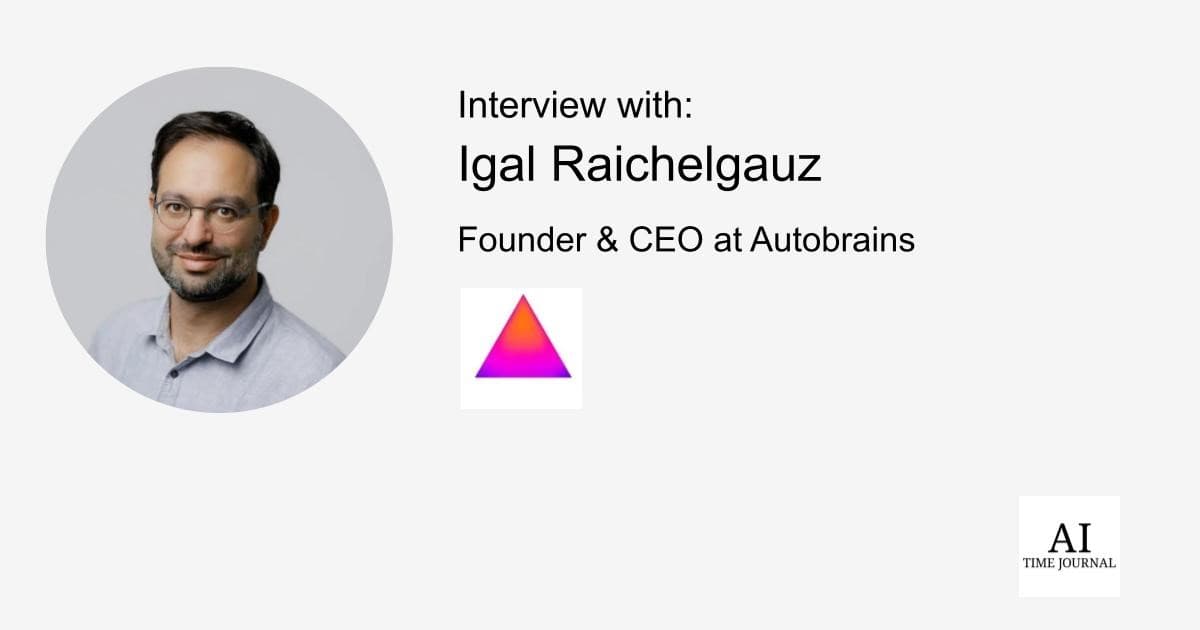
Igal Raichelgauz, Founder and CEO of Autobrains, has taken a distinctive approach to advancing AI in the automotive industry. With a background in military intelligence and research at the Technion, his early experiences shaped his vision for more efficient and adaptable AI systems. In this interview, Igal shares insights into the founding of Autobrains, the development of its innovative Liquid AI architecture, and the challenges the company faces in the autonomous driving sector. He also discusses how inspiration from the human brain plays a key role in their technology. Read on for a deeper dive into the future of AI in autonomous driving.
Explore more CEO interviews here: Michael Phelan, CEO at GridBeyond – Driving Sustainability in Energy: Transforming Global Challenges into Innovative Solutions
How did your early experiences in military intelligence and at the Technion shape your perspective on AI and its potential applications?
The diversity of the teams and research areas, including neuroscience, biology, and engineering, has been crucial in inspiring the AI innovations we are developing at Autobrains. During my studies in electrical engineering at Technion University, I was introduced to biology and neuroscience, where I discovered numerous interesting synergies. I was particularly fascinated by the insights from neuroscience on how the human brain functions. Many of these principles are now implemented in our AI solutions.
What was the driving force behind founding Autobrains, and how does it align with your broader vision for AI in the automotive industry?
I founded Autobrains to introduce a new kind of AI to solve the challenges of autonomous driving. Autonomous driving is one of the most significant and intriguing AI challenges of our century. It must not only solve safety-critical, nuanced tasks but also be affordable and highly efficient to meet the economic requirements for mass production, as well as regulatory requirements and industry standards.
Can you explain how Liquid AI works and what sets it apart from traditional AI models in terms of efficiency and adaptability?
Liquid AI describes a new kind of AI architecture that is modular and adaptable. Together with our Skills technology, the AI system adapts to each driving scenario individually, activating the end-to-end Skill that is optimized to handle the specific driving scenario. With this approach, we break the big driving problem into smaller problems to efficiently solve autonomous driving.
What are the biggest challenges currently facing AI in the automotive sector, and how is Autobrains working to overcome them?
We are seeing three main challenges.First, covering edge cases, which are rare, unexpected scenarios the driving system hasn’t seen before. The backbones of our AI are our self-learned signatures. These are autonomously learned representations of the driving environment and its objects.Second, reaching affordability. Currently, advanced automated driving features are mostly implemented in luxury vehicles. To ensure mass implementation of safety-relevant systems and automation features, the overall costs of hardware and software need to be reduced. At Autobrains, we develop very lean and scenario-optimized AI systems that allow us to not only reduce the computational resources and power needed but also, through being hardware agnostic, to work with any SoC (system on chip) and sensor preferences in the automotive ecosystem, achieving low hardware costs.Third, gaining drivers' trust. In the past, we saw quite a few unexpected incidents and accidents related to autonomous driving. We are convinced that with the right AI approach—emphasizing transparency, explainability, and predictability for the driver—we can regain drivers' trust.
How does Autobrains’ approach to AI development draw inspiration from the human brain, and what lessons have been most impactful?
When we humans are born, we are able to learn and communicate without a language by interacting with and observing our environment. This is the first principle that inspired our AI technology. Autobrains’ AI follows the self-learning principle. It observes the world without human supervision and learns and understands it autonomously while existing systems learn based on human input through manually labeled data. This traditional approach comes with human error, bias, and gaps. Another principle of the human brain we draw inspiration from for our AI technology is the fact that we humans only activate specific areas within our brain based on the goal we want to achieve or the situation we are handling. This makes our brain very efficient, consuming only the relevant resources for the specific scenario we are in and activating only the relevant brain cells and neurons. Autobrains AI solution consists of lean end-to-end networks, Skills, that are optimized for specific driving scenarios and are only activated when those scenarios occur.
Looking ahead, the future of autonomous driving will be shaped by AI systems that are not only intelligent but also adaptable, efficient, and widely accessible. Autobrains is at the forefront of this evolution, pioneering a new era of AI that mirrors human cognition, learns autonomously, and operates with unmatched efficiency. As the automotive industry moves toward greater automation, the ability to handle complex driving scenarios while ensuring safety, affordability, and trust will be paramount. With continuous innovation in Liquid AI and self-learning architectures, Autobrains is not just solving today’s challenges—it is laying the foundation for a future where autonomous vehicles are an integral, trusted part of our everyday lives. The road ahead is one of opportunity, and with the right AI approach, the vision of truly intelligent, scalable, and human-like autonomy is within reach.