
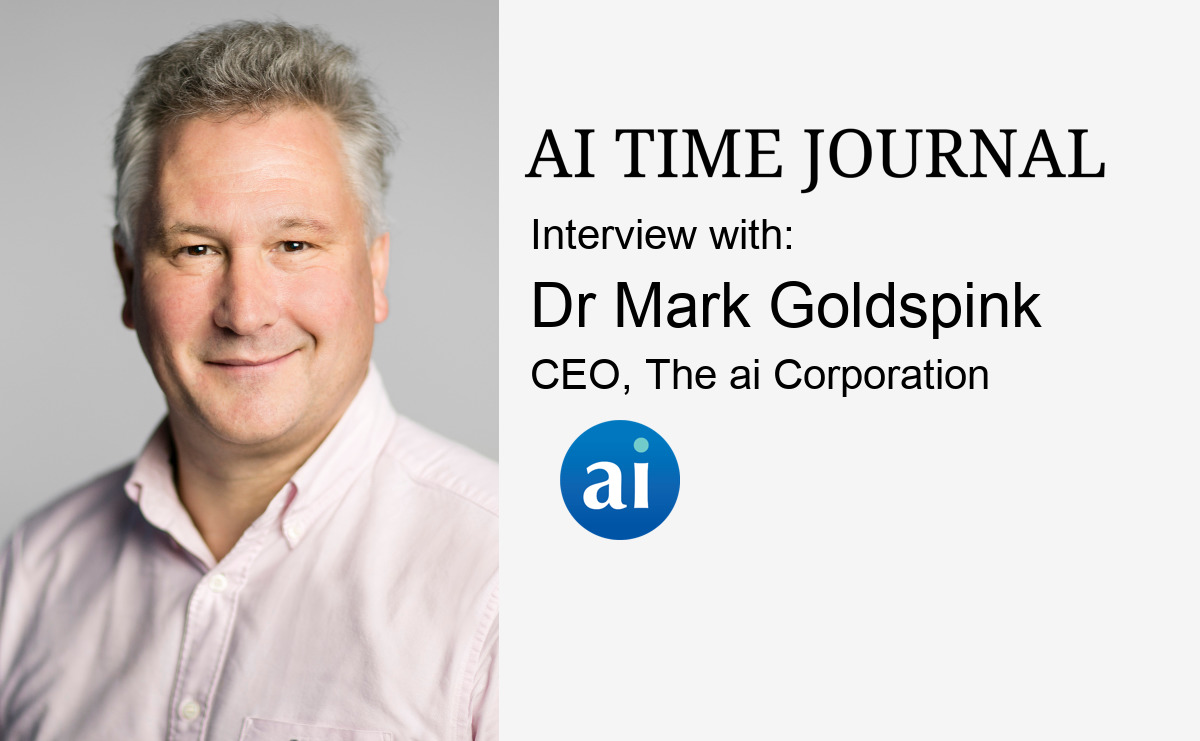
The ai Corporation helps its customers make use of their data in a number of different use cases, including fraud detection, pricing, credit and risk.
We thank Dr Mark Goldspink for the insights he shared, including on the company's culture and how they hire data scientists.
What is ai's mission?
ai’s mission is very simple. We are focused on helping our customers understand the value of their data. We do that by providing our customers with the solutions they need to grow, such as our unique machine learning, self-service fraud detection and payment processing technology. While succeeding through solution innovation, process transparency and a culture built on teamwork.
Many industry
experts believe that our self-service fraud detection and payments solutions
are the best in the world. Since ai was founded in 1998, we have been providing
solutions to some of the world’s largest financial/payment institutions and
international merchants.
Today, our
machine learning and A.I currently protects and enriches payment experiences
for over 100 banks, three million multi-channel merchants and 300 million B2C
and B2B cardholders. We also monitor over 25 billion transactions and
authorisations every year.
However, we
don’t just operate in just one sector, and we are currently working with large
enterprises across a range of sectors, including oil and gas, telecoms and
financial institutions. This ensures that we don’t become overly reliant on one
sector and that we build resilience into the business by re-using our
technology in a repeatable, scalable way.
While our
focus is on payments and fraud prevention, we are using our technology assets
across a wide range of business functions, including market, pricing, credit
and risk. This flexibility, coupled with us adopting the Azure cloud, allows us
to scale our offering around the world to help our customers understand the
value of their data.
Above
all, our longstanding partnerships are based on making things simple. Whether
its fighting fraud or managing payments, we believe that our focus on the
automation of the whole end to end process, not just one part of it, is unique
and has the power to transform the way people do business.
Walk us through ai's products. What problems do they solve?
We offer our
customers a range of products to help them understand the value of their
payment data, either on premise or as part of a cloud-based managed service (SaaS).
ai’s
self-service Enterprise Fraud Solution is a machine learning fraud detection
and prevention tool set designed for all types of card issuers and transaction
acquirers. Which allows our customer to monitor card account and merchant
activity using pre-authorisation and post-authorisation transaction data. The
solution includes several modules, which your readers can find information
about here.
Our fully
white label payment solutions are suitable for companies of all sizes, from
SMEs to multi-national corporations. Offering a truly end to end solution,
which uses “state of the art” machine learning to securely manage omni-channel
payment transactions securely via a cloud-based platform.
Tell us about ai's team.
Being with like-minded people is so
important to me, and I think Voltaire’s “God is not on the side of the big
battalions, but on the side of those who shoot best”, sums up the ai culture.
ai’s team is brilliant, and I am lucky to be part of it.
How many data scientists or machine learning engineers do you have in your team?
Over 400. We believe that by mixing our
team of over 20 data internal experts with external sources, we will not silo
our thinking and create true innovations. This has led us to seek an academic
partnership with the University of Southampton, a global top 100 university,
which means we have access to a network of over 400 technical professors,
students and post doctorate students working on cutting edge research across
multiple different disciplines, including computer science, machine learning,
AI, mathematics and Chemistry (molecular Chemistry provides one of the world’s
greatest big data problems).
By working closely with senior academic we
will ensure that we have the latest advances are brought into our products to
give us the edge over the competition. We also have ongoing projects through a
well-defined PhD and KTP (Knowledge Transfer Partnership – part funded by
Innovate UK) programme. Our agile methodology enables us to integrate the
research completed by university projects into our products quickly, providing
the rapid benefits of the latest technology to our customers.
To ensure we maintain our industry
relevance, we also work closely with Gartner. This partnership supports our
strategy of ensuring that we leave no stone unturned, in our quest for
excellence. Our strategic solution steering boards are designed to capture
information from our customers, industry sources and from leading academics
institutions.
Which ai technologies are you experts on and leveraging the most?
Our automated machine learning solution (AutoPilotML) utilises a combination of
different fraud detection algorithms. Our technology automatically produces a
set of manually implementable rules using a specialised machine learning
technology that has been developed and refined in-house over the last 6 years.
The rules which are produced discover unique
fraud patterns in real time versus a fraud SME who would need to undertake a
substantial offline manual review. Our solution uses neural network-based
machine learning alongside the rules generation algorithms to get a wide
coverage of high-performance rules to give best in class fraud detection
performance. The system constantly assesses the fraud strategy and makes
changes frequently to optimise fraud detection, whilst minimising false alarm
rates, which ensures the smallest impact to business.
What skills do you look for when hiring data scientists?
We are looking for data scientists that are interested in turning their ideas into commercial reality. I know this sounds trite, but we operate a strict ‘theoretical research to applied research to user acceptance’ process within the business.
We are looking for data scientists that are interested in turning their ideas into commercial reality.
What are the biggest challenges that you are currently facing at ai?
Growing in a controlled manner (common
issue for a company of our size) and creating more states of predictable
success.
What are ai's biggest achievements in the last 12 months?
ai’s board tasked the management team with:
Continuing to invest in driving product innovations and ensuring
that we fully optimise the opportunities the Azure cloud offers. Therefore, one
of our biggest achievements is creating our industry leading payment platform,
acceptance, issuing and state of the art analytics capabilities. We are ahead
of the technology convergence curve on payments management.
Implementing a company-wide plan to focus on building a highly
scalable business. We have been implementing that plan over the past 12 months,
and the team have worked tirelessly to create end-to-end business standards
that we know will improve our customer intimacy strategy. We still have work to
do, but we are starting to see strong operational improvements within the
business.
Our top achievement, however, is the work we are doing to create an
even better ‘best in class’ set of industry leaders – we have a very talented
team. Sometimes it is easy forget this, so I want to go on record of thanking
them for all the hard work they do.
Which AI-related technology trend do you think will have the biggest impact in your industry in the coming years?
These types of questions make me nervous,
because they create an opportunity to get things wrong. So, it is important to
keep an open mind and make sure you are constantly looking to innovate by
utilising technology to solve problems – in our case business problems.
The reason any prediction is hard to make
is because technology is multi-faceted and complex. What I do know is AI and ML
technology will continue to evolve rapidly, adoption however is always
difficult to predict and there are much more eminent individuals who have
shared a wide range of views.
However, within the area we operate,
automating payment fraud management is well underway and we are at the
forefront of this change.