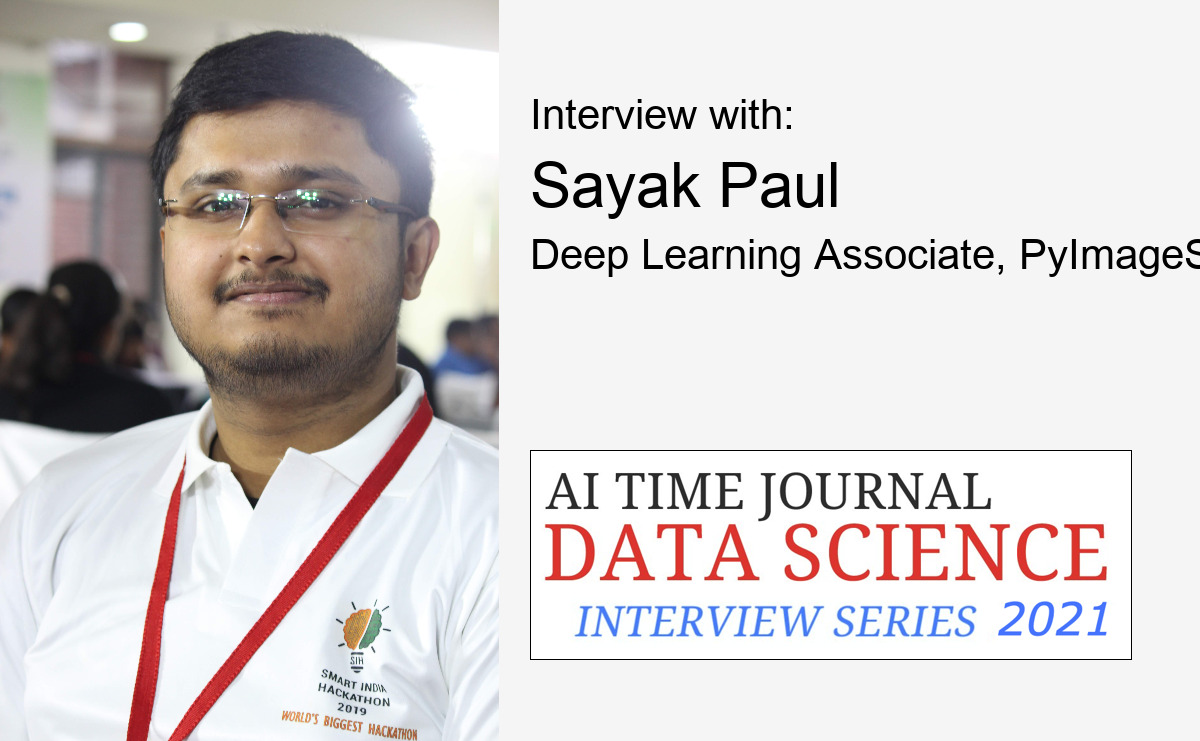
Sayak Paul is a Deep Learning Associate at PyImageSearch where he works on projects that cover a variety of topics such as Model Optimization, Generative Modeling and CRNN architectures for an upcoming book on advanced Deep Learning for Computer Vision.
We thank Sayak Paul from PyImageSearch for taking part in the Data Science Interview Series and sharing several insights, including:
- How he broke into the Data Science industry
- His trials and tribulations in the field
- Recommended books
Nisha: How did you first get into data science?
Sayak: Back in my undergraduate days, I had taken an elective called Pattern Recognition and Machine Learning. It was late 2015 and ResNets were already making waves in the computer vision community. So coupled with that, my undergraduate curriculum is what got me into the subject and I have been hooked ever since.
"I cannot say I have developed them -- I am still developing them rather."
Nisha: What are the key skills that you use every day as a data scientist, and how did you develop them?
Sayak: Well, the development bit is a process for me. So, I cannot say I have developed them -- I am still developing them rather.
My everyday responsibilities include Python programming with frameworks like TensorFlow, Scikit-Learn, PyTorch, and a bit of terminal skills. Others include the usage of different cloud services like AWS and GCP. mostly to run large-scale model training. Domain-wise, I work in computer vision aided with deep learning. In particular, my projects are based on topics like transfer learning, resource-efficient model deployment, adversarial robustness, generative modeling, etc.
I follow resources like RealPython, Automate the Boring Stuff with Python for honing my Python programming skills. The frameworks I mentioned above have a plethora of useful examples on their official website for anyone from any level to get started and dive deeper. So, to gain more knowledge in those, I mostly follow whatever is there on their official websites. Apart from that, I generously take the online courses offered by platforms like a., Coursera. This helps me to get a deeper understanding of things and the exercises come out as good mental workouts.
"I try to be transparent in my communication with my teammates and ensure we all are on the same page."
Nisha: What are the top challenges you currently face as a professional data scientist, and how do you go about tackling them?
Sayak: I think the technical debt to be quite the challenge. Since my work is very interdisciplinary it often gets overwhelming to get through the fuss and focus on ultra-specific things. So, I try to be transparent in my communication with my teammates and ensure we all are on the same page.
Also, it's often unrealistic to know everything about a particular topic beforehand. So, I often jump right into it by doing a few hands-on examples to gain a better understanding.
Nisha: How important is the domain knowledge of the business/industry you’re in as a data scientist, and how did you acquire it?
Sayak: Domain knowledge is extremely important for effectively working through a project, particularly in this field. It helps to gauge what is and is not possible to achieve realistically. With an abundance of data, people often think if we throw them at a learning algorithm, we would get expected results for the task at hand.
This is where domain knowledge comes right in helping to determine what level of data preprocessing is required in order to rightly feed that data to the algorithm.
Nisha: 3 words that best summarize how you learned ML and data science:
- Patience, Perseverance, Dedication
(I am still learning, though)
Nisha: Books: which books have helped you the most in your journey and why?
Sayak:
- Grokking Deep Learning (Andrew Trask)
- Deep learning with Python (Francois Chollet)
- Data Science from Scratch (Joel Grus)
- Automate The Boring Stuff with Python (Al Sweigart)
Nisha: Courses: what courses/programs have you taken that have significantly contributed to advancing your career in data science?
Sayak:
- Practical Deep Learning for Coders (fastai)
- Deep Learning Specialization (DeepLearning.AI)
Nisha: What is the biggest improvement that you introduced in the last 12 months that has considerably improved your workflow?
Sayak: From mid-2020, I started to use small Python scripts to automate what I find to be boring in my daily works. This has greatly improved productivity. Of course, figuring out what was boring required me to do the boring for some time until I realized it.
Nisha: What advice would you give to someone who wants to get into data science today?
Sayak: Start with a drive and don't just start because of the buzz.
Nisha: What inspires you about working in Data Science?
Sayak: The ability to uncover patterns from data to develop impactful products.