
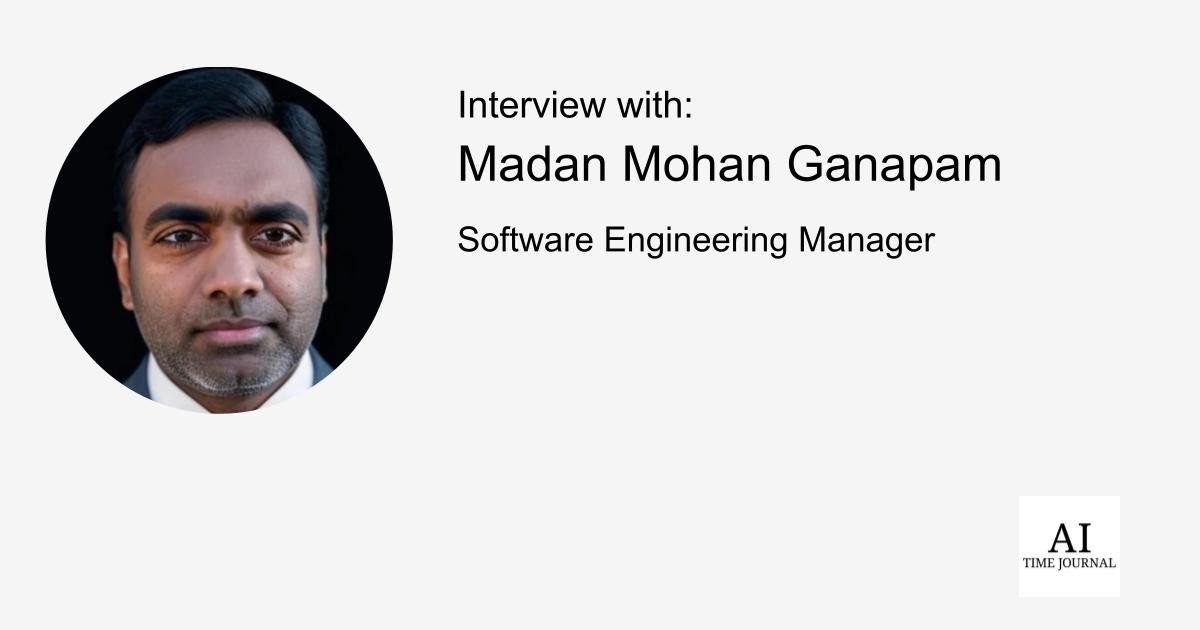
Madan Mohan Ganapam, Software Engineering Manager, has spent nearly two decades shaping the evolution of Intelligent Automation, particularly in finance and healthcare. In this interview, he offers valuable insights into the challenges and breakthroughs in AI and RPA, emphasizing how the landscape has shifted from simple task automation to more intelligent, decision-making systems. Madan discusses key strategies for balancing efficiency with ethical considerations, explores the role of Natural Language Processing in customer interactions, and delves into the potential of AI in risk management and fraud detection. Read on for expert perspectives on driving successful AI-driven transformations in business.
Explore more articles here: The Impact of AI Agents on Business Operations
You’ve been at the forefront of Intelligent Automation for nearly two decades. How have you seen AI and RPA evolve, and what pivotal moments have shaped the automation landscape in finance and Healthcare?
I've had the fantastic opportunity to work on building automation systems across both the finance and healthcare domains, which has given me a broad and practical understanding of how automation has evolved in real-world business environments. In the Early stages of my professional career, I was deeply involved in building foundational automations by writing custom scripts to automate backend functionalities within IT systems. This required hands-on work with multiple programming languages, tools, and complex frameworks to ensure efficiency and scalability. At that stage, it was primarily task-based automation, streamlining repetitive processes like data entry, report generation, and system integrations.
Over time, I’ve seen a significant shift toward more intelligent automation where RPA and AI play a key role in enhancing decision-making and enabling advanced analytics like trend detection and predictive modeling. Being part of this evolution has been incredibly rewarding, especially as the focus moved from just “doing things faster” to “doing things smarter” by incorporating AI into RPA workflows.
This journey has helped me develop not just strong technical skills but also a business-oriented perspective on how to design automation solutions that are secure, scalable, and aligned with organizational goals.
There are several pivotal moments in building Intelligent Automation systems that I have experienced in both Finance and Healthcare over the last two decades. A few of them are digitization of Electronic Health Records, Healthcare Claims Adjudication systems, Automated customer interactions, and rise of RPA bots in both front-end and back-end process automations
With AI and automation redefining business processes, how do you strike the balance between efficiency and human oversight to ensure ethical and responsible automation?
Striking the right balance between efficiency and human oversight is critical for ethical and responsible automation, especially in high-stakes domains like finance and healthcare, where it deals with sensitive data about customers or patients. I always follow key principles while designing, developing, and delivering AI-driven Intelligent Automation Systems.
Automation should be designed with intentional checkpoints where humans can review, validate, or override decisions, especially Loan Approvals and claim Adjudications. Even if AI flags the loan application as high risk, the final decision should be reviewed and made by a qualified expert.
prioritize building systems that can provide clear, auditable explanations for their actions. This not only helps in debugging and compliance but also builds trust with end users
I’ve seen the value of having strong feedback mechanisms where humans can report issues or exceptions, and those insights are used to retrain or refine the automation models. I believe the goal of Automation is to empower people for efficiency and decision making while keeping fairness, security, and accountability at the center
Enterprise automation comes with its own set of challenges—technical debt, scalability, and change resistance. What strategies have you found most effective in overcoming these hurdles while implementing large-scale automation frameworks?
Great question! We have to see both side of the coin, while automating enterprise business process flows. It gives tremendous business value in terms of efficiency and accuracy,at the same time poses challenges too like scalability, Maintainability and Change Resistance. We need a clear strategy to overcome those challenges.
Modular and Scalable architecture is one of the key aspects while I am designing the automation framework. This allows for easier maintenance and upgrades without reworking entire systems. Reusable components, API-driven integrations, and version control practices help scale automation incrementally without introducing fragility.
I always recommend going with small first and prove the value to buy in Business confidence. Before rolling out large-scale automation, running pilot projects with clear ROImetrics builds confidence and gives space to identify potential technical and process blockers. Involve business users early through workshops and demos to understand how automation will augment their work, not replace it
Along with these, choose the right tool to minimize the development and support scalability without compromising privacy and security.
Given your deep experience in AI-driven automation, how do you foresee Natural Language Processing (NLP) transforming financial services, particularly in customer interactions and compliance?
I believe Natural Language Processing (NLP) is already transforming financial services in significant directions, and it will have a greater impact when the models become sophisticated. From a technical standpoint, what I am observing is that NLP is driving change in Customer experience and compliance automation.
Recently, conversational AI and chatbots are growing exponentially, and Modern NLP models have advanced contextual understanding, allowing virtual assistants to go far beyond scripted interactions. Sentiment analysis is a key capability of modern NLP models. It allows systems to identify negative feedback or high-priority customer interactions and intelligently route them to human agents, ensuring a higher quality of service. These models also support multiple languages, making them ideal for global deployments. Ultimately, it's not just about handling a higher volume of customer interactions—it's about delivering a more personalized and meaningful customer experience at scale.
Financial institutions handle massive volumes of text-heavy compliance material where NLP is primarily helping by extracting obligations and constraints using rule-based parsing and summarizing changes in regulations using abstractive summarization. These models classify unstructured documents (e.g., trade confirmations, contracts, KYC documents) and extract critical clauses or data points. It ultimately helps financial institutions to comply with state and federal regulations in an effective manner.
I foresee that there will be Autonomous AI Agents that allow complex multi-step workflows driven by NLP-based reasoning and combine NLP with image and document AI for real-time understanding of scanned forms, ID cards, and handwritten notes.
Looking at the intersection of Cloud and AI, how do cloud-native automation solutions enhance scalability and resilience in financial institutions compared to traditional on-premise implementations?
In my opinion, selecting the appropriate infrastructure and tools is critical for financial institutions undergoing digital transformation and automation initiatives. Due to the sensitive nature of the financial data involved, any compromise could have widespread implications, affecting numerous individuals. Therefore, it is equally essential to prioritize scalability and resilience alongside robust data security measures.
Cloud-native solutions empower financial institutions to dynamically scale infrastructure resources in real-time, enabling automatic provisioning of additional capacity during peak periods and scaling down when demand subsides. Utilizing automation tools such as Kubernetes and container orchestration platforms significantly reduces manual intervention. Conversely, implementing similar scalability in an on-premises environment typically demands extensive manual effort, often resulting in limited flexibility. This limitation can compromise scalability, causing institutions to lose market competitiveness.
Resilience is another critical aspect in developing and managing financial applications. Cloud environments offer built-in, automated disaster recovery mechanisms, enabling rapid failover and minimal downtime. It also provides easy replication across multiple geographic regions and reduces the risk of localized disasters or outages impacting critical systems.
To effectively adopt cutting-edge AI technologies and deliver state-of-the-art intelligent automation systems, the clear choice is a combination of Cloud and AI. This approach has significantly evolved, especially with modern cloud-native frameworks that provide enhanced support for scalability and resilience
There’s a growing concern that automation might displace jobs in certain sectors. How do you approach change management to help organizations and employees transition into an AI-augmented workforce?
It is understandable that organizations and employees have concerns about AI-driven automation, particularly around potential job displacement. However, it's not entirely accurate to see AI as purely disruptive. While certain jobs may indeed change or become obsolete, AI simultaneously creates millions of new opportunities, empowering employees to engage in more creative, strategic, and fulfilling roles. AI-driven automation is less about replacement and more about workforce transformation and evolution.
To effectively transition an organization and its employees into an AI-augmented workforce requires a strategic, structured approach to change management. Clearly communicate the purpose, scope, and benefits of introducing AI. Along with that, provide comprehensive training and educational resources to equip employees with necessary skills, reducing uncertainty and fear about job displacement. Foster a culture of continuous learning, emphasizing how AI augmentation complements human work, rather than replacing it.
When assessing automation opportunities, what are the key indicators you look for in determining whether a business process is suitable for AI-driven transformation?
Selecting the right use cases for AI-driven automation is absolutely critical. Poorly chosen use cases can lead to significant losses in both time and resources, ultimately resulting in failed initiatives. To ensure success, it's essential to assess each potential use case against both business value and technical feasibility.
Any target process should be well-defined and stable. Automating immature or frequently changing processes can introduce unnecessary complexity. Evaluating how easily the AI solution can integrate with existing systems via APIs or middleware is a critical aspect.
Ensuring the AI solution that can scale effectively as process volume grows, without compromising performance or latency, especially in real-time or customer-facing scenarios
Finally, Assess the expected ROI by comparing the costs of development, deployment, and maintenance against potential gains in efficiency, accuracy, and customer experience
These are the key factors I consistently apply when evaluating business processes for AI-driven automation
What role does AI play in risk management and fraud detection in the financial sector, and how can automation help companies stay ahead of emerging threats?
Risk management and fraud detection: That’s where the real power of AI plays in the financial sector. It offers both real-time insights and predictive capabilities that go far beyond manual or rule-based systems.
Predictive Analytics is a key aspect that AI assists in risk management. AI can analyze historical data to predict potential risks, such as credit defaults, market volatility, or liquidity crises. Machine learning models can identify the patterns that human analysts might miss or take a lot of time to solve.
AI systems can continuously monitor transactions and financial activities, flagging unusual behavior in real time. This allows institutions to react quickly to potential risks rather than relying on retrospective reporting
AI Fraud Detection: AI systems can establish a baseline of normal behavior for individual users and detect deviations that may indicate fraudulent activity, such as abnormal login times, transaction amounts, or locations.
Once fraud is detected, automation can trigger predefined response workflows, such as freezing accounts, notifying customers, or escalating to fraud teams without human delay
AI and automation together provide a proactive, scalable, and intelligent approach to risk management and fraud detection
In your opinion, what is the most overlooked aspect of Intelligent Automation when organizations rush to implement AI-driven solutions?
I have experienced where Organizations often rush to apply AI to existing workflows without properly evaluating whether those processes are standardized, optimized, or even necessary in their current form. Automating a broken or inefficient process only amplifies inefficiencies, leading to suboptimal results and wasted investment.
AI systems are only as good as the data they are fed. Rushing into implementation without ensuring high-quality, clean, and accessible data often results in poor model performance and unreliable outcomes.
AI-driven automation affects how people work, yet many organizations fail to prepare teams adequately. Without proper change management, user resistance and lack of trust can stall adoption and reduce impact.
These Intelligent Automation systems require ongoing monitoring, retraining of AI models, and continuous feedback to remain accurate and effective over time.
In my opinion, Intelligent Automation is not just about technology, it's about aligning people, processes, and platforms with clear goals, clean data, and a readiness for change.