
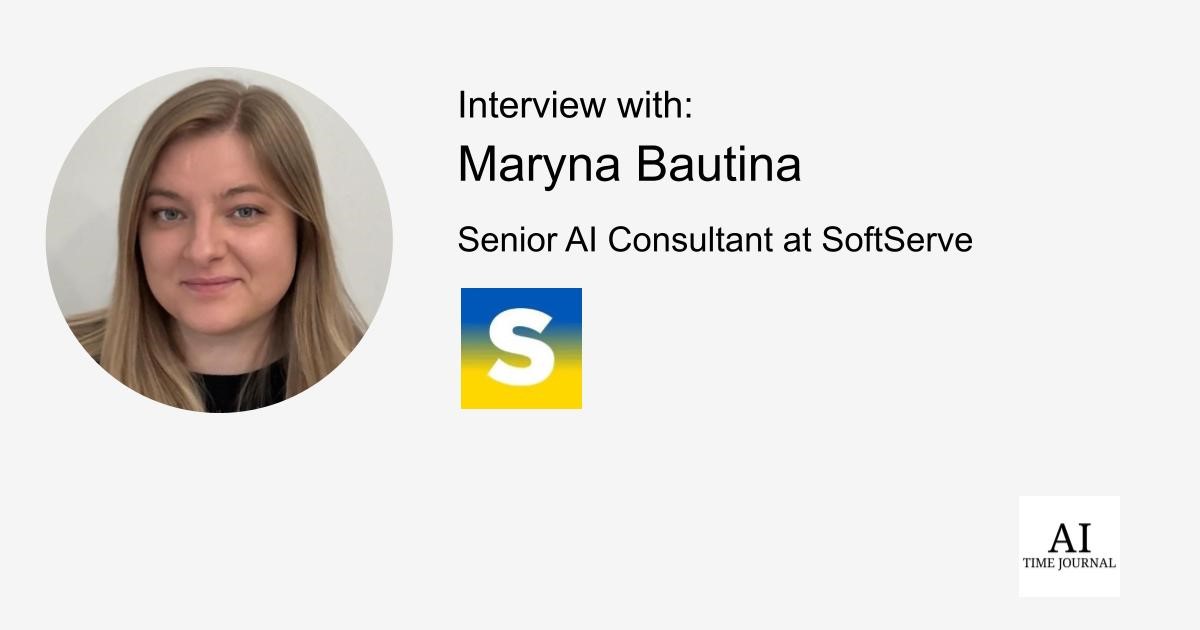
AI is transforming industries at an unprecedented pace, and navigating this evolving landscape requires both technical expertise and strategic vision. In this interview, we speak with Maryna Bautina, Senior AI Consultant at SoftServe, who brings extensive experience in machine learning, AI-driven business solutions, and leadership. Maryna shares insights on bridging software engineering with AI, scaling into leadership roles, overcoming MLOps challenges, and aligning AI innovation with business goals. She also discusses industry trends and offers career advice for professionals looking to advance in AI.
Discover more interviews like this here: Dr. Joerg Storm, Board of Advisor Musavir.AI – Navigating Global IT Challenges: Insights from a Dynamic and Diverse Career in Automotive IT Infrastructure
How has your software engineering degree influenced your approach to machine learning?
It taught me how to write clean, scalable code, structure complex systems, and think in terms of performance and maintainability - all essential for building real-world AI solutions. Instead of just focusing on model accuracy, I approach ML with an engineering mindset, ensuring that models are efficient, reproducible, and deployable in production. Having a strong foundation in data structures, algorithms, and software architecture also helps me optimize ML pipelines, handle large-scale data efficiently, and integrate models into existing systems, ensuring that models don’t just work in a notebook but can be monitored, retrained, and scaled effectively. It helps me bridge the gap between research and real-world AI applications, ensuring that machine learning solutions are not only accurate but also practical and robust.
Can you walk us through your experience growing from a mid-level role to a leadership position at SoftServe? What were some of the biggest challenges you faced in this journey?
Pretty early on, I realized that technical skills alone weren’t enough - I needed to understand the bigger picture, like how AI fits into business strategy and how to work effectively with different teams. As I took on more responsibilities, I had the opportunity to step into a technical leadership role. This meant not just solving problems myself but guiding a team, ensuring high-quality work, and making sure our AI solutions aligned with business needs. Working in a consultancy setting was a great learning experience because I got exposure to different industries, which helped me see how AI can drive value in various contexts. One of the biggest challenges was keeping up with the fast-moving AI landscape. There’s always something new - whether it’s a breakthrough model, a new framework, or shifting industry trends - so continuous learning has become a necessity. Another challenge was transitioning from being an individual contributor to a leader. It wasn’t just about coding and problem-solving anymore; I had to think about team dynamics, communication, and the strategic impact of our work. Ultimately, this journey helped me grow both technically and as a leader, learning how to bridge the gap between AI innovation and real-world business impact.
What does being a Senior Member of IEEE mean to you, and how has it contributed to your professional growth in AI and machine learning?
It is both an honor and a great way to stay connected with the AI and engineering community. It’s not just a title—it reflects the work I’ve done in the field and gives me access to a network of top professionals, cutting-edge research, and industry discussions. One of the biggest benefits is staying updated on the latest trends in AI, machine learning, and Generative AI. Through IEEE, I get access to technical conferences, research papers, and collaborations that help me keep learning and growing. It also gives me a chance to contribute - whether it’s sharing insights, discussing best practices, or helping shape responsible AI standards. Beyond the technical side, being part of IEEE has been a great way to meet like-minded professionals, exchange ideas, and stay involved in conversations that shape the future of AI. It’s a constant reminder of the importance of learning, sharing knowledge, and driving AI advancements in a responsible way.
How do you balance technical innovation with aligning AI and machine learning solutions to meet business goals?
I try to maintain the balance by focusing on three main things: keeping AI projects tied to real business needs, experimenting responsibly, and working closely with different teams. First, AI should always solve a real problem - it's not about using the latest tech just because it’s exciting. I make sure every AI initiative is tied to measurable business outcomes, so it actually drives impact rather than just being a cool experiment. Second, while staying on top of new advancements is important, not every cutting-edge idea is practical. I always evaluate things like scalability, data availability, and cost-effectiveness before diving in. It’s about finding the right mix of innovation and real-world feasibility. Finally, AI isn’t built in isolation. I work closely with business leaders, product managers, and domain experts to make sure AI solutions fit seamlessly into business processes. It’s this collaboration that turns AI from a technical achievement into something that delivers real value.
With over seven years of experience across various industries, what’s one of the most impactful AI-driven projects you’ve worked on, and what results did it deliver?
If I had to choose one, it would be developing an AI-powered conversational analytics system that extracted insights from customer support interactions for an international financial institution. They struggled to analyze vast amounts of unstructured conversation data, making it difficult to identify recurring issues, customer pain points, and opportunities for product improvement. Our solution leveraged large language models to automatically extract key elements such as problem statements, troubleshooting steps, resolution strategies, and product references. The system detected trends, enabling the company to proactively address common issues and enhance the customer experience. Additionally, it generated summarized reports and knowledge base entries, significantly reducing manual review time while improving resolution efficiency. The AI-driven system cut review time by 80% and increased resolution efficiency, allowing support teams to work more effectively while helping businesses optimize their products based on real customer feedback. This project demonstrated the power of Generative AI in transforming enterprise knowledge management, proving that AI can do more than automate - it can generate strategic value by turning unstructured data into actionable intelligence.
As a leader in data science, how do you approach managing teams with diverse technical skill sets, and what strategies do you use to foster collaboration and innovation?
Managing a team comes down to three things: playing to strengths, sharing knowledge, and fostering a problem-solving mindset. First, I make sure everyone is working on tasks that match their expertise while also giving them chances to grow. More experienced team members tackle complex challenges, while those still learning get hands-on experience with the right support. Second, I encourage open knowledge sharing - whether through informal mentorship, team discussions, or working together on projects. No one should feel like they’re solving problems alone, and the best ideas often come from bouncing thoughts off each other. Lastly, I try to create an environment where experimentation is welcome and diverse perspectives are valued. AI is all about solving real-world problems, so I make sure brainstorming is practical and focused on meaningful impact. This approach keeps the team engaged, helps everyone grow, and leads to stronger, more effective AI solutions.
MLOps is gaining significant traction in the industry - what are some of the biggest challenges you face when implementing MLOps practices, and how do you overcome them?
Implementing MLOps isn’t always smooth sailing - it comes with challenges like scaling, automation, reproducibility, and getting different teams on the same page. One of the biggest headaches is integrating it into existing systems, especially when companies have a mix of cloud, on-prem, and legacy infrastructure. To tackle this, we focus on standardizing workflows, using containerization (like Docker), and choosing cloud-agnostic tools that make deployments more flexible. Another challenge is automating the ML lifecycle while keeping models reliable in production. Things like CI/CD for ML, data drift, and monitoring model performance can get tricky. We address this by using feature stores, setting up automated retraining pipelines, and implementing monitoring tools to catch issues early. Lastly, MLOps requires a culture shift - data scientists, DevOps, and business teams need to work together more closely and adopt software engineering best practices in ML development. To bridge this gap, we use version control for models and datasets (like DVC or MLflow), keep documentation clear, and make sure there are regular cross-team check-ins. At the end of the day, the key to overcoming MLOps challenges is a mix of the right tools, automation, and strong collaboration between teams.
How do you foresee AI and automation continuing to shape business operations in the next five years, and how can professionals in AI stay ahead of the curve?
AI and automation are going to keep transforming business operations in big ways over the next five years. We’ll see more hyper-personalization, real-time decision-making, and automation at scale. Generative AI, AI-powered analytics, and autonomous systems will become even more common, helping businesses optimize workflows, improve customer experiences, and create new revenue opportunities. AI copilots will likely be standard tools across industries, assisting professionals with complex tasks, while automated decision-making will streamline areas like finance, supply chain, and customer support. Plus, with advancements in multimodal AI and edge computing, AI will be able to operate more efficiently in real-world settings, reducing delays and improving overall performance. For AI professionals, staying ahead means constantly learning. Emerging technologies like LLMs, reinforcement learning, and AI ethics are evolving fast, so keeping up with trends is key. Hands-on experience with open-source AI models, cloud platforms, and real-world applications will be essential for staying competitive in this ever-changing landscape.
With your vast experience across sectors like retail, education, and e-commerce, what industry-specific AI trends or challenges do you find most intriguing right now?
One of the most exciting AI trends right now is how Generative AI is driving hyper-personalization and automation across different industries. But each sector has its own unique challenges. In retail, AI is making demand forecasting, dynamic pricing, and personalized recommendations more accurate. The tricky part is keeping up with constantly changing consumer behavior while also respecting privacy concerns. In education, AI-powered adaptive learning and automated content creation are making learning more engaging. However, making sure AI-generated content is accurate, fair, and aligned with proper teaching methods is a big challenge. In e-commerce, AI is improving customer experience through chatbots, smarter search, and automated fulfillment. But issues like fake reviews, algorithmic bias, and regulations around AI-generated content are becoming bigger concerns. Across all industries, businesses need to focus on scalability, AI governance, and responsible AI adoption. Companies that integrate explainable AI, real-time analytics, and ethical AI practices will not only stay competitive but also build stronger customer trust.
What’s your philosophy on leadership in the data science space, and how do you ensure that your team’s work remains aligned with long-term strategic goals?
It is all about keeping things practical, outcome-driven, and aligned with real business needs. I make sure my team’s work stays on track by maintaining clear priorities, encouraging open communication, and ensuring that our projects directly contribute to long-term goals. Since business needs can change quickly - especially in response to customer demands - I build flexibility into our workflow. This way, we can adapt without losing momentum. Rather than chasing AI trends just for the sake of innovation, I push for solutions that are both impactful and scalable. To keep projects moving in the right direction, I set clear milestones, encourage iterative development, and create feedback loops so we can quickly adjust as needed. I also believe in hands-on collaboration - everyone should have the support they need to grow while staying focused on delivering real value. At the end of the day, it’s all about balancing technical excellence with adaptability and business relevance. That’s how we make sure our work isn’t just innovative but also drives meaningful, lasting results.
Finally, for professionals looking to advance their careers in AI, what advice would you give them regarding skill development, career trajectory, and staying competitive in an ever-evolving field?
If you want to grow your career in AI, my biggest advice is to focus on three things: mastering the right skills, staying adaptable, and building a strong network. First, go deep into core AI/ML skills like deep learning, generative AI, MLOps, and data engineering - but don’t just stop at theory. Get hands-on experience with real-world projects that involve the entire lifecycle, from building models to deploying and monitoring them. AI isn’t just about training models; it’s about making them work in production. Second, AI is moving fast, so staying adaptable is key. Keep up with the latest research, open-source tools, and industry trends. Engage with the AI community - whether it’s through conferences, online forums, or contributing to open-source projects. Don’t be afraid to explore new areas like multimodal AI, reinforcement learning, or AI ethics to expand your expertise. Lastly, technical skills alone won’t get you ahead. The best AI professionals know how to communicate their work’s business impact, collaborate with different teams, and think strategically. Writing blogs, giving talks, or mentoring others can also help position you as a thought leader. By combining strong technical skills with strategic thinking, communication, and continuous learning, you’ll stay competitive and set yourself up for leadership opportunities in AI.