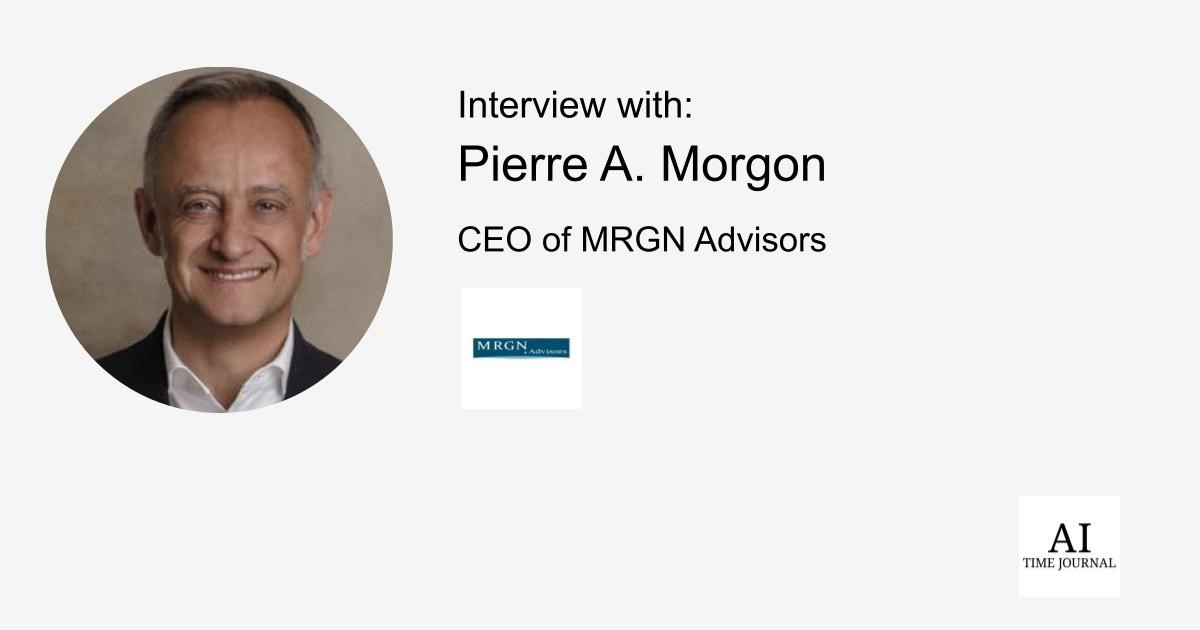
Pierre A. Morgon, CEO of MRGN Advisors, brings over three decades of experience in the life sciences sector, spanning multinational corporations, biotech startups, and regulatory organizations. In this conversation, he shares his insights on the evolving role of AI in healthcare, the challenges and opportunities in immunotherapy and vaccines, and the qualities that define successful biotech ventures. He also discusses the shifting investment landscape, ethical dilemmas in AI-driven healthcare, and how global biotech ecosystems can learn from each other. Read on for his perspective on the future of healthcare innovation.
Explore more interviews like this: Leslie Orne, President and CEO of Trinity Life Sciences — Life Sciences Innovations, Data-Driven Strategies, AI in Pharma, Executive Leadership, Strategic Transactions, Brand Planning, and Executive Work-Life Balance
With over 35 years in the life sciences industry, you’ve navigated both multinational corporations and startups. How do you balance the agility of startups with the structured environment of large organizations, and what lessons do you take from one to the other?
I started my career in large, multinational companies. The involvement with smaller companies, including startups, took place in the past 12 to 15 years.
The learnings during my time in large companies include processes, and tools (finance, planning, marketing, etc.) and were extremely useful to contributing a toolbox required to address challenges in emerging ventures
There were also insights on corporate governance, which proved useful as a startup entrepreneur (to retain only the essence of the governance principles, without the cumbersome aspects) and also as a board director
The agility in emerging companies has to be balanced – and even controlled – by rigorous preparation (fact-finding) and thinking, to avoid taking hasty decisions
So far, I haven’t had a chance to apply the insights from emerging companies in larger corporations
Your work spans immunotherapy, vaccines, and specialty care. What do you see as the most pressing challenges in these fields today, and how can innovation help address them?
Innovation is like the search for happiness… it’s an endless process of making assumptions, testing them, and depending on the results, moving forward or redefining the assumptions, and/or the experimental model
There is a focus on mobilizing the immune system – which is the result of millions of years of evolution – to tackle both transmissible (infectious) and non-transmissible diseases
The progress of the technologies (single cell, genomics, proteomics, etc., and material science) is pushing the boundaries and opening new possibilities, new hypotheses.
There is also progress made in the understanding of the pathophysiological mechanisms of the diseases, to a level of granularity that opens new research avenue
As an advocate for AI in healthcare, where do you see the biggest impact of AI in the near future? Are there specific breakthroughs or applications that excite you the most?
AI is going to change the way life science innovation is handled, because it has always been data-driven, and the monumental expansion of the amount and of complexity of the data is calling for more efficient approaches to draw insights from the vast amount of knowledge accumulated thus far (and it keeps expanding), to shape new assumptions and novel experimental models, and to leverage the data stemming from the research and development initiatives
The entire value chain is “in scope” for AI leverage, from the design of novel therapeutic or preventative candidates to the early (preclinical) testing, to the development and scale-up of the manufacturing process and the quality controls, to the design and execution of the clinical testing (profiling of the patient populations, management of enrollment, etc.), to the preparation of the regulatory submissions, to the assessment of the economic value of the novel solutions, and finally to their efficient supply in all relevant geographies to the end-users, and their commercialization
There’s a flurry of experiments along that value chain. Some will fail miserably, and some will succeed, thereby providing fresh insights that could be leveraged to accelerate further and gain effectiveness
Developing countries often struggle with access to cutting-edge medical technologies. How do you see AI bridging this gap, and what are the key challenges in ensuring equitable technology transfer?
Developing countries are already factored into the development of novel therapeutic or preventative candidates, sometimes thanks to special incentives to ensure that so-called “neglected diseases” are addressed properly
The challenge in developing countries will come from the quality and the reliability of the inputs (data) that will feed the models and support the assumptions underpinning AI models and initiatives, to maximize the relevance of the outputs
AI should help to plug the gaps (missing data), leverage unstructured data, and increase the robustness of the models and the outcomes pertaining to developing countries.
You mentor startups in Switzerland and Israel. What qualities do you believe are essential for biotech and life sciences startups to succeed in today’s rapidly evolving healthcare landscape?
- First, the Team: having experience with a targeted field, the ability to anticipate change and to react to changing risk, a genuine commitment to success, ideally a leadership and business track record, a balanced management team (not a single “hero”) and the willingness to work with investors
- Second, the Venture: demonstrated superiority and uniqueness, solid IP situation, clear specifications, with a defendable competitive position and a good fit with the targeted existing ecosystem and/or ability to drive the ecosystem evolution
- Third, the Market: a genuine growth potential and an attractive size, a manageable intensity of the competition, well-understood and manageable barriers to entry and exit, and a solid understanding of the required changes in the existing ecosystem and value chain to the innovation to be adopted and used
As a board member of multiple biotech firms, you have a unique vantage point on investment and innovation. What trends are shaping the biotech investment landscape, and what should entrepreneurs focus on to attract funding?
Current trends regarding the asset type point to a focus on:
Since 2022, the aggressive rate hikes meant easy money was gone and startups that had raised capital expecting long runways are suddenly realizing that their next funding round might not come. Consequently, a major correction happened and startups that had raised at peak valuations in 2021 found themselves in trouble with slow growth, and lower revenue multiples, and the only way to stay afloat was raising at a lower valuation (hard to swallow, especially by founders).
Moreover, VCs rely heavily on exits (through IPOs or M&A) to generate returns for LPs. For decades, exit values followed a predictable trend, but in 2021, the gap between expected and actual exits exploded and it resulted in a cash crunch. Less cash for VCs means less financing for startups, and longer timelines to complete a fundraise. Consequently, there has been a surge in down rounds and valuations have shrunk.
Stating the obvious: the key is to profile the investors properly and to focus only on those whose investment thesis is aligned with the startup assets and priorities.
Your work with IABS and GCRI involves biological standardization and risk innovation. How do you see regulatory frameworks evolving to keep pace with the rapid advancements in AI and biotech?
As always in fast-moving environments, the regulatory and legal frameworks will evolve, starting from key principles driven by existing requirements (for instance data privacy and confidentiality, data integrity, ethical standards, etc.) and evolving as the boundaries are changing.
Unfortunately, it may also take some deviations or wrongdoings to see some of the restrictive parts of the regulatory and legal frameworks to take shape, which may take a few years until some form of “steady state” can be reached.
Professional associations such as IABS, and NGOs such as GCRI, AIFOD, or AIFN will contribute by assembling the inputs of thinkers, academics, and other professionals to drive a balanced evolution of the regulatory and legal frameworks.
Given your background in both pharmacy and business law, how do you navigate the ethical and legal complexities of AI-driven healthcare solutions? Where do you see the biggest regulatory hurdles?
The key is to remain vigilant, open to changes, and keep ethical and moral standards in sight to avoid crossing the lines.
The biggest hurdle may be the opposing forces, with the advocates of regulations on one side, and the ultra-liberal on the other. Sensible people should strive to find common ground, which leaves enough space for growth and innovation while respecting ethical, moral, and legal standards.
You have held leadership positions across continents. How do regional differences influence biotech innovation, and what lessons can global biotech ecosystems learn from each other?
One has to be mindful of cultural differences, which have a bearing on management styles and employee expectations, as well as on the dynamics of negotiations.
Otherwise, all the biotech ecosystems are pretty much working along the same principles, with nuances in terms of strengths, infrastructure, access to capital and human resources, and skills.
There are also some nuances in terms of the R&D priorities, sometimes driven by the policies of the local authorities and regulators, and sometimes linked to the local public health priorities.
With your extensive involvement in AI and healthcare, what is your long-term vision for the industry? How do you see AI reshaping healthcare over the next decade?
See above, it will be a long, evolving process, with profound implications and impact along the entire value chain.