
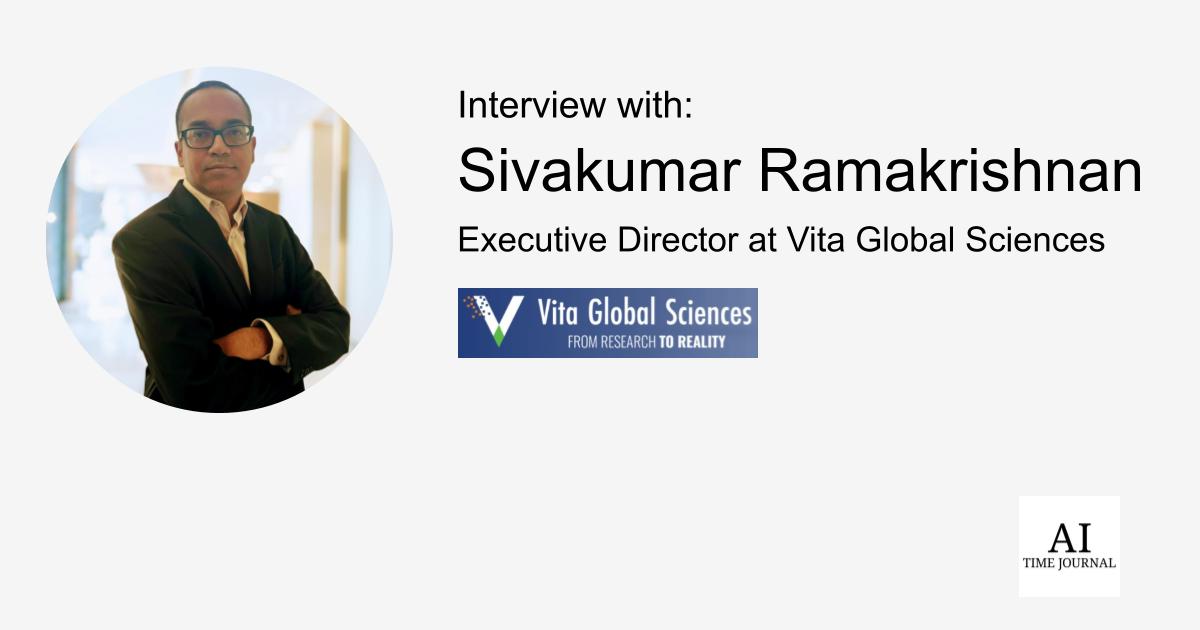
Sivakumar Ramakrishnan, Executive Director at Vita Global Sciences, brings a unique perspective to the intersection of statistical programming, AI, and healthcare innovation. In this interview, he delves into the evolution of his career, leadership principles, and the transformative role of artificial intelligence in the life sciences sector. Ramakrishnan shares how his team navigates the balance between industry standards and customized solutions, and the critical skills future leaders must cultivate in an ever-evolving landscape. Read on to discover his insights on accelerating the delivery of life-changing therapeutics.
Read more interviews related to healthcare here: Slawa Madelska, Health Tech Entrepreneur — Healthcare AI, Pain Management Tech, Preventive Care, Back Pain Innovations, and Healthcare Trend
What inspired you to pursue a career at the intersection of statistical programming and innovation, and how has your vision evolved?
From my early days in SAS programming, I quickly realized that statistical programming is more than just a technical discipline. Its ability to transform raw data into actionable insights, drive critical decisions in healthcare, and ultimately improve patient outcomes truly inspired me.
Over time, my vision expanded from a purely technical focus to a broader perspective encompassing leadership, strategy, and impact. I came to see statistical programming as a critical bridge connecting science, technology, and practical results - one that demands seamless collaboration and a commitment to innovation throughout the drug development lifecycle. This evolution naturally led me to concentrate on three key pillars: nurturing high-performing, diverse teams; embracing emerging technologies to enhance efficiency; and keeping patient-centered goals at the heart of every initiative.
Ultimately, my goal has been to help shape the future where healthcare is more precise, efficient, and accessible. By combining robust technical expertise with an empathetic, forward-thinking approach, I strive to make a lasting impact on the healthcare industry and the lives it touches. With advancements in artificial intelligence and machine learning, the future is bright for accelerating the delivery of transformative therapeutics to those who need them most.
As a leader of a global team, what principles guide your approach to fostering innovation and delivering impactful solutions?
As a leader of a global team, I anchor my approach in a clear vision and inclusive collaboration. By aligning our innovative efforts with organizational objectives, customer needs, and broader global health goals, we tackle real-world challenges with measurable impact. At VGS, I strive to cultivate a culture where each individual feels valued, understands their role, and is empowered to contribute unique ideas.
Recognizing that change is constant, adaptability and continuous learning are vital. I encourage and inspire my team to adopt emerging technologies, experiment freely in a trust-based environment, and learn from both successes and failures. Over the past four years, I’ve built teams from the ground up, instilling a sense of ownership that sparks creativity and uncovers transformative solutions.
I firmly believe that mentorship and growth drive the delivery of innovative outcomes. By fostering curiosity, offering professional development opportunities, and nurturing talent, we maintain a motivated and high-performing workforce. These principles form the foundation of my leadership approach, enabling us to consistently push boundaries and deliver lasting, meaningful results.
How do you see the role of AI and automation transforming statistical programming in the life sciences, and what challenges accompany this shift?
Automation in statistical programming has a long history, leveraging traditional high-level programming languages and software. At VGS, we have continually enhanced code maintainability, reusability, and other best practices through these automated approaches.
Now, artificial intelligence (AI) is creating a significant impact, offering both hope and novel possibilities. Most in the industry agree that AI is here to stay and will simplify our work and drive efficiency. However, we view it as a complementary tool rather than a replacement. Our focus is on “Augmented AI”, where humans and AI collaborate seamlessly to achieve transformational impact and efficiency, with AI designed to enhance, not replace, human intelligence.
Moreover, the highly regulated nature of the pharmaceutical industry necessitates caution when relying on AI. Concerns such as “bias”, “hallucination”,” traceability”, “Privacy”, and “ethical considerations” remain critical. As we integrate AI, vigilance is essential to ensure its use is both responsible and compliant, striking the right balance between innovation and accountability.
What strategies do you employ to balance industry standards with customized solutions for diverse stakeholders?
Customized solutions need not stray from industry standards. Our stakeholders range from large pharmaceutical companies to medium-sized biotech firms and small startups - each with distinct requirements. From a sourcing perspective, we tailor our approach to fit these varied needs. Some stakeholders may only need support in a specific biometric area, while others might require an end-to-end solution. Additionally, urgent resource demands can arise, and we address these promptly through our extensive recruitment network and internal pipeline.
We also offer technical solutions that adhere to regulatory guidelines while allowing for customization in the intermediate processes and support provided. For instance, we can develop custom programming for clinical and statistical applications to deliver specialized reports offering deeper insights. These reports serve as a valuable complement to the standard regulatory requirement, ensuring stakeholders benefit from both compliance and flexibility. Ultimately, we strike a balance between standardization and customization, ensuring we achieve the best of both worlds: efficiency without compromising on specific needs.
How has your involvement with the Forbes Technology Council and the AI Frontier Network influenced your work at Vita Global Sciences?
Through my membership at these esteemed communities, I have benefited from a broad network of industry innovators and thought leaders who share transformative ideas across multiple technology domains. This exposure has helped me leverage industry trends and incorporate forward-thinking strategies into Vita Global Sciences’ operations. For instance, articles, discussions, and collaborations within these groups have informed my approach to adopting new processes and tools. Additionally, these connections have created opportunities for mutually beneficial partnerships with stakeholders, allowing us to integrate emerging solutions into our biometrics workflows and leverage best practices in technology adoption and change management.
Who are some of the individuals who have significantly influenced your career and your leadership style?
I have had the privilege of learning from countless people throughout my journey. My philosophy is to act as a “mirror,” absorbing lessons from everyone I encounter and embracing the positive qualities they offer. However, one key influence in my current role is my boss, Tim Southwick - the President and Founder of VGS. Our weekly interactions have revealed his unwavering composure, regardless of the situation. This stoic demeanor is something I strive to emulate. He also shares invaluable insights, such as an early piece of wisdom: “We are only as good as our last deliverable.” This resonates with me deeply and is a principle I often reiterate to my team at VGS. It keeps us grounded, prevents complacency, and motivates us to consistently deliver the highest level of service to our clients and patients.
What steps do you take to ensure that innovation aligns with the overarching goal of accelerating the delivery of transformative therapeutics?
I employ a structured approach guided by strategic alignment, collaboration, and adaptability. It begins with a clear roadmap focused on enhancing efficiency, shortening timelines, and improving patient outcomes. By involving key stakeholders- ranging from biostatistics and data management to statistical programming and regulatory teams - we ensure innovations address real-world challenges and blend seamlessly into existing workflows.
Interdisciplinary teams further enrich this process by offering diverse perspectives, resulting in comprehensive end-to-end solutions. Regularly assessing emerging technologies, methodologies, and tools helps identify high-impact opportunities that can accelerate development while maintaining compliance and scalability.
To ensure consistency and reliability, I promote well-defined SOPs, robust quality checks, and governance frameworks. We track metrics - such as timelines, cost efficiency, and deliverable success rates - and fine-tune our strategies based on measurable outcomes. A culture of adaptability and continuous improvement is fostered through prototyping, piloting new technologies, and incorporating lessons learned where it makes sense.
Clear communication around the vision and purpose of each innovation initiative underscores its contribution to delivering transformative therapeutics. At the same time, investments in upskilling and encouraging curiosity keep teams competitive and forward-thinking. By integrating these elements, every initiative remains aligned with organizational goals and helps deliver life-changing therapies to our stakeholders and patients in need.
In your opinion, what are the most critical skills future leaders in statistical programming and analytics should cultivate?
Future leaders in statistical programming and analytics need a combination of technical expertise, domain knowledge, strategic thinking, and interpersonal skills to succeed in the evolving healthcare landscape. They must stay ahead of emerging technologies and methodologies, remain proficient in multiple programming languages, and excel at data visualization and storytelling to effectively communicate insights.
However, tools and technical prowess are only a means to an end. True leadership requires the ability to craft a clear vision, identify opportunities, and align initiatives with those opportunities. Adaptability, team building, collaboration, and continuous learning are also vital. By embracing these qualities, leaders can evolve with the field and leverage technology to achieve strategic goals.
How do you envision the role of statistical programming evolving within the broader context of global health and precision medicine?
Statistical programming has experienced remarkable growth in collaboration and knowledge sharing in recent years. This is largely due to the rise of open-source technologies- particularly R and Python- in clinical programming, as well as the rapid development of new statistical methodologies and machine learning libraries. Furthermore, global information-sharing initiatives have fostered faster innovation and broader access to critical information. As these trends continue, statistical programming will play an increasingly pivotal role in advancing global health and precision medicine.
What motivates you personally to push the boundaries of modern medicine through your work?
At VGS, we are driven by a profound sense of purpose and the understanding that our efforts directly contribute to improving lives on a global scale. The life sciences industry carries the immense responsibility of tackling some of humanity’s most urgent health challenges, and being part of this mission inspires both me and the entire team at VGS every day.
At the core of my motivation is the belief that behind every dataset and analysis is a patient hoping for better outcomes. Each subject number represents an individual with a unique life story and a journey toward healing. This perspective fuels my commitment to leveraging statistical programming and innovation to accelerate the development of life-saving therapies. It is this knowledge that pushes me and my team to break boundaries and pursue transformative solutions that make a real difference in people's lives.
Throughout my time at VGS, I have had the privilege of leading statistical programming efforts for a wide range of impactful therapies, that have achieved regulatory approval, and several other treatments fast-tracked for FDA review, among many others. Reflecting on the outcomes of our work - therapies that transform and save lives - fills me with a profound sense of gratification that is unmatched by any other endeavor.