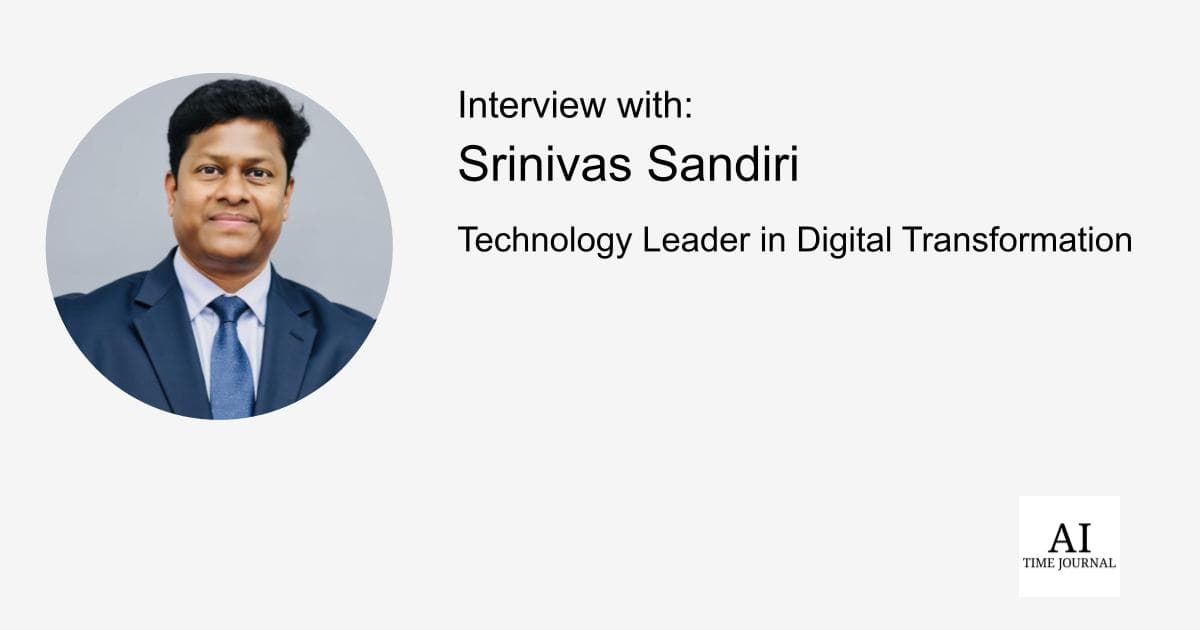
In this interview, we speak with Srinivas Sandiri, a seasoned technology leader in digital transformation, whose experience spans over two decades in IT and AI strategy. Drawing from his background in enterprise-scale innovation, Srinivas explores how AI is reshaping customer experience, where to balance automation with human touch, and what ethical considerations are critical as AI systems gain influence. He also shares practical insights on aligning cross-functional teams and mentoring the next generation of tech professionals.
Explore more interviews here: Interview with Radhika Arora, Director – Autonomous Vehicles, Intelligent Sensing Division, ON Semiconductor
You’ve spent two decades in IT, specializing in AI-driven digital transformation. How have you seen the evolution of AI impact customer experience over the years, and what key trends do you foresee shaping the next decade?
AI has evolved over the past two decades from a support function to a strategic force that shapes the customer experience. In the early stages, AI was primarily reactive and focused on automating routine tasks, such as case routing and basic self-service. It improved efficiency but lacked personalization and depth. Today, AI plays a far more integrated role. We now see intelligent systems that anticipate intent, detect sentiment, and deliver context-aware interactions in real-time. At this level, AI isn't just solving problems fast; it's helping businesses understand customers more deeply and respond more intelligently across channels.
Several trends will redefine AI's role in the future of CX:
Real-Time Personalization at ScaleAI will shift from segment-based personalization to moment-based engagement by tailoring interactions dynamically based on context, behavior, and emotional tone.
AI-Human Collaboration The future isn't full automation—it's orchestration. AI will guide agents with the best actions, automate routine steps, and free humans for complex, high-empathy interactions.
Ethical, Explainable AI. As AI increasingly drives decisions, customers and regulators will demand greater transparency. Organizations will need to design AI systems that are not only intelligent but also accountable, fair, and trusted.
Experience-Led Data StrategyClean, unified, customer-centric data will become the foundation for all AI innovation. Organizations that treat data as an experience enabler, not just an input, will lead the next wave of transformation.
With your expertise in designing scalable solutions, what are the biggest challenges enterprises face when implementing AI-driven customer experience initiatives, and how do you navigate them?
The most common challenge in AI-driven customer experience initiatives isn’t the technology—it’s alignment. Many organizations pursue automation and personalization without establishing a strong foundation of unified data, clear business objectives, and cross-functional collaboration. Disconnected systems, siloed teams, and unclear ownership often lead to fragmented customer journeys, stalled implementations, or inconsistent experiences. AI solutions implemented in isolation can struggle to deliver lasting value without the proper data context or process integration.
Organizations must treat AI both as a tool and as an enterprise capability that links business strategy with system operation and team performance. Achieving success requires organizations to convert business and customer targets into measurable performance indicators while integrating AI into operational processes and establishing reliable stakeholder relationships. When thoughtfully implemented, AI becomes more than an optimization engine—it becomes a strategic enabler that improves decision-making, enhances customer engagement, and drives long-term experience transformation.
Automation has been instrumental in reducing handle times and improving operational efficiency. Where do you draw the line between automation and human interaction to ensure a seamless yet personalized customer experience?
Automation plays a vital role in optimizing service delivery; however, the key to an excellent customer experience lies in knowing when to automate and when to humanize. The best results come from a hybrid approach where automation removes friction, and human interaction adds empathy.
Here’s how that balance can be thoughtfully designed:
Automate repetitive, predictable, and time-sensitive tasks, such as identity verification, status updates, or document retrieval.
Route nuanced, high-emotion, or exception-based issues to human agents, better equipped to respond with empathy and judgment.
Use AI to enhance—not replace—human decision-making, by offering guided actions, real-time insights, and context-aware recommendations.
Design seamless handoffs between bots and agents, ensuring customers don’t feel like they’re starting over when escalation occurs.
The main purpose is to increase the quality of human interaction rather than reduce it. Organizations achieve efficient and personalized experiences when automation provides customers with fast service while offering agents detailed context.
You’ve led cross-functional teams in aligning technology with business goals. What strategies do you use to bridge the gap between technical teams and business stakeholders to ensure successful AI implementations?
Bridging the gap between business goals and technical execution is one of the most critical success factors in any AI initiative. Technology teams focus on what's possible; business leaders focus on what's valuable. Establishing alignment requires mutual agreement between parties on an identical outcome.
To close the gap and drive scalable results, I suggest the following:
Outcome-first thinking: Define success in business terms, such as reduced churn or improved resolution time, before exploring solutions.
Translating complexity into clarity: Use visual storytelling, user journeys, and KPIs to make technical ideas accessible and aligned with stakeholder priorities.
Inclusive collaboration models: Embed business stakeholders in agile sprints or design sessions to co-create solutions and accelerate adoption.
Ultimately, AI succeeds not when it is deployed, but when it is understood, trusted, and operationalized across teams. True transformation requires not just more innovative systems but also stronger collaboration.
AI-powered decision-making is transforming business operations. What ethical considerations should leaders keep in mind when deploying AI-driven solutions to ensure transparency and fairness?
As AI becomes increasingly integral to decision-making, leaders must prioritize ethics throughout the entire design and deployment process. Bias in training data can reinforce inequalities; therefore, diverse and representative datasets, along with regular audits, are essential. Explainability is equally critical; customers and stakeholders should understand how AI decisions are made, especially in high-impact areas such as customer service or financial eligibility.
Beyond technical fairness, organizations must establish clear accountability frameworks. AI should support human decision-making, not replace it entirely. Ensuring human oversight, escalation paths, and transparent communication builds trust between internal users and customers. Ethical AI isn’t just a compliance requirement—it’s a leadership responsibility and a foundation for building long-term credibility in digital transformation.
As a mentor in the tech space, how do you prepare the next generation of professionals for the challenges and opportunities presented by AI-driven digital transformation?
I mentor professionals to think beyond tools and focus on the broader implications of technology. As AI continues to shape the evolution of industries, I encourage emerging talent to remain curious, cultivate cross-functional awareness, and learn how to apply technology thoughtfully. I emphasize the importance of adaptability and ethical knowledge, and link innovative solutions to meaningful business goals or customer needs, for each team member working in data, design, or development. It’s not just about learning new technologies—it’s about solving real problems with purpose and responsibility.
The next generation will determine how digital transformation and AI evolve. I aim to develop professionals who will maintain technical competence and leadership qualities to guide others through complex situations and generate beneficial effects in our intelligent future.