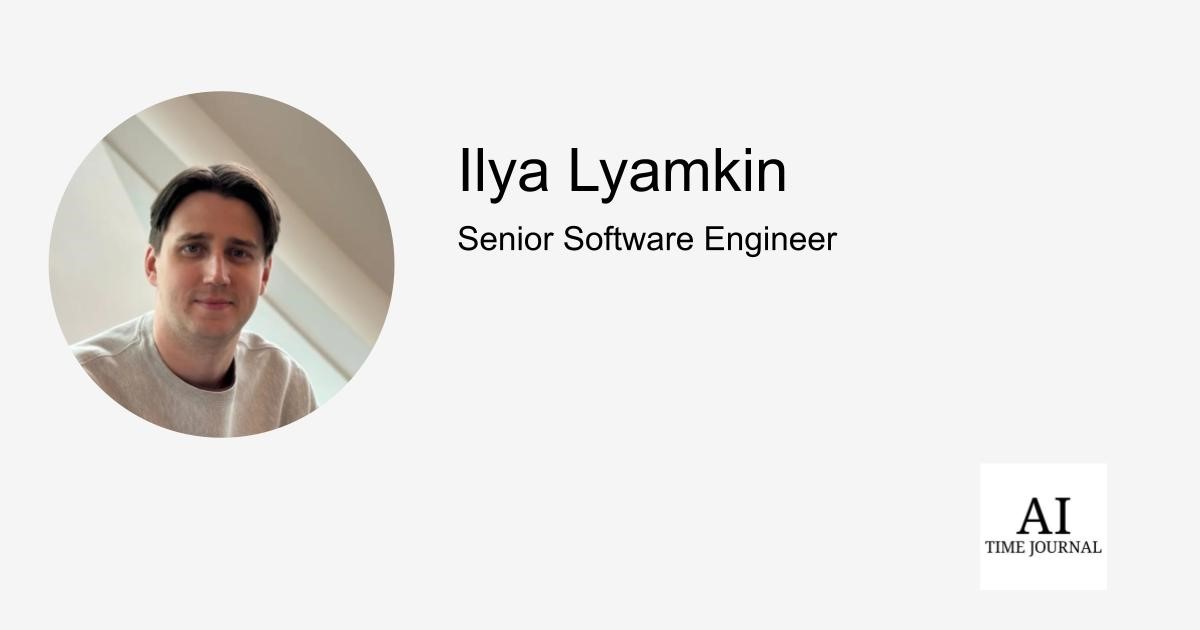
Ilya Lyamkin, a Senior Software Engineer with years of experience in developing high-tech products, has created a solution to streamline the startup evaluation process for venture capital funds. His platform, DualSpace.AI, merges his expertise in software engineering with his practical experience in technical business analysis. In this interview, Ilya shares his professional approaches, details the implementation of complex algorithms, and discusses how technology can transform the venture investment landscape. For more on the importance of AI Application development for startup ventures click here.
Can you tell us about your projects and why you created DualSpace.AI? What inspired the idea?
I have extensive experience working with internal technical products at Spotify. Knowing this, venture capital funds began reaching out to me for technical evaluations of startups they were considering for investment. As an expert, I analyzed how these startups were being used, leveraging data from GitHub and other open sources. Initially, I compiled this information manually into spreadsheets and sent it to the VCs via email. After completing a few requests, I started thinking about automating the process to save time and evaluate more companies.
This became the early prototype of DualSpace. I aggregated a wide range of data about technical startups from public sources and concluded the technical quality of their products and their investment potential. Of course, the results are just one piece of the puzzle—investors ultimately use a mix of sources for decision-making, with DualSpace being just one of them.
Who is your primary audience, and what key problems are you solving for them?
Our main audience includes venture funds and investors looking for additional data about startups to support their investment decisions. Another problem that DualSpace solves is discovering new technical companies for investment. The platform identifies emerging projects, enabling investors to reach out to founders and inquire about potential funding opportunities.
What advantages does DualSpace.AI offer for technical evaluation and deal analysis?
The venture funding process typically starts with startups pitching their ideas through decks, followed by multiple conversations with investors. At this stage, investors rely primarily on the information provided by the startup and anecdotal references. There is usually no reliable technical evaluation, which often leads to errors. DualSpace provides these missing technical indicators, enabling investors to make more informed decisions by analyzing open-source data.
What unique metrics and analysis parameters does DualSpace.AI provide for startup evaluation?
Our platform offers insights into a startup’s growth rate compared to competitors. For instance, we position startups within percentiles (10th, 25th, 50th, 75th, or 90th), with the 90th percentile representing the top-performing companies.
We analyze GitHub activity to validate the quality of "stars" a project receives—distinguishing real users from bots or engineers using the product casually. This validation ensures credibility.
Beyond GitHub, we gather data from Discord, Slack, Reddit, and Hacker News. By analyzing user comments and mentions, we understand the challenges users discuss and their perceptions of the product. These platforms are rich sources of additional data, especially within the developer community.
What role does AI play in ensuring the accuracy and relevance of DualSpace.AI’s data?
AI primarily ensures data relevance. By searching across resources associated with a company name, we identify GitHub repositories, community platforms, and other assets. AI agents validate this information to avoid mismatches with similarly named companies, thus ensuring reliable outputs.
Additionally, our AI analyzes extracted data to identify the technologies used by startups and assess whether these technologies are innovative and modern.
Can you elaborate on the algorithms you’ve developed for your platform and how they enhance the accuracy of due diligence analysis?
We employ a variety of algorithms to assess companies. For instance, we use a gradient boosting algorithm to normalize extensive datasets and evaluate a company’s popularity relative to its peers in the same industry. This helps identify which players dominate a particular market niche.
The algorithms we rely on are a subset of machine learning techniques. Typically, investors provide us with just the company name, and nothing more. To automatically gather insights—from identifying the company’s founder and evaluating their competencies to assessing the technological sophistication of the business—we use machine learning. The better the research process, the more accurate the conclusions.
Additionally, we implement active monitoring. We have a dashboard that displays every step of the algorithm’s actions, down to individual lines of code. This enables us to track whether, for instance, Reddit discussions mention bugs in the product and to analyze the sentiment of those conversations. We also use a confidence score, which allows the AI to rate its own certainty in the data it has provided. When confidence is low, we manually verify the findings. By reviewing the dashboard and tweaking the code to address specific scenarios, we continuously improve and train the AI.
What methods and algorithms have you used for data cleansing and classification, and how were they adapted to process information about hundreds of startups?
Every piece of data we collect undergoes rigorous validation and testing before being integrated into the system. For example, we review all AI-generated research outputs to verify that links are accessible and match their described content. This validation process is extensive, as each dataset is tested multiple times and subsequently classified. For instance, based on a company’s description, we determine the appropriate category to place it in, enabling meaningful comparisons with other companies in the same sector.
We use a range of statistical methods to assess companies. For data cleansing and validation, we rely on the Instructor library, which helps validate all responses provided by the AI. Additionally, we use Pydentic, a Python library that validates data types, ensuring accurate cleansing and classification.
The classification system for industry sectors was manually created to ensure precise comparisons. Once classified, the system grades companies on a scale from A to F, where A represents the highest rating and F the lowest. This grading is applied across all key informational sectors, and an aggregate score is then assigned based on the cumulative findings.
Which emerging technologies do you find promising as a developer and founder?
I believe AI agents capable of making thoughtful investment decisions represent the next breakthrough. While we’re not there yet, advancements in AI suggest it’s only a matter of time before these technologies surpass technical evaluation and directly influence investment decisions.
Finally, how do you envision the future of DualSpace.AI?
Our main goal is to incorporate more data sources and metrics. For instance, LinkedIn could provide valuable insights into founders’ expertise and how it aligns with their projects. We also aim to improve the accuracy of our algorithms. Working with unstructured data often presents challenges, such as misclassification or lack of verifiable information. We want to minimize these issues.
Another direction is evaluating the social activity of investors and startups on platforms like X (formerly Twitter). This would allow users to track investors’ interests and collaborations, offering a clearer view of market trends.
DualSpace.AI is positioned to redefine how startups are evaluated, combining automation and data-driven insights to empower venture capital funds with more precise decision-making tools.