
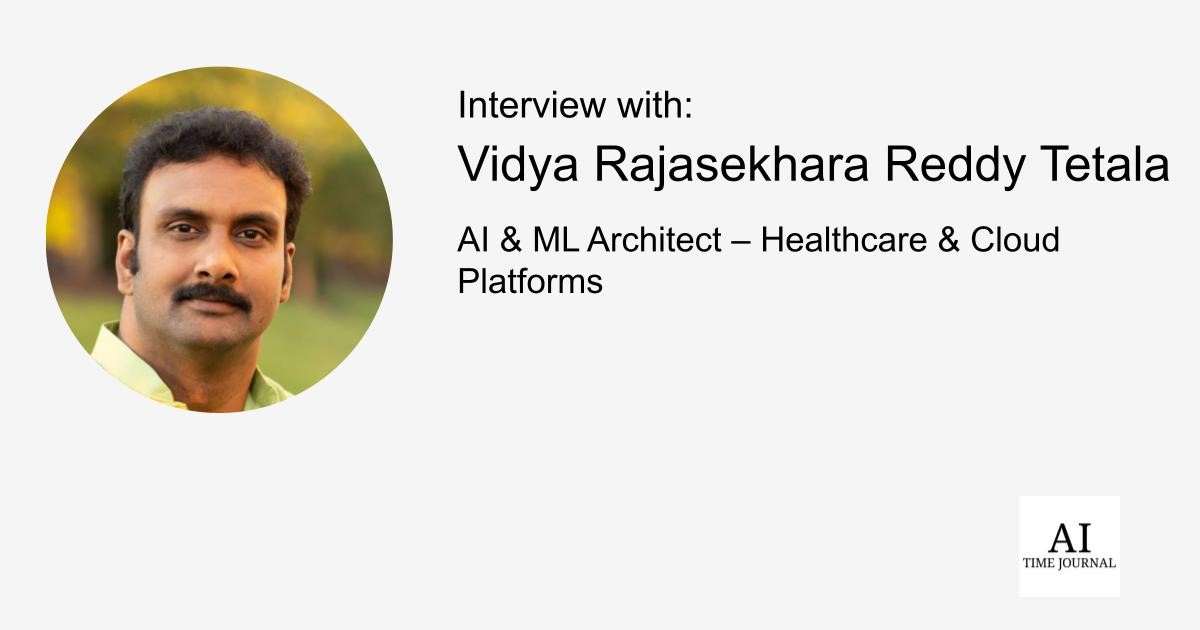
In this interview, Vidya Rajasekhara Reddy Tetala, AI & ML Architect for Healthcare & Cloud Platforms, shares his insights on the transformative role of artificial intelligence and machine learning in the healthcare sector. With expertise in AI-driven solutions, Vidya explores critical topics such as predictive analytics, model explainability, and bias mitigation. He also delves into the challenges of integrating AI/ML into healthcare systems, from ensuring data accuracy to addressing scalability. As AI continues to revolutionize drug discovery, clinical decision-making, and patient care, Vidya highlights the pivotal innovations that will shape the industry in the coming years.
Explore more interviews related to healthcare here: Towards a Better and Accessible Healthcare Industry with AI – Hear from Margaretta Colangelo
As an AI & ML Architect – Healthcare & Cloud Platforms how do you see Artificial Intelligence and Machine Learning transforming the healthcare industry, particularly in areas like predictive analytics, patient diagnostics, and operational efficiencies?
Artificial Intelligence (AI) and Machine Learning (ML) are revolutionizing healthcare with predictive analysis, enhancing diagnostics for patients, and operational efficiencies. In predictive analysis, AI algorithms scan massive datasets, including EHRs, claims, and real-time tracking of patients, to identify high-risk patients, make disease progression forecasts, and prescribe proactive interventions. Techniques such as Difference-in-Differences (DID) analysis have been critical in estimating intervention impact, with a purpose of optimizing treatment planning and curbing healthcare costs.
Inpatient diagnostics, AI-powered deep learning algorithms in AI detect abnormalities in X-rays, MRIs, and CT scans with a level of accuracy like experienced radiologists. AI-powered NLP unlocks important information in unstructured clinical documentation, improving accuracy and automating documentation processes. AI algorithms even make precision medicine a reality, with analysis of genomic information for personalized therapy based on individual patient profiles.
From an operational efficiency perspective, AI-powered automation optimizes hospital planning, scheduling, and administration processes for increased efficiency. AI-powered cloud platforms such as Snowflake’s Healthcare Data Cloud and AWS SageMaker allow for real-time analysis, secure information exchange, and elastic AI model hosting. AI optimizes claims processing, medical coding, and fraud detection, with reduced paperwork and compliance with GDPR and HIPAA mandates.
The integration of AI in the medical field is reorienting the sector towards a proactive, information-led model, with increased patient care, lowered costs, and effective, scalable operations. With AI combined with expert human talent, medical professionals can deliver high-value, patient-centered care with trust, accuracy, and transparency maintained.
With AI-driven healthcare solutions becoming more sophisticated, how do you navigate the challenges of ensuring data accuracy, bias mitigation, and model explainability in critical medical applications?
Ensuring data accuracy, suppression of bias, and model interpretability in AI-powered healthcare offerings is critical for trust establishment, improvement in patient care, and compliance with regulating agencies. Data accuracy begins with meticulous data validation, cleaning, and real-time integrity checking to enable AI models to learn with high-quality, normalized datasets. AI architectures in cloud, such as Snowflake’s Healthcare Data Cloud, enable efficient integration, deduplication, and anomalous value detection in electronic health records (EHRs) before having an impact on clinical actions.
Bias mitigation entails training datasets that cover diversity and demographics, socioeconomic, and clinical variation. Techniques including re-sampling, bias-aware loss, and adversarial debiasing remedy imbalanced datasets. Model audits and fairness tests conducted periodically monitor AI for bias over a period of years. Federated training approaches, in which model training can occur at numerous institutions but not with shared sensitive information, enable even increased inclusivity with patient anonymity
Model explainability is paramount for both medical acceptance and approval for use in a medical setting. Explainable AI (XAI) techniques, such as SHAP, LIME, and neural networks with an attention mechanism, enable clinicians to understand AI decision processes. AI-facilitated human-in-the-loop technology keeps medical professionals in ultimate decision-making position, with AI-facilitated recommendations working to confirm trust in them.
Compliance with GDPR, HIPAA, and FDA mandates is achieved through effective governance frameworks, moral AI values, and continuous observation. By blending transparent, intelligible, and bias-aware AI tools, clinicians can actualize AI’s potential for enhancing clinical performance, operational efficiencies, and patient security, with fairness and accountability intact.
Automation and AI are revolutionizing healthcare workflows. Can you share an example where AIML has significantly improved data processing, patient care, or clinical decision-making?
A great example for AI/ML in transforming healthcare is predictive analysis and automation in reducing rehospitalization in hospitals and improving disease management for long-term disease. One such case included leveraging AI-powered algorithms for risk-stratification in electronic health records (EHRs), claims, and real-time tracking of patients to identify high-risk cases.
Using machine learning algorithms in Snowflake’s Healthcare Data Cloud and Amazon’s SageMaker, hospitals analyzed trends in patient histories, blood tests, and medication compliance to predict at-risk patients for post-discharge complications. With such information, early interventions such as individualized follow-up care, at-home care, and virtual follow-up care lowered readmission in a considerable way.
Another impactful use case is medical imaging with AI. AI deep learning algorithms in radiology exams (X-rays, MRIs, and CTs) detect abnormalities with high accuracy, even at a level equivalent to experienced radiologists. It accelerated diagnoses, reduced manual errors, and optimized medical decision-making. With Snowpark for real-time processing and federated approaches, hospitals supported AI use at a larger level with assured security and anonymity of data.
In operational workflows, NLP powered AI facilitates automation of medical documentation, lessens physician burnout, and opens doors for additional care for patients. AI-powered automation in claims processing and prior approval have also maximized insurance approval, lessening administration-related waits.
These AI-driven enhancements not only have increased efficiency and care for patients but have lowered medical expenses, providing real-life value for AI/ML in present medical infrastructure.
Generative AI is making waves across industries. How do you see it contributing to areas like drug discovery, medical imaging analysis, or patient interaction in the healthcare sector?
Generative AI can make a significant impact in transforming healthcare with its accelerated drug discovery, enhanced medical imaging analysis, and reimagined patient engagements. In drug discovery, AI-powered algorithms like AlphaFold and GANs are predicting protein structures, molecular modeling, and generating new compounds for drugs at record velocities. It brings down timelines and costs for R&D massively, and pharma companies can discover drugs with potential in a shorter period. Generative AI can even simplify clinical trials with simulation of numerous patient populations, improving efficiency and success in trials.
In medical image analysis, AI-facilitated generative capabilities enhance image reconstruction, anomalous discovery, and synthetic data creation for model training. AI algorithms such as diffusion models and GANs can generate high-resolution medical images from poor-quality scans, improving radiology, pathology, and oncology diagnostics. In MRI and CT scan, AI accelerates image processing, and diagnoses can be performed at a high pace with fewer repeat scans. AI-facilitated computerized segmentation tools, in contrast, assist radiologists in identifying potential abnormalities, improving efficiency and accuracy.
For patient care, AI-powered chatbots and virtual assistants simplify telemedicine, patient education, and symptom evaluation. LLMs including MedPaLM and ChatGPT enable conversation AI for personalized care guidance, with patient queries and medical documentation automation becoming a reality. AI-powered voice assistants simplify clinic workflows with real-time dictation transcribing of a doctor, minimizing administration workloads.
By integrating its AI in its formative state in medical infrastructure, studies, and patient care, the industry can stimulate innovation, enhance diagnostics, and deliver efficient and personalized care with complete compliance with both GDPR and HIPAA legislation.
Healthcare organizations handle massive and complex datasets. What are the biggest hurdles in integrating AI/ML solutions within healthcare data systems, and how do you overcome these challenges?
Integrating AI/ML capabilities in medical information systems entails a range of complications, including interoperability of information, security and compliance, model scalability, and real-time processing.
One of the biggest challenges is interoperability of information between sources such as electronic health records (EHRs), claims, IoT sensors, and genomic databases. Most providers have older systems with disorganized information, and it’s not an easy job to integrate and normalize AI models in such a case. With Snowflake’s Healthcare Data Cloud, with both HL7 and FHIR standards supported, interoperability of information can be achieved seamlessly, with transformation and normalization at a variety of sources, and AI models can have organized and cleaned information.
Security and compliance with laws are also a top concern, with patient health information (PHI) being sensitive in character. Stringent laws and mandates under HIPAA, GDPR, and FDA require robust data encryption, access controls, and logging audits. Snowflake’s native security feature, role-based access control (RBAC) and end-to-end encryption, when embraced, will cause AI-powered healthcare software to maintain data integrity and compliance.
Scalability and expense controls become a concern with increased AI workloads. On-demand cloud AI platform scaling, including for AWS SageMaker and Snowflake Snowpark, enables optimized computation cost for big-data predictive analysis, real-time AI inference, and anomalous behavior analysis.
Lastly, real-time processing via AI is paramount for application in such critical care cases and life-saving interventions. Integrating streaming analytics and AI-driven anomaly detection in pipelines for real-time processing enables real-time decision-making, improving patient care and operational efficiency.
By adopting cloud-native architectures, AI governance, and normalized frameworks for data, healthcare providers can effectively integrate AI/ML solutions with security, compliance, and scalability.
You specialize in Snowflake, Teradata, and AWS-based architectures. What best practices do you follow when designing scalable, compliant, and cost-effective AI-driven healthcare data infrastructures?
Designing scalable, compliant, and efficient AI-powered healthcare data architectures entails leveraging Snowflake, Teradata, and AWS for performance, security, and efficiency. Scalability is facilitated through Snowflake’s multi-clustered architecture, elastic computation-storage decoupling, and near-infinte concurrency, and Teradata’s analytics and AWS’s auto-scaling for large healthcare datasets. Teradata Vantage, Snowflake Streams, Snowflake Tasks, and decoupled pipelines through AWS Glue make real-time processing and transformation and ingestion a reality with zero downtime.
For compliance and security, architectures must align with HIPAA, HITRUST, and GDPR, using Snowflake’s Tri-Secret Secure encryption, fine-grained RBAC, dynamic data masking, and secure data sharing to prevent unauthorized access. Snowflake’s Zero-Copy Cloning ensures efficient, compliant data management without replication.
Cost efficiency through serverless computation, Snowflake’s Time Travel & Fail-safe for optimized storing, and Teradata’s Intelligent Memory.
AI insights make use of Snowpark for in-database machine learning, Amazon’s AWS SageMaker for high-level AI training, and Teradata ClearScape Analytics for real-time predictive analysis.
All these methodologies make best use of AI infrastructure in healthcare for performance, security, compliance, and cost savings.
Moving AI/ML models from Proof of Concept (PoC) to large-scale deployment is a common challenge in healthcare. What strategies do you use to ensure these solutions deliver real-world impact?
Transitioning AI/ML models from a Proof of Concept (PoC) stage to widespread use in healthcare entails a systemic journey towards scalability, dependability, and compliance with laws and regulations. To begin with, prioritization of data governance and quality entails use of normalized pipelines, checking through automation, and compliance with HIPAA and GDPR for accuracy and integrity maintenance. Snowpark, Glue, and Terdata Vantage allow feature engineering at a high level, and model robustness in a range of patient populations can be facilitated through them.
For scalability, serverless AI (AWS SageMaker), distributed computation (Dask, Spark), and containerized environments (Docker, Kubernetes) are leveraged to effectively manage big datasets. Best practices in MLOps, including continuous integration and delivery (CI/CD pipelines), model drift, and automated tracking, allow for continuous improvement with high dependability.
To drive clinic acceptance, AI models become integral to EHR platforms, real-time dashboards, and decision-support tools, with techniques for explaining (SHAP, LIME) earning clinicians' trust. With a combination of scalable infrastructure, compliance with regulation, and rollout to clinicians, AI offerings can have real-world impact and maximize patient care.
Deep learning, neural networks, and advanced ML techniques are rapidly evolving. What specific AI advancements excite you the most in their potential to revolutionize healthcare?
Transitioning AI/ML models from a Proof of Concept (PoC) to full-fledged, widespread use in healthcare requires a careful planning for supporting dependability, scalability, and compliance. Governance and integrity of data are maintained through normalized pipelines, real-time data checking, and GDPR/HIPAA-compliant architectures. Snowpark’s native Python, Java, and Scala capabilities in Snowflake allow feature engineering and preprocessing, with direct training of ML models in Snowflake with zero data movement, for added efficiency and security.
For scalability, model deployment takes advantage of containerized environments (Docker, Kubernetes), serverless AI (AWS SageMaker), and distributed processing (Spark, Dask). Snowflake ML capabilities, including native model training, native inference, and native feature stores, enable real-time predictive analysis in situ in the data warehouse. Best practice for MLOps, including continuous integration and continuous delivery (CI/CD pipelines), continuous monitoring, and model drift, enable continuous improvement.
To enhance clinic acceptance, AI models integrate into EHR platforms, real-time dashboards, and decision-support tools, with techniques for explainability (SHAP, LIME) working to build trust with clinicians. Scalable, compliant, and clinician-facing, such a model ensures AI models deliver real-world value, improved patient care, and operational efficiencies in healthcare.
Many fear that AI and automation will replace human expertise in healthcare. How do you address these concerns, and what strategies do you recommend for augmenting healthcare professionals rather than replacing them?
Concerns about AI and automation dominating expertise in medical care spring out of a lack of understanding about AI’s role. AI is not a substitution for medical professionals but an adjunct tool that can enhance decision, productivity, and patient care. AI is most effective at dealing with massive datasets, identifying trends, and providing predictive information, but humans' expertise is paramount in interpretation, empathetic, and moral decision-making.
To ensure that AI supplements and not replaces medical professionals, human-in-the-loop AI must become a focal point. Clinicians can correct, validate, and override AI-derived information through such frameworks, with ultimate decision-making in hands of humans. AI-powered diagnostics, for example, assist radiologists in detecting abnormalities in medical images, streamline review, and maintain human oversight.
Explainable AI (XAI) techniques, such as SHAP, LIME, and neural networks with an attention mechanism, enable trust and transparency through providing clinicians with an understanding of AI's decision processes. Adoption is facilitated and AI collaborates in harmony with medical expertise and not in a "black box" form.
Additionally, AI integration in workflows in a medical environment must work towards minimizing workloads in administration—autonomation documentation, scheduling, and claims processing—and allow for less direct care and more direct care for physicians. AI-powered virtual assistants and NLP-powered platforms simplify efficiency and keep medical professionals at the center of decision processes.
Lastly, upskilling in AI and medical professionals' data literacy will allow them to utilize AI effectively. With collaboration, transparency, and an educational frame, AI can become a valued collaborator, improving patient care and protecting medical expertise' unreplaceable role.
If you had to predict the most transformative AI-driven breakthrough in healthcare within the next five years, what would it be, and why?
One of the most important AI advances in healthcare over the next five years will be AI-facilitated personalized medicine, supported through multi-modal AI frameworks that integrate genomics, medical imaging, electronic medical records (EMRs), wearables, and real-time patient tracking. AI will revolutionize precision medicine through analysis of massive datasets to predict disease risk, personalized planning, and optimized drug reaction for individualized patients. Snowflake’s Healthcare Data Cloud, with its secure information sharing, interoperability, and elastic computation, will become a critical platform for uniting disparate datasets to drive actionable insights for personalized care.
Another breakthrough will be in AI-powered drug development and discovery. Traditional drug development is both time and costly, but deep learning and generative AI can model drugs at high velocity, make molecular structure prediction, and streamline candidates for trials. Snowpark Snowflake and Amazon SageMaker provide in-database training for ML and AI infrastructure at high scalability, creating high velocity in R&D, reducing failure, and bringing life-saving therapies to market in a shorter timeframe.
Additionally, real-time predictive analysis will re-engineer preventive care and early disease prediction. AI algorithms, having been trained with real-time and retrospective patient data, will enable proactive interventions, with reduced rehospitalization and optimized disease management for long-term disease. NLP-powered AI assistants will enable patient activation through automation of overviews of diagnostics, documentation, and virtual observation.
With AI driving high-speed, high-accuracy, and patient-centric solutions, the future of the medical field will become proactive, not passive, with an increased emphasis on early intervention, personalized medicine, and operational efficiency. All of this will drive clinical performance, save expenses, and redefine future worldwide healthcare.