
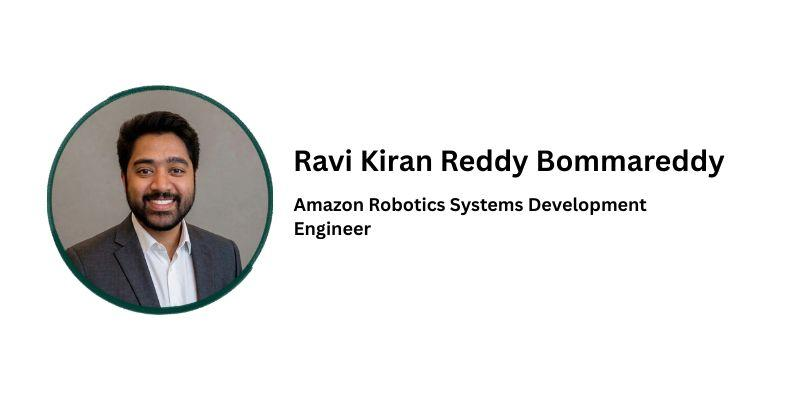
Amazon Systems Development Engineer Ravi Kiran Reddy Bommareddy reduced deployment time by 75%. His work shows that automation and on-premise AI minimize downtime, travel costs, and vendor dependence, and the results point to a repeatable model that other industrial operators can apply.
The Industrial AI Paradox
The industrial AI market faces a paradox. Investment in robotics and automation is accelerating, with the industrial robotics sector projected to grow from $24 billion in 2026 to more than $77 billion by 2034. However, Forbes reports that the average manufacturer confronts 800 hours of equipment downtime annually, and unplanned downtime costs industrial manufacturers approximately $50 billion per year.
The main challenge lies in operational readiness, specifically, how knowledge is transferred between people and systems. Modern industrial facilities connect PLCs, vision systems, warehouse platforms, and older infrastructure, forming complex networks. These environments require careful coordination between engineers, vendors, and on-site technicians to keep operations running smoothly.
Ravi Kiran Reddy Bommareddy, a Systems Development Engineer III at Amazon and recipient of the company's BOOM Award for Innovation, transforms manual deployment processes into standardized, automated frameworks. His work demonstrates that deployment capability is not merely an operational expense but a strategic advantage. It also underscores the widening challenge of industrial knowledge loss, as seasoned technicians retire faster than their successors can be trained, leaving substantial gaps in expertise and long-term operational continuity.
Additionally, his background spans controls engineering at Naina Powers, automation deployments at Bollhoff Inc., widely recognized for its engineering excellence and long tradition of innovation in fastening and assembly technology, serving clients including Tesla, Ford, Volkswagen, and Tower International, and large-scale systems work at Amazon. That range matters: engineers who understand both the theoretical underpinnings of control systems and the pressure of live production environments approach AI deployment differently. They build for failure. They document for the next team. They design around the constraints that actually exist on the factory floor.
The Hidden Cost of Vendor Lock-In
Warehouse control systems restrict access to PLC logic, server interfaces, and system documentation. The result is that even minor adjustments require outside expertise, creating delays, inflating consulting fees, and eroding operational flexibility over time. For manufacturers, this is not a one-time cost. It compounds with every incident, every upgrade cycle, and every new site.
At Amazon, Ravi led a retrofit initiative across multiple North American facilities running Dematic Automated Warehouse Control Systems to reduce vendor dependency and build a migration path toward internally managed infrastructure.
"PLC logic discovery came first, understanding the interfaces between control systems, the Dematic server, and warehouse management systems. We documented everything through a Modeled Change Management process, executed code changes with rollback capability, and created site-specific technical documentation," Ravi said.
The initiative delivered significant million-dollar vendor cost avoidance and enabled the Move Off Corp (MOC) transition to Amazon's internal WCS platform. Critically, the retrofit playbook was designed to be reusable and adapted successfully across multiple sites. For industrial operators evaluating automation partnerships, the lesson is direct: how vendor relationships are structured determines long-term cost trajectory far more than the upfront contract price.
How Remote Intelligence Reduces Travel Costs
Subject-matter expertise in industrial operations is unevenly distributed across global locations. While equipment installations span numerous facilities, the most advanced technical knowledge remains concentrated within centralized engineering hubs. This imbalance often results in costly travel or delayed troubleshooting whenever on-site teams need SME support.
To close that disconnect, Ravi's team at Amazon developed mixed-reality applications that deliver remote expertise without reliance on specialized hardware. Designed using Unity, Python, MongoDB, and OpenCV, the system emerged after rejecting earlier smart-glasses prototypes that introduced platform dependencies, licensing fees, and cumbersome design limitations.
"The constraint was practicality. Solutions requiring specialized hardware create adoption barriers. We built devices people already carry, tablets, phones, with OS-agnostic compatibility." Ravi noted.
The results were substantial. Quality-control time per station fell by 40%, and pre-Go-Green walk support saved dozens of engineer-hours. Training travel expenses and per-deployment costs each saw significant reductions through real-time remote expert support. For organizations operating across multiple areas, these savings compound rapidly, making remote intelligence both a cost-efficient solution and a key enabler of faster, more adaptable global deployment.
Making Deployment Data Visible and Actionable
Slow deployments are rarely caused by a single identifiable problem. They are caused by invisible ones, bottlenecks that accumulate across handoffs, scheduling gaps, and undocumented prerequisites. In 2022, Ravi's SDI Metrics program tackled this directly by instrumenting the deployment process itself rather than adding new tools on top of a broken one.
A QuickSight dashboard was built to surface blockers in real time. ASANA automation rules were upgraded to capture delay driver metadata. KPIs were standardized across all sites to ensure teams were measuring the same things. Average deployment time per site fell by 40%, travel and accommodation costs declined meaningfully per location, and documented annual savings followed, all from making existing data visible and actionable.
The same logic scaled further with the Universal Item Sorter program: software upgrades across hundreds of machines at numerous international sites, completed within six weeks. Ravi's team built a self-service deployment tool, first in PowerShell and SQL, later redesigned with a Google Forms interface based on field feedback, that automated prerequisite checking, sequencing, and validation reporting. The first large-scale rollout in Japan cut completion time by 75% compared to manual processes, with network infrastructure savings documented across configuration tiers.
Why On-Premise AI Is the Right Architecture for Industrial Environments
Cloud-based AI is the default assumption for most enterprise deployments. In industrial settings, that assumption fails on three fronts. Connectivity is unreliable on factory floors. Operational data is frequently too sensitive to route through external servers. And in regulated or defense sectors, external cloud routing is often prohibited entirely.
On-premise AI addresses all three, but only when scoped to the right problems. General-purpose systems are not the answer here. What works in industrial environments is AI designed around specific, high-frequency, high-consequence tasks: configuration validation, diagnostic guidance, and troubleshooting knowledge capture. The kind of work that currently lives in the heads of experienced technicians who are retiring faster than they can be replaced.
"You don't need a giant AI model to solve most industrial problems. You need a system that understands your specific equipment, your specific processes, and can guide technicians through the right steps when something goes wrong. That's achievable with on-premise infrastructure," Ravi observed.
On-premise AI doesn't require massive datasets or cloud-scale compute. It requires precise problem definition and repeatable execution. Ravi is currently building an AI agent to accelerate on-site deployments through structured troubleshooting capture and streamlined expert handoffs.
As a member of the IEEE and the Institution of Engineering and Technology (IET), a globally recognized professional body that advances engineering knowledge and promotes the application of technology for the benefit of society, and as a certified Scrum Master and LOTO (Lockout/Tagout) trainer who has personally certified his own team, Ravi applies the same systematic discipline to safety and process governance that he brings to AI architecture. He is also a fellow of Hackathon Raptors, a UK-registered Community Interest Company that unites engineers and technologists from organizations including Google, Microsoft, Amazon, Meta, and NVIDIA to tackle impactful challenges through collaborative hackathons spanning over 30 countries. His involvement there reflects the same instinct that runs through all of his work: bring rigorous people together around hard problems, and build something the next team can run without you.
That standing within the engineering community extends to peer evaluation as well: in February 2026, Ravi served as an official judge at the AITEX Summit Winter 2026, an international technology summit focused on analytics innovation. Selected for his hands-on experience translating data insights into measurable operational outcomes, including QuickSight dashboards, KPI monitoring systems, and large-scale industrial deployments, he evaluated projects spanning industrial IoT, operational analytics, and real-time decision support systems. The Association of Information Technology Experts recognized his contribution with a Certificate of Appreciation, noting that his practitioner's perspective brought both technical depth and a rare ability to assess business viability alongside engineering soundness. The instinct running through all of it is consistent: define the system, document it completely, and make sure the next person can run it without you.
Ravi's next phase extends that same discipline into structured training and adoption frameworks, giving industrial teams the tools to integrate AI-assisted workflows with measurable outcomes, not just working prototypes. For manufacturers evaluating where AI fits into their operations, the starting point isn't which model to deploy. It's identifying which high-frequency problems are currently solved by people who won't always be available, and building systems that make that knowledge durable.