
Enterprise AI is entering a different phase.
The first phase was largely about proving that AI could work: building models, experimenting with Generative AI, deploying copilots and, more recently, exploring autonomous agents.
The next phase is more fundamental.
As AI moves into the core of how enterprises operate, the question is no longer simply “Where can we use AI?” It is becoming “What architecture does an enterprise need when intelligence itself becomes part of how the organization operates and makes decisions?”
This is the transition from an AI-featured enterprise to an AI-native enterprise.
And it requires us to think beyond technology architecture toward something equally important: Decision Architecture.
From data to data plus intelligence
The digital enterprise was largely built around data.
Traditional software captured data, processed it, moved it through workflows and converted it into information. As enterprises scaled, they learned that data could not remain fragmented across individual applications. This drove databases, warehouses, lakes, lakehouses and eventually enterprise data architectures.
AI introduces something new into this equation.
When machine learning models, LLMs and agents process data together with business context, they can create predictions, learned relationships, recommendations, decision context and, increasingly, executable intelligence.
In simple terms:
Data + Context + AI → Intelligence
Consider an insurer. Claims AI may identify loss patterns. A fraud model develops behavioural intelligence. An underwriting model produces risk intelligence. A distribution model learns customer propensity. A servicing agent accumulates customer context.
Each starts as an AI use case. But each is also potentially creating intelligence that has value beyond the application that produced it.
This leads to an important architectural shift:
Data remains a foundational enterprise asset. Intelligence increasingly becomes another.
The AI-native enterprise will therefore increasingly be built around data plus intelligence.
From AI use cases to AI-native architecture for scaling use cases
This changes what we should mean by “AI-native.”
An AI-native enterprise is not an organization that puts AI everywhere.
Nor is it simply an existing enterprise with hundreds of AI features added to its applications.
It is an enterprise designed so that intelligence can be introduced wherever it creates value, governed wherever it creates risk, and reused where appropriate without repeatedly redesigning the organization around each new AI use case.
That requires an AI-native architecture.
Today, many organizations still build AI vertically: one architecture for claims, another for fraud, another for customer service, another for underwriting, and increasingly another collection of infrastructure for agents.
That works initially. It becomes difficult at scale.
The same lesson enterprises learned with data will eventually apply to intelligence:
Data could not remain trapped inside applications. Intelligence cannot remain trapped inside AI use cases.
As intelligence becomes reusable across models, agents, applications, processes and people, another question naturally follows:
How should that intelligence participate in enterprise decisions?
That is where Decision Architecture begins.
Capability does not confer authority
Technology architecture tells us how models are deployed, how data moves, how systems integrate and where workloads execute.
Decision Architecture addresses a different problem:
What decisions may AI participate in, using what intelligence and context, under whose authority, with what level of human judgment, and within what boundaries?
This distinction becomes critical with agentic AI.
An agent may be technically capable of assessing a claim, communicating with a customer, modifying a record or initiating a transaction.
But technical capability does not give it organizational authority.
Capability does not confer authority.
Enterprises therefore need to explicitly architect levels of autonomy:
Recommend → Assist → Act with Human Approval → Act within Bounded Authority
The objective should not be maximum autonomy.
It should be appropriate autonomy.
Human-in-the-Loop must itself be architected
This is where Human-in-the-Loop becomes fundamental.
HITL should not mean putting a human approval step into every AI workflow. Done indiscriminately, that can simply recreate manual processes around faster technology.
Nor should humans be removed merely because AI becomes technically capable of performing an action.
The more useful question is:
Where does human judgment add necessary authority, accountability, context or intervention?
A high-confidence, low-consequence operational decision may run autonomously within predefined boundaries. A low-confidence decision may automatically escalate. A high-value financial transaction may require approval. A complex underwriting decision may require expert judgment. An anomalous agent action may need immediate human intervention.
Decision Architecture should therefore determine not only whether humans participate, but when, why and with what authority.
This makes HITL dynamic rather than binary.
Humans can review, approve, override, intervene, escalate or stop AI-driven decisions depending on risk, confidence, consequence and policy.
The goal is neither human control of every decision nor AI autonomy everywhere.
It is the deliberate architecture of human judgment and machine intelligence together.
The anatomy of Decision Architecture
For every material AI-assisted decision, an enterprise should be able to answer several questions:
Purpose: What business outcome is this decision intended to support?
Context: What data, knowledge and organizational intelligence may be used?
Authority: What may AI recommend, decide or execute?
Human judgment: When must a person review, approve, override or intervene?
Governance: What policies, permissions and regulatory boundaries apply?
Traceability: Can we reconstruct what intelligence was used, why a decision occurred and what action followed?
Outcome: Did the decision actually produce the intended business result?
This creates a more meaningful enterprise AI loop:
Business Purpose → Data + Context → Intelligence → Governed Decision → Action → Outcome → Learning
The final step matters enormously.
Outcomes create new data and new intelligence. That intelligence can, where appropriate and authorized, inform future decisions.
This is how Organizational Intelligence begins to compound.
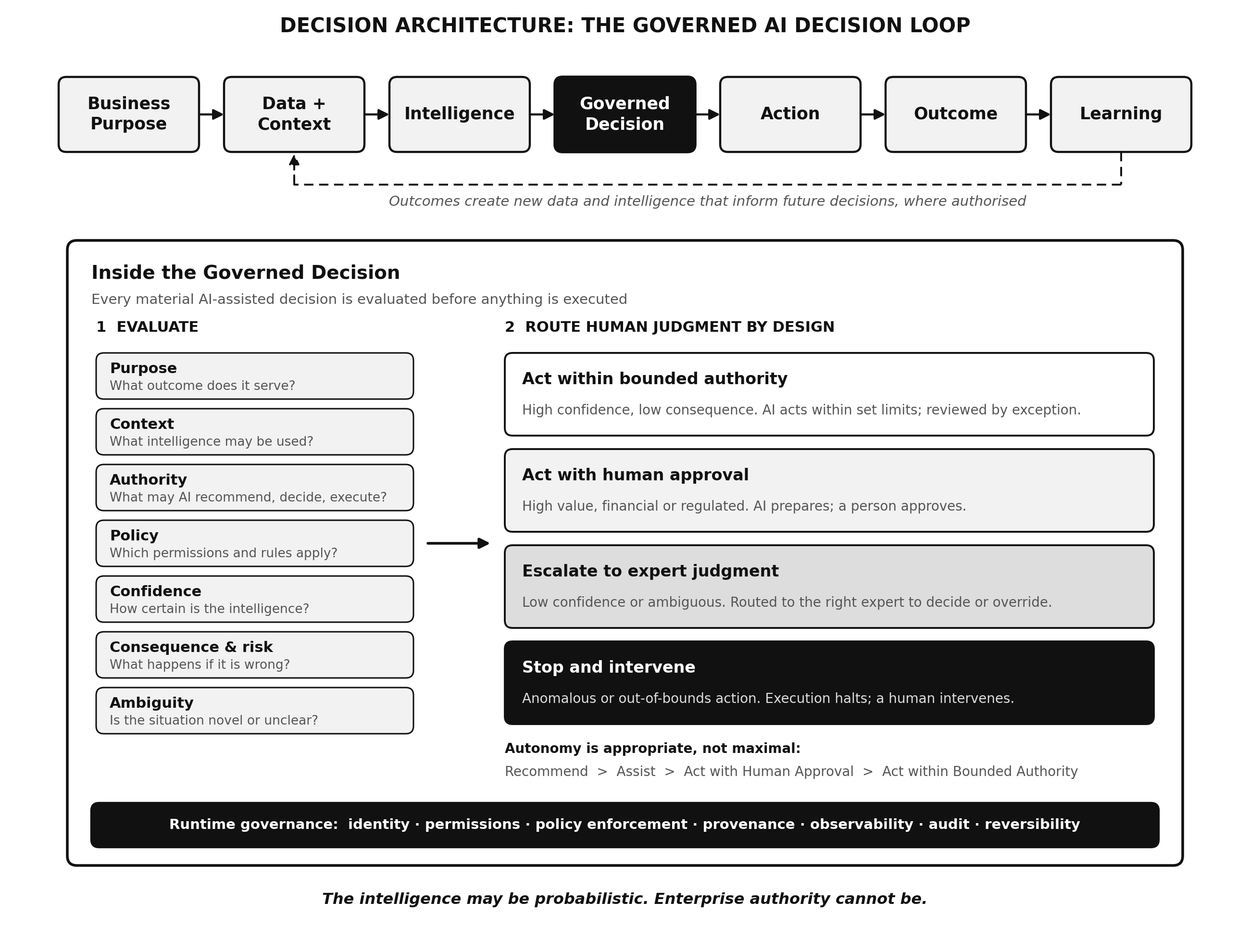
Figure 1. Decision Architecture: how human judgment is designed into the governed AI decision loop
Governance must move into runtime
This also changes how enterprises should think about AI governance.
Policies, committees, model reviews and risk assessments remain necessary, but they are insufficient when AI participates in thousands or millions of operational decisions.
Governance increasingly has to move into runtime.
If an agent cannot approve a transaction above a defined threshold, that should not exist only in a policy document. The architecture should enforce it.
If confidence falls below an acceptable level, escalation to a human should not depend on the AI deciding whether it needs help. The decision architecture should determine it.
Identity, permissions, authority boundaries, policy enforcement, HITL, provenance, observability, auditability and, where appropriate, reversibility therefore become architectural properties.
The intelligence may be probabilistic. Enterprise authority cannot be.
From technology advantage to Organizational Intelligence
Models will continue becoming more capable. Compute will become more accessible. Agent frameworks will mature.
Two competing enterprises may eventually use the same models and similar infrastructure.
But they will never have exactly the same history, customer understanding, institutional context, risk knowledge, business semantics, decision history or accumulated experience.
That accumulated Organizational Intelligence can become a differentiating enterprise asset-provided the enterprise can govern and use it effectively.
The strategic question therefore begins to shift from:
“Which model do we have?”
toward:
“What does our organization know, and how effectively can our AI and our people use that intelligence to make better decisions?”
Technology Architecture remains essential. AI-Native Architecture provides the foundation for operating intelligence across the enterprise.
But as intelligence moves closer to decisions and actions, enterprises need another architectural discipline alongside them:
Decision Architecture.
Because the ultimate measure of enterprise AI will not be how many models, copilots or agents an organization deploys-or even how autonomous they become.
It will be whether the enterprise can transform data and context into intelligence, intelligence into governed decisions, and governed decisions into better business outcomes-with human judgment present where it matters, safely, consistently and at scale.
