Entrepreneur and founder of EventIQ on how analytics and data are becoming key to successful and profitable events.
Events are one of the largest unmanaged capital allocations in business today. Millions are spent globally without a system to control ROI, compare performance, or manage events as investments.
According to the 2026 State of Events Benchmark Report by Bizzabo, companies are increasingly evaluating the effectiveness of their events through concrete business metrics rather than just participant impressions. The trend toward proven event value is becoming global: organizations want to see real outcomes for pipeline, deal velocity, and customer retention–backed by analytics. In 2026, this approach is becoming a strategic necessity for the international events industry.
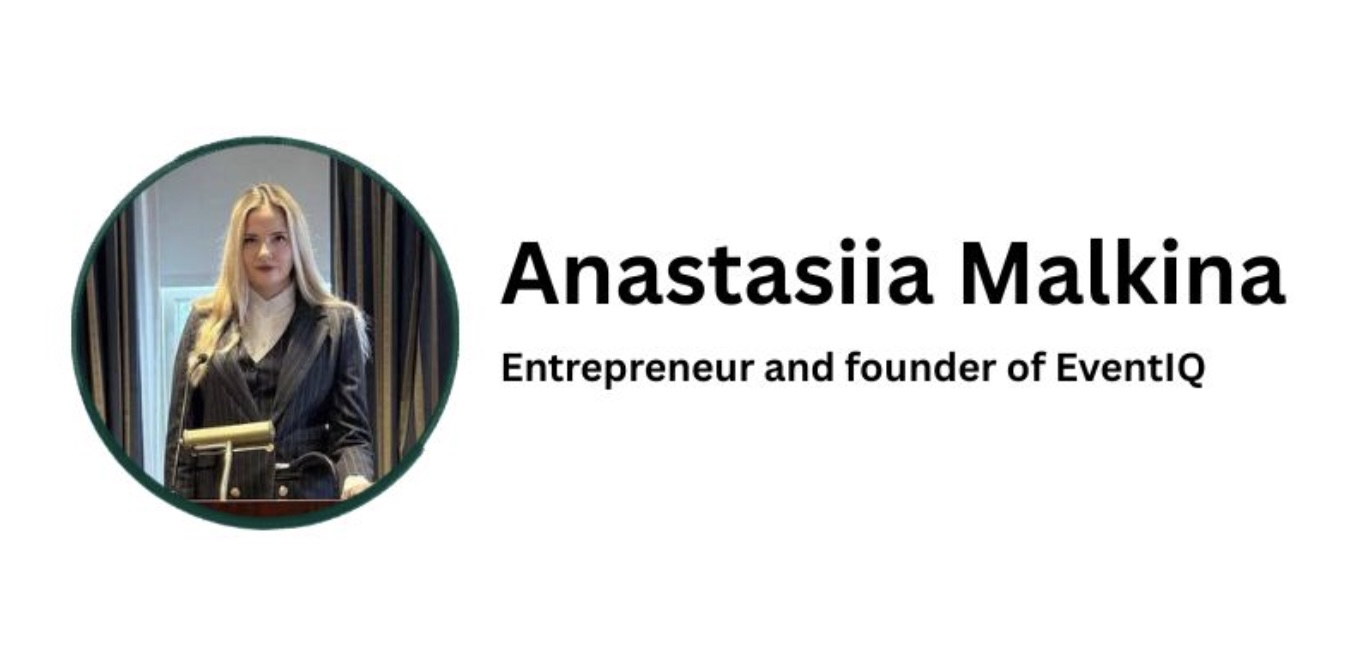
Anastasiia Malkina, founder and CEO of EventIQ, has built her career at the intersection of international events, premium hospitality, and high-level client experiences. Working with major conferences, tech events and premium private projects in Moscow, Istanbul, Dubai, she's seen how much event value goes unmeasured and how difficult it is for companies to prove a real ROI. These insights became the foundation for EventIQ – a platform that turns events into measurable, predictable commercial outcomes: operating within a broader Event Intelligence framework. Event Intelligence is not analytics. It is the missing management layer for event-driven investments.
The company's portfolio includes work with premium clients, implementation of AI-driven analytics for performance forecasting, and building international teams capable of managing high-budget projects at a global scale.
Anastasiia shared with us how to manage events as assets, implement analytics for managerial decision-making, and turn events from cost centers into strategic growth tools.
"The technology exists, AI is already being tested and used, but the key bottleneck is the management model"
Anastasiia, you have built an international career in Moscow, Istanbul, Dubai, and now the U.S., organizing major conferences and premium VIP events, including Step Conference Dubai and TOKEN2049. At what point did you realize that the events industry needed to be rebuilt around data, not just creativity, and that your methodologies should be integrated into managerial decision-making?
I realized it when I started looking at events not as creative one-off projects, but as capital allocations that executive leadership expects to produce measurable returns.
The scale showed that even flawless execution doesn't solve the problem, because the lack of comparability and causality limits it. CFOs and CEOs increasingly ask: "What is the proven value?" And often, data is collected just for reports, not for management. I understood that the industry needs a managerial layer that links events with CRM, marketing, and sales, making them comparable, predictable, and manageable – turning them into a real company asset. That became the core idea behind EventIQ.
Considering your experience in Moscow, Istanbul, and Dubai, where you encountered different event management structures and cultures, what typical differences do you see, and how did they help shape EventIQ as a platform for standardization and comparability?
Moscow is all about people and high speed. Decisions are made quickly, often in a small circle, and much relies on personal expertise; analytics come afterward. On one hand, this allows complex things to happen instantly, but on the other, experience is hard to scale, and team memory is lost. Istanbul is flexibility and ecosystem: many contractors, mixed standards, manual coordination. This brings adaptability but lacks systematization and a common data language. Dubai is institutions and KPIs. Events are integrated into government strategies, with transparency, comparability, and strategic planning. But there's less flexibility, strict regulation, and high entry barriers. Each place has different strengths, but the common problem is the same: events remain isolated projects. EventIQ was born to unite these approaches, standardize data, and make events manageable as assets.
You are implementing AI and analytics in EventIQ, integrating CRM, marketing, and sales. Which barriers in industry transformation are stronger: technological or cultural?
Cultural, without a doubt. The technology exists, AI is already being tested and used, but the key bottleneck is the management model. AI makes decisions verifiable, changes responsibilities, roles, and power within teams. While everything is fragmented, you can rely on intuition. Once there is a unified data model, companies are forced to restructure processes or admit that much was done in vain. EventIQ creates a neutral layer that turns AI from a feature into a system for managerial decision-making. My experience with major conferences confirms: without this layer, technology remains superficial.
"Even with AI implementation, events remain unmanageable without a unified data model"
Your experience in the premium segment and with international conferences allowed you to set standards for precise execution. How do you see the role of intuition in a managed system, and what does EventIQ solve?
Intuition is personal capital, but it doesn't scale or get validated. In small projects, that's fine, but large budgets require proven value. In EventIQ, intuition becomes a hypothesis: we record it, test it, compare results, and learn from successes and mistakes. This way, experience becomes systemic, creates institutional memory, and enables managed risk. For CFOs, it is control; for CEOs, reproducible strategy; for companies, standards that work over time.
Your career path — from producer in Moscow to Event Director at Rocketech and, later, at DTEC Istanbul, and now founder of EventIQ — was it a sharp turn or a gradual evolution in how you came to see events as manageable assets?
It was a gradual evolution. The problem isn't in a single project – it appears when you look at the portfolio as a whole. First, principles emerged: what is event value, how to measure ROI, and how to compare decisions across teams. Then I realized that methodologies, if only in heads and spreadsheets, don't scale. Even with AI implementation, events remain unmanageable without a unified data model. EventIQ solves this problem by linking event data with CRM, marketing, and sales, making decisions explainable and repeatable. It's not just a tool – it's a managerial layer for the entire process.
How has international experience with global brands helped you understand that data changes roles and the distribution of influence in companies?
Data redistributes influence. Without a unified model, each function lives in its own world: marketing counts reach, sales – leads, finance – costs. Whoever tells the story loudest controls the narrative. With a unified model, decisions become verifiable, and causality appears. Immediately, questions arise: who owns the metrics, who is responsible for data quality, and where is the ROI. Influence shifts from personal status to responsibility. EventIQ creates a managerial framework, linking events with CRM, marketing, and sales, making results comparable and manageable.
"Premium clients buy control, stability, and predictability, not flashy interfaces"
You are building a platform where AI and analytics support decision-making, but responsibility remains with people. How do you divide the roles of machines and humans at major international conferences?
AI and analytics excel at calculations, processing large scenario volumes, and risk assessment. But the decision on priorities, acceptable risk, and strategy remains human. Responsibility always rests with people. AI supports, makes consequences transparent, comparable, and predictable, while people make decisions and are accountable to the business and clients. This approach reduces anxiety and builds trust, which is especially important for premium clients.
Your experience in VIP services and premium conferences showed that clients value control and predictability more than the "wow" effect. How has this shaped EventIQ?
Premium clients buy control, predictability, and risk transparency, not flashy interfaces. In the VIP segment, the key is clear expectations and manageable risks. EventIQ is built on this logic: a common metrics language, comparable results, and transparency for CFOs and boards. The product turns events into a manageable asset with clear rules, accountability, and predictable results. It gives companies confidence that they control both the process and its outcome.
You have received international recognition: awards, publications, and jury positions, including National Business Award: Technologies & Innovations, CASES&FACES Award, and Glonary Awards. How does institutional recognition shape your view of leadership and expertise?
For me, recognition matters not for status, but as a signal to the industry that the approach works. Here, public professional evaluation aligns with real impact. Awards and jury roles show that ideas extend beyond a single company and are valuable to the market. True leadership appears when other companies begin using the methodologies. Then the approach ceases to be personal opinion and becomes a contribution to the industry. This combination of public recognition and practical application shapes my view of expertise.
"Without a managerial layer, AI remains just a pretty number"
Your publications on Digital Influence, personalized VIP experiences with AI, Data-Clean Rooms, and Validation of Global Influence Network Framework show deep research on the role of data. What are the most common mistakes when moving to a data-driven model, and how does EventIQ solve them?
The main mistake is treating analytics as reporting. In reality, analytics must enable managerial accountability and decision ownership, not just produce reports.
Event platforms, CRM, marketing, and sales remain fragmented; ROI is hard to prove, metrics exist, but there is no decision owner. EventIQ connects all sources, normalizes data, and turns measurement into a single cycle: goal, action, result, adjustment. Data stops being just reporting and becomes the foundation for reproducible decisions.
In the age of AI, leadership shifts from "personal control" to managerial decision architecture. How does your international premium project experience help design this architecture?
Leadership today is designing the decision system. Without a managerial layer, AI remains just a pretty number. Architecture sets logic and rules, distributes responsibility, assigns metric owners, controls risks, and ensures data becomes action. Algorithms enhance human expertise but do not replace it. Experience with global projects showed that a transparent responsibility structure turns data and AI into manageable value.
How do you see the future of Event Intelligence and the role of EventIQ in transforming the industry? How are you shaping managerial language and forward-looking practices?
In the next 5 years, Event Intelligence will become the operating standard for managing event portfolios, similar to how CRM became the backbone of modern sales. At its core, it functions as a management layer - powered by an AI-driven financial intelligence layer that turns fragmented data into accountable decisions.
First comes a comparability layer – common definitions, normalized data, integration with CRM and finance. Then, a managed decision layer with causality, forecasting, and scenarios. In mature organizations, events are no longer treated as marketing activities; they are portfolio assets that require capital allocation logic, accountability, and measurable returns.
My role is not just product development but also shaping managerial language and practices through EventIQ, methodologies, and publications. The awards and recognition I mentioned are important not for themselves: they confirm that my ideas and practices are no longer personal opinion, but contributions the market takes seriously.