
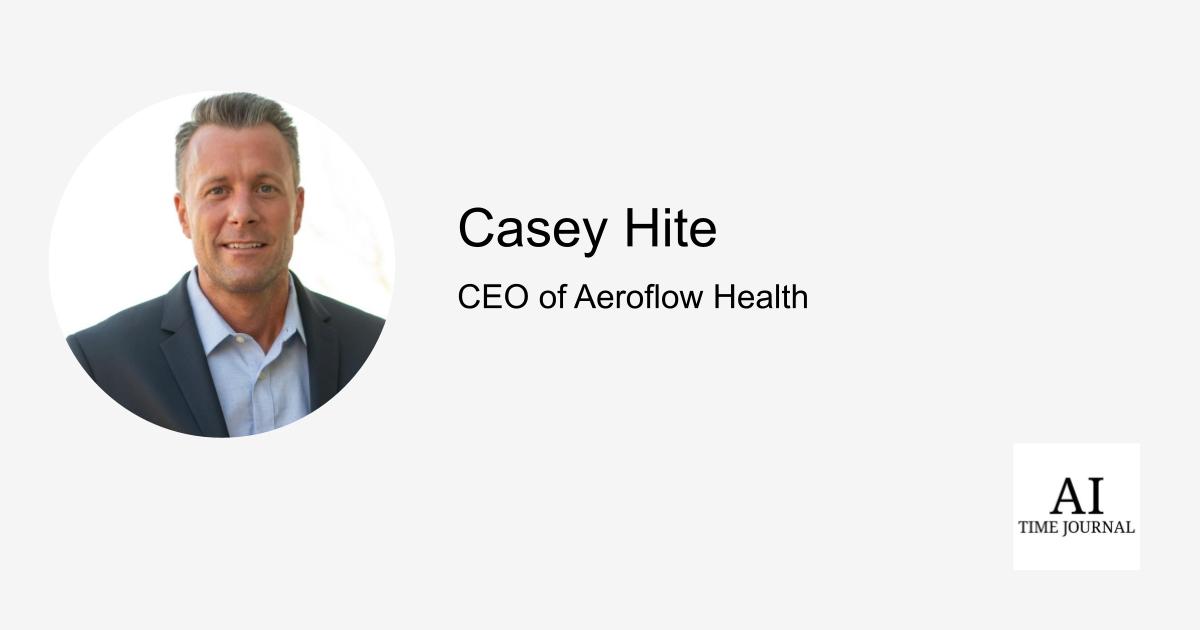
Executive Summary. Casey Hite explains how fragmented insurance workflows are becoming the proving ground for AI in healthcare operations, and why real-time validation, disciplined automation, and governance-first design are essential to improving patient access without eroding trust.
As healthcare organizations scale, administrative complexity around insurance verification, approvals, and documentation continues to act as a hidden bottleneck to patient access. For many providers, the challenge is not a lack of technology but a lack of operational coherence across fragmented payer systems, shifting requirements, and manual workflows.
Casey Hite, CEO of Aeroflow Health, has spent more than a decade building technology-enabled healthcare operations designed to reduce friction while preserving patient trust. Under his leadership, Aeroflow has evolved into a multi-entity healthcare platform spanning sleep therapy, diabetes care, urology, and maternal health, with a strong focus on real-time verification, structured data flows, and patient-centered service design.
In this conversation, Hite outlines why insurance fragmentation remains one of healthcare's most persistent structural problems, where AI delivers measurable operational value, and how healthcare leaders should think about automation, governance, and human accountability as AI becomes embedded across revenue cycle and patient support workflows.
AITJ: Casey, health insurance remains one of the most persistent pain points in healthcare. From your perspective, what makes the insurance verification and approval process so difficult for both patients and providers?
The insurance process was never built as a single, connected system. It evolved in silos, with each payer maintaining its own rules, documentation standards, and timelines. Those requirements change frequently.
For patients, that fragmentation creates uncertainty around coverage and cost. For providers, it results in rework, resubmissions, and avoidable delays.
The core issue is fragmentation. Fragmentation slows access to care.
At Aeroflow, we address this by investing in real-time eligibility and benefit verification, including customization at the employer-group level. We use structured data integrations and automated validation checks to confirm coverage requirements before documentation is submitted. Establishing clarity at the outset reduces downstream errors and unnecessary back-and-forth.
Approval workflows are designed to meet strict documentation and compliance standards. Early validation and documentation alignment reduce variability and improve predictability. Predictability shapes access in healthcare.
The core issue is fragmentation. Fragmentation slows access to care.
Casey Hite
Many healthcare organizations are experimenting with AI to streamline operations. How is Aeroflow Health using AI specifically to untangle the insurance maze without losing the human touch?
We use AI to remove friction, not remove people.
Much of the administrative burden in healthcare comes from routing and preparation. We apply AI to digitize and classify inbound documents, interpret faxed prescriptions and clinical paperwork, extract key information, and route work to the appropriate team.
We also use automated validation checks to identify missing documentation before submission and to classify billing correspondence and denials accurately. These steps reduce rework and prevent avoidable delays.
When a patient has a question about coverage or cost, a person handles that conversation. AI supports our teams with better information so they can focus on listening and explaining clearly.
In patient-facing workflows, AI-powered self-service tools manage routine inquiries and support conversational reorder experiences, while more complex situations are escalated to human representatives. For example, in our sleep therapy business, predictive models help identify patients who may benefit from earlier intervention, enabling targeted support.
At Aeroflow, AI strengthens operational discipline and improves predictability while accountability remains with our teams.
We use AI to remove friction, not remove people.
Casey Hite
You’ve emphasized keeping patients at the center. How do you balance efficiency gains from automation with the need to preserve empathy and trust in patient interactions?
Automation should reduce stress, not increase it.
When documentation is accurate and routed correctly the first time, patients experience fewer surprises. That predictability builds trust.
We automate repeatable tasks. We keep people in moments that require judgment and empathy.
Speed matters. But clarity and reassurance matter just as much.
Insurance workflows are often manual and fragmented. What parts of the process benefit most from AI—and where should humans remain firmly in control?
AI works well in high-volume, rules-based areas, including:
- Document digitization and completeness validation
- Eligibility verification and documentation alignment
- Routing inbound prescriptions, clinical paperwork, and billing correspondence
Humans remain essential for appeals, exceptions, and patient conversations. Those situations require context and accountability.
AI can organize and surface information. Accountability remains with people.
There’s growing concern that some organizations are deploying AI primarily as a cost-cutting measure. How do you ensure AI is used to improve patient outcomes rather than simply reduce expenses?
If the goal is only cost reduction, you run the risk addressing symptoms rather than root causes.
Before we move forward with any AI initiative, we ask: Does this improve access? Does it reduce avoidable delays? Does it make the experience clearer?
In administrative healthcare, many costs stem from rework, preventable denials, and process variability. Addressing those root causes improves both efficiency and patient access.
Efficiency matters. AI earns its place only when it strengthens access, clarity, and reliability.
Nearly 57% of healthcare professionals report using or encountering unauthorized AI tools at work. What risks does this create for healthcare organizations, and why is clear AI governance becoming essential in 2026?
Unauthorized AI creates real risk.
It can expose sensitive data, produce inconsistent results, and remove oversight from important decisions, particularly in areas that influence patient communication, billing outcomes, or clinical care.
Healthcare organizations need clear policies about approved tools, protected data flows, and required human review.
In healthcare, innovation must operate within defined guardrails. Governance does not slow progress. It makes it sustainable.
In healthcare, innovation must operate within defined guardrails. Governance does not slow progress. It makes it sustainable.
Casey Hite
From a leadership standpoint, what guardrails should healthcare executives put in place to ensure responsible AI deployment across billing, verification, and customer service functions?
Leaders should ensure:
- Clear policies on approved tools
- Human oversight for high-impact decisions
- Ongoing performance monitoring
- Collaboration between compliance, IT, operations, and communications
AI outputs must be reliable, explainable, and aligned with both regulatory standards and patient expectations.
Trust is built through clarity and accountability.
What measurable improvements have you seen in areas like approval times, error reduction, or patient satisfaction as a result of AI integration?
We have reduced documentation errors and improved first-pass submission accuracy.
Identifying missing information earlier shortens processing timelines and reduces rework, which leads to fewer resubmissions and more consistent communication with patients.
In customer support, AI-assisted self-service has reduced routine call volume and improved reorder conversion. In sleep therapy, predictive modeling has enabled earlier interventions that support stronger adherence outcomes.
As we expand into additional chronic care categories, these improvements have allowed us to grow without sacrificing service quality.
Looking ahead, what advancements do you believe will drive the next wave of AI adoption in healthcare operations?
The next phase of AI adoption in healthcare will depend on stronger real-time data exchange between payers and providers.
As systems become more connected, AI can help prevent denials before they occur instead of reacting afterward.
The broader shift across healthcare will be from reactive workflows to preventative ones, reducing administrative burden while improving predictability for patients and care teams.
If you look toward 2026 and beyond, what would signal that the healthcare industry has successfully integrated AI into insurance operations—and what would signal that it missed the mark?
Success will mean faster, more predictable approvals, fewer surprise denials, and clearer communication.
Missing the mark would mean adding automation without improving access, transparency, or accountability.
AI’s value will be measured by whether it makes healthcare simpler, more transparent, and more predictable for patients and care teams.
If it adds opacity or removes accountability, it has failed.