
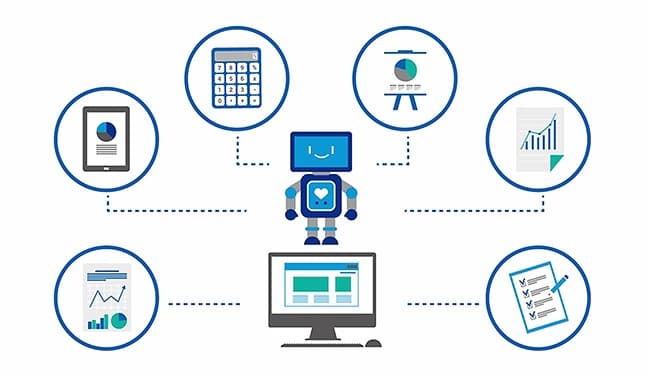
Companies all over the globe are at the cusp of the Industrial Revolution 4.0. In this age of digital transformation, the whole idea of running a successful enterprise is based on superior customer service. It is inevitable that new and better channels of customer service will rise as the volume of customer demands grow.

Chatbots are an
exceedingly sought-after technology that enterprises utilize for front end
customer service. These bots can be found on websites and social media pages of
nearly every business. Chatbots provide instant automated responses to
customer’s routine issues. The customer deals with the live service agent only
if the bot is unable to resolve the issue. Thus, an efficient problem
resolution mechanism is developed. There are three other benefits of using
chatbots;
Round the clock customer service along with minimized response time.
Valuable data is gathered from customer queries that can be used to produce automated answers when the same question (or similar) is reencountered.
Human counterparts in the customer service department can be engaged in more challenging and value-based tasks.
RPA (Robotic Process
Automation) is yet another type of bot that companies are employing to enhance
their customer service. However, there is an essential difference between these
bots.
RPA bots automate repetitive tasks in several domains such as finance, accounting, operations, HR, and IT. They save time spent on hundreds of clicks for performing a single task repetitively. RPA bots are being used to automate processes like searching client databases, filling out paperwork, processing insurance claims, etc.
An amalgamation of RPA and Chatbots
RPA bots work through
the user interface in the same way a human worker does. This makes it quite
easy to combine RPA with chatbots to help when dealing with complex and unique
customer issues. Hence, the integration of chatbots with the RPA bot is
indispensable. The combined forces of RPA bots and chatbots ensure a seamless
customer service experience and give birth to 'The Super Chatbot'.
The chatbots trigger
the RPA bot to execute specific tasks when required by the customer. The RPA
bot, already integrated with various back-end applications and databases, can quickly
retrieve the information requested by the chatbot. The chatbot answers the
customer through text or voice message. This internal process flow is lightning
fast, and hence, the issue is resolved quickly and efficiently. Here is an
example to help you understand how this process works:
You ask the chatbot
about sending your new vehicle for servicing. The chatbot asks for your
vehicle's registration number. After you have entered the number, the chatbot
triggers the RPA bot to take necessary actions.
The RPA bot will
instantly:
Extract customer details using the registration number.
Find the nearest authorized service center.
Generate a service reservation code.
Send you a confirmation email with all the necessary details of your vehicle's service reservation.
Provide the necessary information to the chatbot, which helps it to conclude the conversation.
The chatbot informs you
that an email has been sent which contains all the details of the service center
and timing of service reservation. This concludes the chat and your issue is
resolved within a minute or two.
This is a small example
to demonstrate the efficacy of the combination of RPA bots with a chatbot.
Today, these technologies are used together to handle much more sophisticated
customer issues without any human contact. Companies can create reliable
self-service channels and humans involved in the customer service department
are freed up for highly complex tasks rather than tedious paperwork. RPA bots
and chatbots are here to revolutionize the customer service experience of our
digital age.
What Next?
Businesses globally are already undergoing disruption due to ongoing digital transformation initiatives, and customer service is one of the most rapidly evolving aspects. Leveraging this tide of innovation is crucial for the future of any growing business. How exactly? To find out, register now for Nividous’ upcoming webinar on 30 May, at 1 PM EDT.