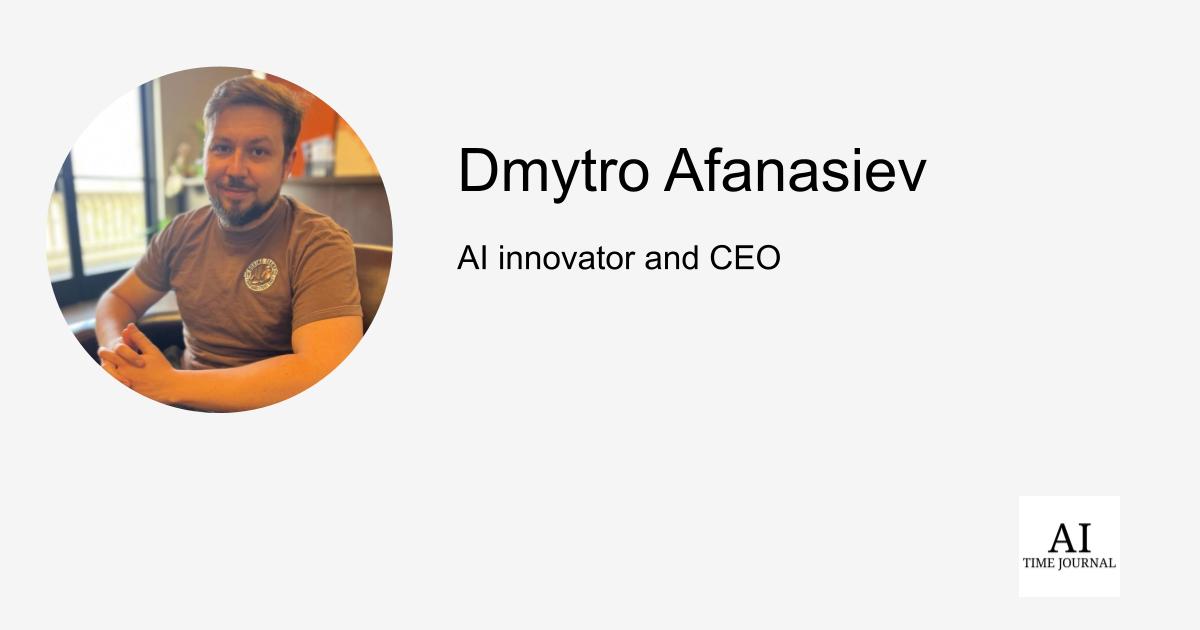
Dmytro Afanasiev, AI innovator and CEO, on why empowering humans, not replacing them, is key to real business impact.
Artificial intelligence has had a fascinating journey in the business environment since 2018. Back then, cutting-edge companies started experimenting with business process automation, but most implementations were limited to simple algorithms and basic forms of machine learning. After the explosive growth in implementations and generous investments, 2021-2023 saw a phase many experts call the "AI Disappointment." Companies that invested millions in AI-based automation found that the technology didn't always live up to expectations: ROI (Return on Investment) was lower than predicted, implementation was more complex than imagined, and some systems designed to replace humans entirely created new problems instead of solving old ones.
This journey has been closely observed by entrepreneurs like Dmytro Afanasiev, who began applying AI elements in his projects as early as 2017 with the creation of Dentist24.online - a SaaS system for dental clinics. Afanasiev, founder of several successful technology companies and developer of an innovative system for optical recognition, verification, and unification of seamen's documents (patent filed in 2021, with approval expected in summer 2025), has witnessed AI's evolution from experimental technology to mainstream implementation.
According to Gartner's 2024 Hype Cycle for Artificial Intelligence report, about 60% of large companies that invested in Generative AI - algorithms that can create new content including text, images, audio, and video based on training data - in 2022-2023 did not achieve the expected ROI due to the wrong approach to implementing the technology. That said, IDC predicts that global AI spending will reach $300 billion by 2026, but the focus will shift from full automation to integrating human experience with the benefits of AI.
Today, in 2025, we are seeing a shift to a more mature understanding of AI's role in business. The key question becomes not "How can we replace humans with machines?" but rather "How can we use AI to empower humans?" This shift from pure automation to augmentation—using technology to extend or enhance human capabilities rather than replace humans—is defining a new phase of digital transformation.
"Automation and augmentation are fundamentally different approaches. In the first case, we try to exclude humans from the process. In contrast, in the second case, we amplify their capabilities and make them more efficient," explains Afanasiev. His current project, Seamensway, where he serves as CEO and co-founder, and the Crew Management System platform his team is developing, embody the principles of augmentation in maritime recruiting, demonstrating how AI can augment, not replace human expertise.
Anatomy of "AI Disappointment"
The period of "AI disappointment," which occurs after the initial wave of enthusiasm for introducing artificial intelligence, has objective reasons. As Dmytro Afanasiev points out, based on his experience working with various industries, many companies face the same problems when implementing AI technologies.
"Most organizations approach AI from the position of full automation, seeking to replace people with algorithms. But practice shows that the technology is not yet ready to fully take on complex tasks, especially those that require contextual understanding and decision-making under uncertainty," explains Afanasiev.
In his work with maritime recruitment and training, Afanasiev examines the processes of AI implementation in companies of different sizes. His approach is based on real cases from his extensive experience in both the maritime and SaaS industries.
"The human factor is critical to the success of AI projects. When we exclude people from the process and rely entirely on algorithms, we lose the tacit knowledge and experience gained through years of practice. This knowledge cannot be fully formalized and transferred to a machine," Afanasiev notes.
According to the 2024 MIT Technology Review, companies using an augmentative approach to AI are, on average, 37% more effective at improving productivity than those seeking full automation. Augmentation allows for the retention of uniquely human qualities—intuition, creativity, and ethical thinking—complemented by AI's computational power and analytical capabilities.
Working on automation projects in maritime recruitment, Afanasiev has developed an approach to task assessment that determines where full automation is more effective and where augmentation is more effective. This approach considers industry specifics, task complexity, potential risks, and the need for human expertise.
"Not every task requires full automation. Sometimes it is much more effective to use AI as a tool that empowers humans and makes their work more productive, but it leaves key decision-making to them," Afanasiev emphasizes.
This approach allows companies to avoid disappointment from AI implementation, as it sets realistic expectations and focuses on creating real business value rather than implementing technology for technology's sake.
The augmentation approach in practice: Tweendeck and maritime recruitment
The augmentation theory comes to life in Afanasiev's current project, Tweendeck, which was developed within his company, Seamensway. The platform addresses recruiting challenges in the maritime industry, a sector critical to the global economy and logistics.
"The maritime industry is facing a serious skills shortage. According to the International Chamber of Shipping, the world will need around 89,510 additional new officers for ships by 2026. At the same time, recruitment processes remain highly inefficient, with a lot of paperwork and a high risk of errors," Afanasiev notes.
The CMS (Crew Management System) combines several advanced technologies to solve these challenges:
- A computer vision-based optical document recognition system for automated data entry from maritime certificates
- Document verification algorithms, including verification through international certificate registries
- Predictive analytics to assess candidate eligibility for position requirements
- Certificate validity monitoring and training planning systems
The key innovation of this platform is its ability to accelerate the processing of seafarer data by 70% compared to similar solutions, using a combination of computer vision, AI, and unique software algorithms. This represents a significant improvement in efficiency for an industry that has traditionally relied on manual document processing.
Importantly, the platform does not replace recruiters but significantly expands their capabilities. It takes care of routine tasks - processing paperwork, verifying certificates, monitoring deadlines - leaving it to humans to make final hiring decisions where experience, intuition, and understanding of candidates' soft skills are needed.
The results speak for themselves: Seamensway has experienced 3500% growth in its first year and has trained and certified nearly 10,000 seafarers, which represents approximately 10% of all active seafarers in Ukraine.
This practical application demonstrates the benefits of an augmentation approach: instead of trying to fully automate the process, AI acts as a tool to empower human experts, leading to better results with less risk. In addition to his practical work, Afanasiev has contributed to academic research on the digital transformation of maritime logistics. His scientific article, "Big Data as a Tool for Increasing the Efficiency of Maritime Logistics Processes," explores how advanced data analytics and digital technologies can enhance operational efficiency, reduce costs, and improve forecasting accuracy in global shipping. This academic perspective further reinforces the practical solutions implemented through Tweendeck CMS.
From maritime expertise to technical innovation
Afanasiev's path to creating Tweendeck is grounded in his extensive experience in the maritime industry. Before founding Seamensway in 2020, he co-founded and led Crew Recruitment Services (2007-2019), which became one of the largest private recruitment companies in Ukraine and the only one with the right to employ Filipino seafarers.
This deep industry expertise proved invaluable when developing technological solutions. With Crew Recruitment Services, Afanasiev and his team managed to place over 10,000 seafarers on international vessels, giving them unique insights into the complexities of crew qualification, document verification, and the challenges of matching the right seafarers with the right vessels.
"Understanding the specific pain points of the industry from the inside was crucial for developing effective AI solutions," says Afanasiev. "The maritime sector has its language, regulations, and workflows that would be difficult to grasp without direct experience."
His earlier experience creating SaaS platforms for dental clinics (Dentist Plus from 2015-2017 and Dentist24.online from 2017-2020) provided the technical foundation for developing sophisticated software solutions. These previous ventures, though in a different vertical, allowed him to develop expertise in building scalable architecture, creating user-friendly interfaces, and implementing subscription-based B2B software products.
The combination of deep maritime industry knowledge and software development expertise uniquely positioned Afanasiev to address the inefficiencies in the seafarer recruitment and certification process. As he transitioned from managing Crew Recruitment Services to founding Seamensway in 2020, he brought with him a comprehensive understanding of both the challenges faced by the industry and the potential for technological solutions to address them.
Ethical dimensions of augmentation
Unlike full automation, which often raises questions about job loss and depersonalization of labor, the augmentation approach has other ethical dimensions that require attention. As Dmytro Afanasiev points out, when developing augmentation solutions, several fundamental ethical considerations must be taken into account:
- Transparency of algorithms - the user should understand what the AI recommendations are based on
- Equality of access - technologies should be available to different categories of users
- Preservation of human autonomy - humans should retain the right to make the final decision
- Data protection and privacy - especially important when handling seafarers' personal information
"In the US, the ethical aspects of AI adoption are fundamental due to strict regulatory requirements and high public awareness of digital rights. Any AI-based solution implemented in the US market must meet not only technical but also ethical standards," Afanasiev notes.
In 2024, the US adopted new requirements for algorithm transparency and assessment of their impact on society and business. This makes the augmentation approach particularly relevant, as it involves maintaining human control over the decision-making process. For Afanasiev, whose Tweendeck platform aims to expand into international markets, including the United States, adherence to these ethical standards is a key consideration in his product development strategy.
The future of human-machine symbiosis
Drawing on his experience implementing AI in the maritime recruitment industry, Afanasiev predicts that by 2030, augmentation technologies will significantly transform the labor market. Educational systems will develop the skills that machines cannot: critical thinking, creativity, and emotional intelligence.
New professions are already forming at the intersection of traditional industries and AI: specialists in teaching industry-specific AI systems, human-machine interaction analysts, and ethical AI consultants. This confirms the trend: AI is not so much replacing existing professions as creating new specializations.
For businesses seeking to implement augmentation approaches effectively, Afanasiev offers four recommendations based on his experience with successful implementations:
- Start with a clear business goal rather than technology - identify specific business problems that need to be solved, and only then select technology tools
- Involve end users at all stages of implementation - consider the needs and experience of those who will work directly with the system
- Develop employees' digital skills in parallel with technology implementation - provide the necessary training and support for effective use of new tools
- Create a culture where technology and people complement each other - create an organizational environment where both technological innovation and unique human qualities are valued
The Tweendeck platform exemplifies this philosophy, offering an end-to-end solution for maritime recruiting that combines the automation of routine processes while retaining human control over key decisions.
"The true purpose of artificial intelligence is not to replace humans but to unlock their potential," Afanasiev emphasizes. "In a world where technology is becoming more and more advanced, it is human qualities - empathy, intuition, creative thinking - that acquire the highest value. The future belongs to those who create a harmonious symbiosis between human and artificial intelligence."
The augmentation approach is not just a technology trend but a new philosophy of digital transformation that puts people at the center and uses technology to empower rather than replace them. In this philosophy, companies that have overcome the "AI disillusionment" are finding a path to sustainably and effectively integrate artificial intelligence into business processes. As Afanasiev demonstrates through his work with Seamensway and Tweendeck, when AI is designed to complement human capabilities rather than replace them, both technology and humanity can reach their full potential.