
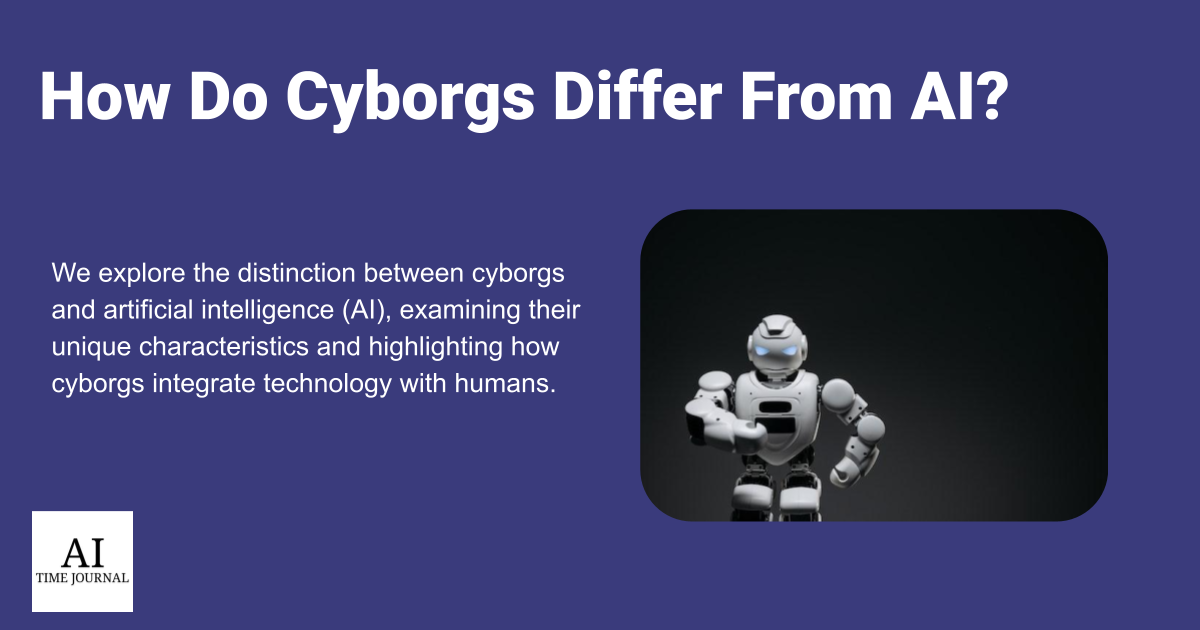
As we delve deeper into the realms of advanced technology and science fiction. It becomes an increasingly tangible reality; it is important to define and distinguish key concepts. Among these are "cyborgs" and "artificial intelligence" (AI). These two terms are often used interchangeably but represent very different ideas. Understanding the nuances that separate cyborgs from AI is crucial. For analyzing their potential impact on society and humanity's future.
Cyborgs are biological entities enhanced with artificial parts. Possessing physical existence and human consciousness. They retain autonomy and typically have a human lifespan. In contrast, AI is software that mimics human intelligence, lacks a physical form or consciousness, and can operate indefinitely within its hardware. AI learns through algorithms, while cyborgs learn like humans, potentially augmented by technology. Read on as we explore how Cyborgs differ from AI.
Definition of Cyborgs and AI
Cyborgs
The term "cyborg" is short for "cybernetic organism". Typically refers to a being that integrates both biological and artificial components. The concept of a cyborg is used to address situations. Where an organism has restored function or enhanced abilities. Due to the integration of AI or technology that relies on some feedback.
The broad application of the term "cyborg" is influenced by how humans perceive their engagement with technology. In a sense, one could deem a person a cyborg if equipped with implants. Like artificial heart valves, cochlear implants, or insulin pumps.
Moreover, the label 'cyborg' could also extend to individuals utilizing particular wearable technologies. Such as Google Glass, or those who depend on laptops or mobile devices for their daily tasks. The spectrum of what constitutes a 'cyborg' is thus vast, stretching from the medically enhanced to the digitally connected.
Artificial Intelligence (AI)
Artificial intelligence embodies the imitation of human cognitive functions. Through machines like computer systems, noteworthy uses of AI encompass expert systems, natural language understanding, etc. With the escalating buzz around AI, providers have been in a rush to highlight their AI-enabled products and services.
However, oftentimes, what's referred to as AI is merely a component of broader technology, such as machine learning. For AI to function, it necessitates a solid foundation of specialized hardware. And software to write and train machine learning models. While there's no programming language that is exclusively associated with AI, Python, R, Java, C++, and Julia. Are favored by AI developers due to their suitable features.
In essence, the core difference between cyborgs and AI is that cyborgs are originally organic beings. Enhanced or restored with technology. AI represents entirely synthetic entities designed to simulate human processes. This difference has significant implications when considering aspects like rights, consciousness, and ethical considerations.
Similarities between Cyborgs and AI
Despite their differences, cyborgs and artificial intelligence (AI) do share some common ground:
- Technological Integration: Both cyborgs and AI represent the integration of technology into aspects associated with biological entities. For cyborgs, this takes the form of physical enhancements or replacements. While for AI, it is the simulation of human cognitive processes.
- Enhancement of Capabilities: Both concepts aim to extend or augment capabilities beyond biological limitations. Cyborgs use artificial components to augment physical capabilities or compensate for a loss of function. In contrast, AI seeks to extend cognitive capabilities and processing large volumes of data.
- Ethical and Societal Implications: The integration of both cyborgs and AI into society carries significant ethical and societal implications. Questions around personal identity, privacy, and the definition of life itself arise in both cases. Similarly, both bring up concerns about technological dependence, equity, and potential misuse.
- Science and Speculation: Both cyborgs and AI have been subjects of science and speculative fiction for many years. Reflecting societal hopes and fears about the future of technology.
- Continuous Development: The fields of both AI and cyborg technology are in continuous development. Driven by advancements in related areas such as robotics, machine learning, bioengineering, neuroscience, and computer science.
- Potential for Synergy: While distinct, there is a potential synergy between AI and cyborg technology. For example, AI can be used to improve the functionality of the artificial components that a cyborg might use, and, conversely, cyborg technology could provide a platform for AI operations beyond traditional computers.
Differences between Cyborgs and AI
While cyborgs and artificial intelligence (AI) share similarities, several fundamental differences exist.
- Physical Form a. Cyborgs: By definition, cyborgs are organisms enhanced or restored with artificial components. They have a physical form that is partly biological, like a human body, and partly artificial, like a prosthetic limb or a cochlear implant. b. AI: In contrast, AI does not have a physical form, it exists within computer systems and software. While an AI can control physical objects, like a robotic arm or a self-driving car, the AI itself does not inherently have a physical presence.
- Human Element a. Cyborgs: The very concept of a cyborg implies the presence of a human or organic element, augmented or repaired by technology. This means that a cyborg, in most traditional uses of the term, has a human consciousness and subjective experiences. b. AI: AI, however, is entirely machine-based. Although it simulates human intelligence, it does not have human consciousness or subjective experiences. It does not have feelings, needs, or personal experiences.
- Consciousness and Autonomy a. Cyborgs: As cyborgs have a human or organic basis, they retain the consciousness and autonomy of the original organism. They can make decisions based on their subjective experiences and desires. b. AI: On the other hand, AI systems operate based on pre-defined programming and learning algorithms. They can make decisions, but only within the parameters set by their programming and learned patterns. As of 2021, they do not possess consciousness or personal autonomy.
- Origin and Development a. Cyborgs: The development of a cyborg involves the modification of an existing organic organism. It's a combination of biological evolution and technological intervention. b. AI: Conversely, AI is entirely a product of technological development. It's developed from the ground up using programming languages, machine learning algorithms, etc.
- Lifespan a. Cyborgs: The lifespan of a cyborg is typically tied to the biological lifespan of the organism. Although some artificial components might have different lifetimes. For instance, a prosthetic limb might need replacement or repair over time. But the human part of the cyborg is subject to the usual biological aging and lifespan. b. AI: AI systems, on the other hand, do not have a defined lifespan in the same sense. They can continue to function as long as they have access to operational hardware and the necessary electricity. And their 'lifespan' can potentially be indefinitely extended through updates and upgrades. However, they can become obsolete as technology advances.
- Learning Mechanisms a. Cyborgs: Learning for a cyborg, assuming a human base, remains largely an organic process. Albeit potentially augmented by artificial components. This might include traditional learning methods like reading or practical experience. But could also involve more direct methods of information acquisition if the cyborg has. b. AI: AI systems learn through a variety of machine learning algorithms. Which are fundamentally different from human learning. These algorithms learn by detecting patterns in data, and they require large amounts of data to learn effectively. While they can learn and adapt based on the data they process. They do not 'understand' information in the same way a human or a cyborg might.
Advantages of Cyborgs
Cyborgs harmoniously blend biological and technological elements, presenting an array of prospective benefits.
- Physical Enhancements: Cyborg technology can enhance or replace human physical capabilities. For example, a prosthetic limb could be stronger or more durable than a biological one. Enabling the individual to perform tasks that a normal human couldn't. Similarly, sensory augmentation devices could enhance human senses. Giving cyborgs the ability to see, hear, or feel beyond the normal human range.
- Cognitive Enhancements: Cyborgs could potentially benefit from improved memory, faster processing speeds, etc. For instance, a brain-computer interface could enable a cyborg to access and process information directly from the internet. Enhancing their cognitive abilities significantly.
- Increased Resilience: Cyborgs could potentially have greater resilience than ordinary humans. Artificial components could be more resistant to damage, require less maintenance, or be easily repaired or replaced if damaged. This could extend to increased resistance to disease and extreme environments. And the aging process, potentially extending the cyborg's lifespan.
- Adaptive Abilities: Cyborgs could potentially adapt to a wider range of environments and tasks. For instance, they might be able to survive in extreme conditions like space or deep sea. Or adapt to different jobs or tasks by installing different modules or upgrades.
- Continuous Upgrades: As technology continues to evolve, cyborgs could be continuously upgraded to benefit from the latest advancements. This could keep them at the forefront of capability and performance. And allow them to adapt to changing circumstances.
Disadvantages of Cyborgs
While cyborgs offer several potential benefits, there are also significant disadvantages and challenges that need to be considered:
- Societal Acceptance: As with any radical change or advancement, there can be societal pushback and a lack of acceptance toward cyborgs. This could result in social exclusion, discrimination, or stigmatization.
- Ethical Concerns: The concept of merging humans and machines raises a host of ethical questions. These include issues related to personal identity, human enhancement, and the definition of what it means to be human. And potential inequities between cyborgs and non-enhanced humans.
- Health Risks: Incorporating artificial components into the human body could lead to health complications. Ranging from physical issues at the site of integration to broader concerns, such as the body's immune response to foreign objects. In addition, any technical failure of the artificial components could have serious, even life-threatening, consequences.
- Dependence on Technology: Cyborgs are partly made up of technological components. They may become reliant on those technologies to function. This could lead to issues around access to updates, maintenance, power sources, and potential cybersecurity risks.
- Psychological Impact: The transition to becoming a cyborg could have psychological impacts. There could be challenges related to identity, self-perception, and mental health, especially if the transformation is significant.
- Regulation and Legal Status: Given the blending of humans and machines. The legal status and rights of cyborgs could be a complex and unresolved issue. This could potentially lead to legal complications and vulnerabilities.
- Economic Implications: The process of becoming a cyborg and maintaining the enhancements could be costly. This may limit who has access to these technologies and could exacerbate social inequalities.
Conclusion
Cyborgs and AI both embody technological advancements. Have distinct attributes rooted in their inherent natures. Cyborgs, combining the biological with the artificial, exist physically. While AI, born from advanced programming and algorithms, exists as intangible entities within computing systems. A key distinction is the presence of a human aspect in cyborgs, absent in AI despite its capability to mimic human cognition.
Moreover, cyborgs preserve human consciousness and decision-making. Unlike AI which operates based on pre-determined programming and lacks personal consciousness or autonomy. Despite both pushing the boundaries of technological potential. Cyborgs and AI are fundamentally distinct in their make-up, capabilities, and implications. Acknowledging these differences is crucial for comprehending their potential impacts and related ethical issues.