
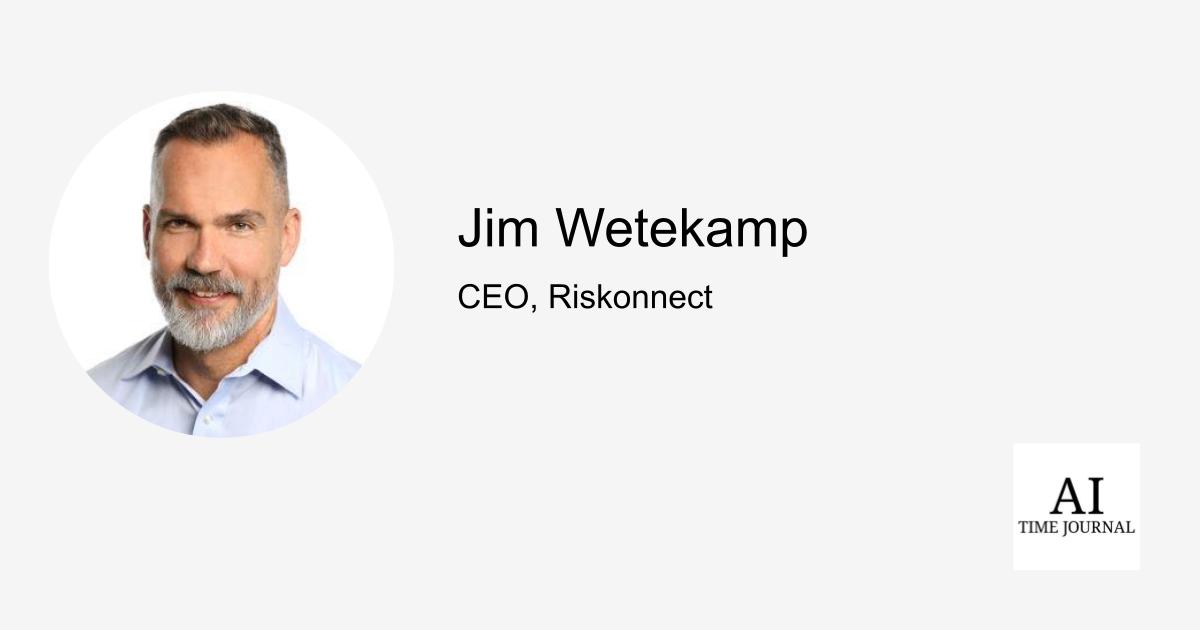
Executive Summary. As risk becomes faster and more interconnected, traditional periodic review models are breaking down. In this conversation, Riskonnect CEO Jim Wetekamp explains why enterprise risk management is emerging as a key proving ground for AI, and how integrated data, agent-based workflows, and governance-first design are shifting organizations from retrospective reporting to continuous risk orchestration in regulated environments.
Enterprise risk management is entering a structural transition. As organizations adopt AI across core operations, the velocity and interconnectedness of risk have begun to outpace traditional control models built around periodic reviews and functional silos.
In this interview, Jim Wetekamp, CEO of Riskonnect, outlines why risk has become one of the most demanding and consequential domains for enterprise AI. He explains how the company’s Intelligent Risk Framework and agent-based architecture embed domain-specific intelligence directly into risk workflows, enabling continuous monitoring, prioritized response, and stronger organizational resilience.
Wetekamp also examines the governance implications of more autonomous systems, arguing that integrated data, auditable outputs, and human accountability remain essential as enterprises move toward what he describes as Connected Risk Intelligence.
AITJ: Jim, as enterprise leaders rethink how they manage risk in an AI-driven environment, where are traditional assumptions about risk starting to break down?
Traditional risk management assumed that risks could be identified, categorized, and reviewed on a predictable schedule. Annual assessments, quarterly updates, and siloed ownership structures were considered sufficient.
That model no longer holds. Risk now evolves in real time and rarely stays confined to one function. A cyber vulnerability can quickly trigger compliance exposure. A third-party disruption can simultaneously affect operations, revenue, and reputation. The interconnected nature of modern enterprises means risks compound faster and in ways single-function reviews cannot anticipate.
The core assumption that risk can be managed through periodic review is no longer realistic. Organizations need continuous visibility, integrated data, and faster response cycles to match how risk actually behaves.
Risk now evolves in real time and rarely stays confined to one function.
Jim Wetekamp
That gap between how risk is perceived and how it actually behaves seems to be widening. Why has risk management become such a critical proving ground for enterprise AI right now?
The scale and velocity of risk data have outpaced manual processes. Boards expect timely insight, regulators demand stronger controls, yet many organizations still rely on spreadsheets, fragmented systems, and retrospective analysis.
AI can continuously process structured and unstructured data, detect patterns, flag anomalies, and surface prioritized recommendations as conditions change. This enables faster, more informed decisions under uncertainty.
Risk management also operates under low tolerance for errors. Every recommendation must be traceable. Every action must be documented. Every decision must withstand regulatory and board review. When AI performs under these constraints, it proves its value in one of the most demanding environments in the enterprise.
Riskonnect recently announced its Intelligent Risk Framework. At a high level, what does this framework enable that traditional risk systems simply couldn’t?
Most traditional risk platforms operate as systems of record. They centralize data, document controls, and generate reports. They rely on people to interpret insights and decide what to do next.
The Intelligent Risk Framework embeds AI directly into workflows across the enterprise, including RMIS, GRC, resilience, claims, compliance, and third-party risk. By connecting enterprise-wide risk data with contextual, domain-specific intelligence, it enables real-time analysis and action inside the system.
Organizations move from retrospective reporting to proactive risk orchestration, continuous monitoring replaces periodic assessments, insights include recommended next steps, and actions can be triggered automatically within existing processes.
The framework doesn’t just improve visibility into risk, it transforms how risk is anticipated, prioritized, and managed across the enterprise.
Organizations move from retrospective reporting to proactive risk orchestration
Jim Wetekamp
You’ve described this evolution as a move toward “Connected Risk Intelligence.” What does that concept mean, and why is connectivity so essential to making AI useful in risk and compliance?
Risk does not exist in isolation, yet many organizations still manage it that way. Cybersecurity, compliance, third-party risk, claims, and resilience often operate in parallel systems. That structure fails when a single event can cascade across the enterprise in hours.
A vendor issue can trigger regulatory exposure. A cyber incident can evolve into operational disruption and reputational damage. A control breakdown in one function can create financial and strategic consequences elsewhere. When risk data is fragmented, leaders only see partial impact. Decisions become reactive because there is no unified view.
AI will not solve structural silos. Without integrated data and workflows, intelligence simply reinforces blind spots. AI must operate across integrated data, shared workflows, and aligned governance structures. Only then can it assess how risks interact, prioritize actions based on enterprise impact, and support decisions that reflect how the business actually operates.
The framework is built on an agent-based platform. How do autonomous agents change where intelligence lives in the enterprise—and how risk decisions are actually made?
Agent-based architecture embeds intelligence directly into current operational workflows. Agents continuously monitor data, evaluate risk conditions, and generate recommendations within established processes.
These agents are purpose-built for risk environments. They understand insurance structures, compliance requirements, control frameworks, cyber terminology, and claims processes. That domain specificity improves the relevance of outputs and reduces noise.
Decision authority remains with risk professionals, but what changes is the timing and context. Instead of waiting for periodic reviews, teams receive prioritized guidance as risk conditions evolve.
Risk and compliance demand a much higher standard of trust than most AI applications. How do you think about balancing autonomy with human oversight, accountability, and governance?
AI in risk management operates in a high-stakes environment. Recommendations must be grounded in evidence, actions must stand up to scrutiny, and governance must be rigorous and transparent.
Governance is not optional, yet adoption is outpacing oversight. Forty-two percent of companies lack policies governing employee use of AI and 72% have no policies for partner or supplier AI use. On top of that, 75% do not have a plan for emerging risks like deepfakes or AI-driven fraud.
Organizations must build governance into AI from the start. Autonomy can accelerate monitoring and decision-making, but only within defined guardrails. Policies, escalation protocols, and oversight mechanisms must be clear and enforced. Recommendations and outputs must be transparent and auditable, while humans maintain ultimate authority over critical decisions.
Automation should handle repetitive tasks, enforce controls, and surface high-risk areas. Humans make the final call and evaluate outcomes. Continuous monitoring, clear policies, and cross-functional oversight ensure AI operates safely and in alignment with organizational and regulatory expectations.
Where are organizations already seeing real, measurable impact from AI embedded directly into risk workflows—not just better insight, but better decisions in real time?
Organizations are reducing response times in areas such as incident intake, claims triage, and third-party risk monitoring with the help of AI. Automated classification and prioritization allow teams to focus on high-impact issues sooner.
Continuous control monitoring is replacing point-in-time testing. This improves detection of gaps and reduces compliance surprises. Executive reporting is more timely because insights are generated from live, integrated data.
Outcomes include shorter remediation cycles, fewer unexpected control failures, and improved visibility into enterprise risk posture.
Compared to AI use cases in sales, marketing, or customer experience, what makes enterprise risk such a distinct and demanding domain for AI?
Risk management operates under tighter constraints. Errors carry financial, regulatory, and reputational consequences. AI outputs must be explainable, auditable, defensible, and aligned with governance frameworks while protecting sensitive data.
The combination of speed, accountability, and complexity makes AI in risk more demanding than other enterprise applications. When implemented effectively, it strengthens resilience, oversight, and decision quality across the organization.
As AI becomes more autonomous, what cultural or operational shifts do risk teams need to make in order to fully realize its value?
Risk teams need to move from documenting risk to actively orchestrating response. That requires collaboration with IT, security, compliance, and business leadership.
They also need a governance-first operating model. AI outputs must be monitored, interpreted, and applied within defined policy and oversight frameworks. Organizations should formalize decision rights, define escalation protocols, train staff on AI risk, and continuously evaluate outcomes. Only with these foundations can autonomous AI deliver consistent, reliable value.
Looking three to five years ahead, what would success look like for autonomous AI in enterprise risk management—and what would tell you the industry took the wrong path?
Success means continuous, enterprise-wide visibility into risk exposure, with AI embedded in workflows to support faster and more accurate decisions. Teams remain accountable, outputs are auditable, and governance keeps pace with adoption. Decision cycles shorten, remediation improves, and risk is proactively managed across functions.
Failure looks like rapid AI deployment without integration, governance, or accountability. That increases complexity without improving outcomes and exposes organizations to compliance failures, operational mistakes, or reputational harm.