
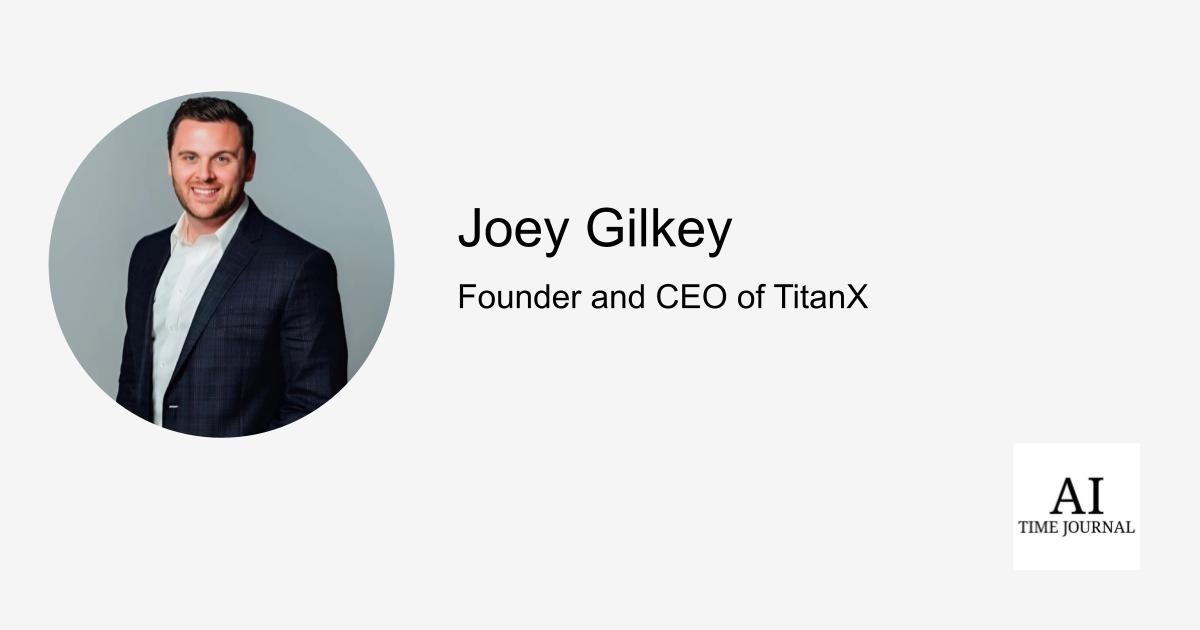
Executive Summary. TitanX Founder and CEO Joey Gilkey explains why sales organizations are shifting from activity-based outreach to intent-driven precision. He outlines how Phone Intent infrastructure, AI-powered behavioral signals, and channel restructuring are redefining SDR productivity, connect economics, and the future division of labor between automation and human sellers.
As outbound channels saturate and connect rates decline, revenue leaders are rethinking the economics of pipeline generation. In this conversation, TitanX Founder and CEO Joey Gilkey argues that the traditional volume model has hit a behavioral ceiling. He explains how Phone Intent, predictive intelligence, and AI-driven decision layers are helping teams prioritize the right prospects, increase real conversations, and restructure outbound around human-to-human moments. The discussion highlights the emerging split between autonomous text channels and high-leverage phone engagement.
AITJ: Joey, outbound sales has long been driven by volume — more dials, more emails, more headcount. What fundamentally changed in the last few years that made that model break?
The math stopped working. For years, the industry's response to missing targets has been to dial more, using parallel dialers and power dialers to drive more volume. But we ran into a behavioral wall. The reality is that in any market, only about 20% of prospects will consistently answer cold calls. The other 80% won't pick up no matter how many times you dial.let
When you combine that fixed human behavior with the fact that outbound channels like cold email are now completely saturated and carriers are flagging calls as spam, the "volume" model collapses. Email is tanking, LinkedIn is throttling you and connect rates are collapsing across every channel. If 80% of your list was never going to answer, dialing them faster doesn't help, it just burns through your total addressable market (TAM) faster.
Now, I'm not saying those other channels are dead. But what happened is every channel got automated and saturated at the same time and the phone is the only one left that's still real-time and human. That's what changed.
You've framed this moment as the shift from "activity-based" to "intent-based" outbound. What does that shift mean operationally for a revenue leader?
It means you stop measuring effort and start measuring outcomes. The "do more with less" mandate is the biggest challenge in the market right now. Operationally, this shift requires moving away from the idea that "more dials equals more revenue."
Instead of forcing reps to make hundreds of blind dials, we shift the performance model. By identifying the 20% of people who actually answer, we shift a rep's reality from having one conversation every 30–50 dials to one conversation every few dials. We don't change where teams get their data; we just tell them who to call first. That is precision over volume.
But here's what most people miss: this isn't about going phone-only. It's about restructuring how work gets divided. The phone is where your human reps should live. It's the only real-time, human-to-human channel left, and it's the highest-leverage thing a rep can do. Email, on the other hand, should be centralized and automated. Marketing or AI should own your volume email (your sequences, nurture and mass outreach). Your reps should not be grinding out 200 templated emails a day. The only emails a rep should be writing are the handful of high-fidelity, one-to-one messages for strategic accounts, maybe with some AI assistance to help them craft those. Everything else is infrastructure, not rep activity.
So when I say "intent-based," I mean reps are having conversations on the phone with the right people, and the rest of the channels are systematized around them.
TitanX talks about "Phone Intent™" as predictive infrastructure rather than just another sales tool. How should executives think about that distinction?
Most tools help you do a task faster; infrastructure changes how the task is done entirely. TitanX is the first Phone Intent platform. We aren't just giving you a list of numbers; we are aggregating data across sources to build a behavioral profile per contact.
We use AI to turn unstructured signals into structured insights, determining if a number is accurate, active and, crucially, whether that prospect has the behavioral propensity to answer unknown calls. That is intelligence that simply doesn't exist anywhere else. It's the difference between a faster car (a dialer) and a better map (Phone Intent).
And here's the important thing: Phone Intent doesn't just tell you who to call. It organizes your entire outbound motion. If a prospect has high Phone Intent—call them. If they have low Phone Intent—multichannel them with more personalized touches across email, LinkedIn and voicemail. And if they have no intent or the data is bad—market to them, don't waste a rep's time dialing them.
So it's not "phone or nothing." It's a decision layer that tells you the right channel for the right person. The phone just happens to be the highest-converting channel for the people who will actually answer.
If AI can now predict who is likely to answer before a rep dials, how does that change the economics of SDR teams and pipeline generation?
It changes the unit economics of the rep. We have seen teams create 5x more conversations without adding headcount.
Look at Vanta, one of our customers. They were at 70% target attainment and needed to close the gap without hiring additional headcount. By making fewer dials but making the right dials, they went from 70% to 140% attainment. When you increase the output per rep that significantly, it fundamentally changes how you think about hiring and scaling. You no longer need an army to get a meeting.
It also changes what reps spend their time on. When phone becomes primary for distributed reps, they stop being part-time content producers sending mediocre bulk emails. That volume gets centralized into marketing automation or AI. Now a rep's job is conversations, real selling, and the handful of high-fidelity, handcrafted emails they write for strategic accounts actually matter because they're not buried under 200 templates they were forced to crank out.
What happens to the traditional metrics — call volume, touches per day, activity quotas — in a world where precision replaces brute force?
The phone-specific metrics get exposed for what they are: vanity metrics. If you are dialing the 80% of people who never answer, you are just busy, not productive.
The goal of TitanX is to stop teams from wasting time on that 80%. In a precision-based world, "dials per day" matters far less than "conversations per day." The metric shifts to efficiency: conversation rates, connect rates and pipeline per hour. We help teams prioritize, allowing them to drive results more efficiently rather than just activity.
Now, does a CRO still care about email engagement and LinkedIn metrics? Of course. But those should be tracked at the marketing and automation layer, not as individual rep activity metrics. When you centralize and automate email, you measure deliverability, open rates and reply rates as a system. You don't measure how many emails a rep typed today. The rep metric becomes: how many conversations did you have and what did you do with them?
You've claimed connect rates in the 20–30% range compared to the industry's 3%. Beyond the headline number, what structural changes occur inside a sales org when those connect rates shift?
It solves the morale and burnout crisis. Dialing into the void destroys a rep's soul. When you shift from a 3% connect rate to a 20–30% rate, reps are actually doing the job they were hired to do: selling.
It also stabilizes forecasting. When Vanta increased their pipeline from the phone from 8% to nearly 40%, it wasn't just about more deals; it was about diversification and control. You stop relying on luck and start relying on a predictable flow of conversations.
And there's a compounding effect: when reps are having real conversations instead of leaving voicemails all day, they get better at selling faster. They develop skills that actually matter. You can coach on real calls, not hypotheticals. The whole development flywheel accelerates.
The acquisition of FrontSpin brings dialing infrastructure together with predictive intelligence. Why was owning both layers — prediction and delivery — strategically important?
The original solution we built was powerful, but we had to invest heavily to productize it into software that was fast and scalable. Owning the infrastructure allows us to close the loop. If we provide the intelligence on who to call, but the delivery mechanism, the dialer, is inefficient or disconnects that data from the workflow, we lose precision. By integrating prediction with delivery, we ensure that the "lens" of decision-making—does this move us toward the outcome?—is applied to every single dial.
FrontSpin also brings something critical on the deliverability side. Call deliverability—making sure your number doesn't show up as spam, that you're rotating properly, that you're compliant—is half the battle. You can know exactly who to call, but if your call gets flagged before it rings, it doesn't matter. Owning both layers means we control the full chain from intelligence to execution.
How do you see outbound evolving as email and LinkedIn continue to lose effectiveness and buyers become harder to reach?
I'm not saying CROs should abandon email and LinkedIn. A CRO is running a full go-to-market motion across multiple channels. I get that. But here's where the restructuring happens.
The phone is the only channel where you can have a real-time, human interaction. It is by far the highest-leverage channel for a distributed team of reps. The research backs this up. Voice creates connection in ways that text simply cannot. That's not opinion; there are hormone studies showing that voice communication triggers oxytocin responses that text doesn't even register on. In a world where everyone is automating everything, a real human voice becomes the ultimate differentiator.
So what happens to email and LinkedIn? They get centralized and automated. Marketing owns volume email (sequences, nurtures and campaigns). AI writes and sends at scale. LinkedIn outreach follows the same path. The only written outbound your reps should be doing is the occasional high-fidelity, handcrafted email for a strategic account, maybe with some AI assistance to help them personalize it. That's it.
Your reps' job is conversations. Everything else is infrastructure. And Phone Intent is the operating system that tells them who to have those conversations with.
There's a broader enterprise trend toward AI-driven decision systems replacing human guesswork. Do you see outbound sales becoming more autonomous over time?
Absolutely. AI already plays a substantial role in how we work, specifically in aggregating data and building behavioral profiles.
But here's the nuance: the channels where AI replaces humans and the channels where it empowers humans are splitting apart. Email? AI is already writing and sending emails as well or better than most reps. That channel is going fully autonomous and that's fine. Let it. LinkedIn outreach? Same trajectory. These are text-based channels that AI can handle.
The phone is different. The future isn't about AI replacing the human on the phone; it's about AI replacing the human decision of who to call. We use AI to turn unstructured signals, like whether a number is active or accurate, into structured insights. This removes the guesswork so the human can focus entirely on the conversation.
That's the split: AI owns the decision layer and the text-based channels. Humans own the phone. And the companies that figure out that division of labor first will dominate.
What risks do companies face if they continue investing in high-volume outbound strategies while competitors move toward predictive precision?
They risk burning through their market and killing their efficiency. The "do more with less" pressure isn't going away. If your competitor is getting a conversation every 4 dials and you are getting one every 50, they will eat your lunch.
Parallel dialers and volume strategies come with tradeoffs: awkward pauses, bad prospect experiences and ultimately, burning through your TAM. You cannot efficiency-hack a behavioral problem with more volume.
And here's what people don't talk about enough: the damage compounds. Every bad experience—the robocall pause, the spray-and-pray email, the LinkedIn automation that reads like a bot—makes your brand a little more toxic in your market. Your TAM doesn't just get burned through; it gets burned.
For a CRO evaluating their 2026 GTM strategy, what is the first question they should ask about their outbound infrastructure?
The first question should be: "Where should my reps be spending their time versus what should be automated?"
And the answer, increasingly, is this: your reps should be on the phone with the right people. Period. Email should be centralized and automated—marketing and AI own that now. LinkedIn is headed the same direction. The few high-fidelity, handcrafted outbound messages your reps write for strategic accounts? Great, those matter. But that's 5% of written outbound, not 95%.
Then the follow-up question becomes: "Does my infrastructure help me identify the 20% of my market that actually wants to talk to us?" If the answer is no, you are building a strategy based on waste. I use a simple filter for decision-making: does this decision move us toward our outcome or not? If your infrastructure creates 80% waste by design, it's not moving you toward that outcome.
Five years from now, what will look outdated about how most companies build pipeline today?
The idea of "lists" based solely on firmographics (company size, industry and title) will look archaic. We will look back at the era of parallel dialers and "power dialing" the same way we look at the fax machine—clunky, inefficient and annoying.
We'll also look back at the era of individual reps manually writing hundreds of emails a day and wonder what we were thinking. That will be fully automated and it should be. The idea that you'd pay a human $75K a year to type emails that an AI can write better and faster will seem absurd.
The future is Phone Intent. We are building the category. In five years, the standard will be behavioral-based targeting: knowing not just who fits your ICP, but who behaves in a way that allows you to sell to them. And the reps who thrive will be the ones who are great on the phone, because that's the one channel that still requires a human.