
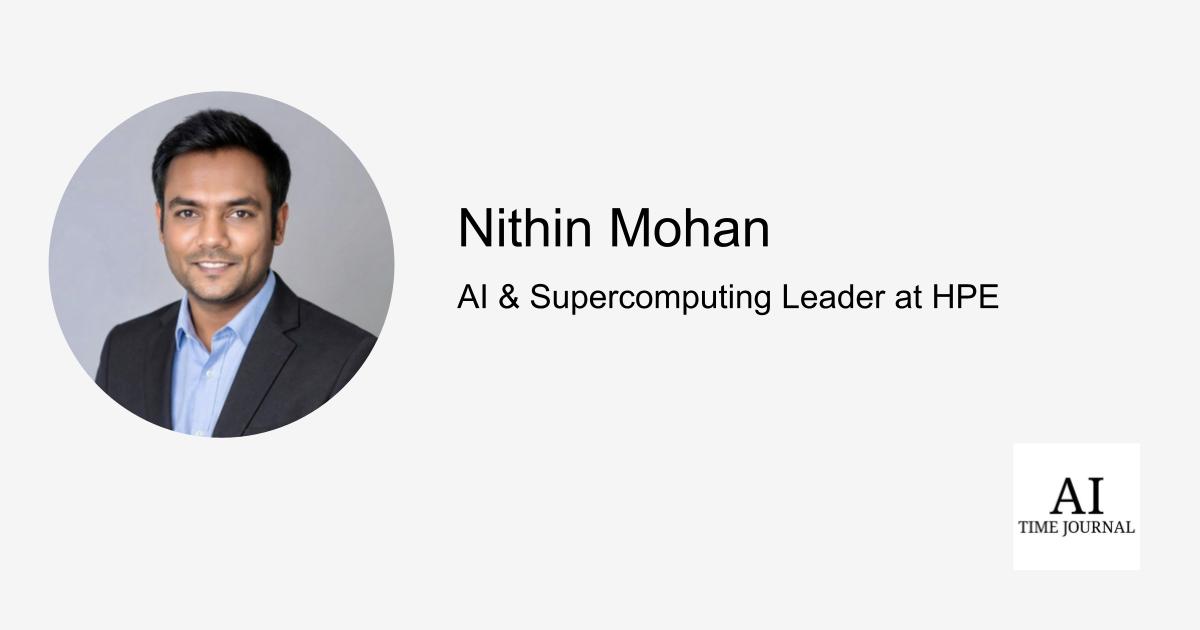
Executive Summary. As enterprises race to adopt AI, HPE leader Nithin Mohan explains why infrastructure, not algorithms, is becoming the real constraint. He outlines how exascale computing, agentic system reliability, and distributed AI operations are redefining what it takes to move from impressive demos to economically viable production systems.
As generative AI captures boardroom attention, the infrastructure required to run it at scale remains widely underestimated. In this conversation, HPE AI and Supercomputing leader Nithin Mohan explains why enterprise AI success increasingly depends on distributed systems discipline, exascale computing lessons, and governance built into the stack from day one. He outlines how agentic systems, data movement, and operational reliability are becoming the real battleground for AI in production environments.
AITJ: Nithin, enterprise leaders hear a lot about AI breakthroughs, but far less about the infrastructure required to make them real. From your vantage point, where does the conversation about AI and supercomputing still miss the mark?
Think about how closely these two moments sit next to each other. In November 2022, ChatGPT launched and created a global frenzy around what AI could do. Just months later, in 2023, humanity officially entered the exascale computing era. Frontier became the world's first verified exascale supercomputer, a system performing a quintillion calculations per second. TIME Magazine named it one of the best inventions of 2023 and quoted experts calling it our generation's moon landing equivalent. One event dominated every headline and boardroom conversation. The other, arguably just as consequential, barely registered outside the scientific computing community.
That disconnect is exactly where the conversation misses the mark. We talk about AI as though it's purely a software story. But exascale supercomputing represents a convergence of hardware innovation, networking architecture, and intelligent software that has to work together flawlessly. Frontier wasn't just a hardware milestone. It was a signal that the infrastructure layer had become the enabling force behind AI breakthroughs in drug discovery, climate modeling, and materials science. The two revolutions, generative AI and exascale computing, arrived at the same moment in history, and they are deeply connected. The models everyone is excited about need infrastructure at this scale to train, to run, and to operate reliably. Yet most of the conversation still treats infrastructure as an afterthought, a procurement exercise rather than a discipline that determines whether AI actually works in production.
And behind all of this is a set of engineering challenges that directly determine whether AI is economically viable at scale. Cooling, energy efficiency, operational reliability, these aren't back-office concerns. They are the unit economics of AI.
Most of the conversation still treats infrastructure as an afterthought, a procurement exercise rather than a discipline that determines whether AI actually works in production.
Nithin Mohan
At Hewlett Packard Enterprise, you work at the intersection of AI and supercomputing. Why is scale, compute, data movement, and reliability, becoming the defining constraint for enterprise AI?
Because the problems enterprises want to solve with AI have outgrown the infrastructure most of them have. Training a large language model or running inference at scale isn't a single-server problem. It's a distributed systems problem. You're coordinating thousands of GPUs across a high-speed interconnect, moving petabytes of data through a fabric that has to maintain microsecond-level consistency, and doing it all while keeping the system available around the clock.
As organizations scale their AI workloads, they run into the exact same challenges we've been solving in High Performance Computing for decades: data movement bottlenecks, interconnect reliability, job scheduling across heterogeneous hardware, thermal constraints. The lessons from exascale computing are directly transferable. The competitive advantage isn't in who has the best model. It's in who can run it reliably at scale.
The competitive advantage isn’t in who has the best model. It’s in who can run it reliably at scale.
Nithin Mohan
Agentic systems are moving from theory into production environments. How do you distinguish between agentic AI that looks impressive in demos and systems that actually hold up under enterprise-grade workloads?
The gap between a demo and production in agentic AI is enormous. I think about this constantly because my day job is essentially making AI systems work under the most demanding operational conditions on the planet.
Here's what I look for. Can the system recover from failure? In a demo, the agent handles the ideal scenario perfectly. In production, you find out what happens when it hits an ambiguous input, a degraded network link, a partially corrupted state. Does it degrade gracefully and escalate to a human, or does it spiral?
Then there's observability. If you can't trace what an agentic system decided, why it decided it, and what information it used, you don't have an enterprise system. You have a liability. The supercomputing community learned this decades ago. When a computation runs across thousands of nodes for weeks, you need forensic-level visibility into what happened and why. Agentic AI needs that same discipline, and most implementations I see don't have it yet.
Supercomputing has traditionally been associated with science and research. How is that changing as enterprises begin to adopt AI systems that require similar levels of performance and orchestration?
This shift is one of the most significant trends I've watched unfold over the past few years. Supercomputing used to be a niche discipline, a few hundred sites worldwide running weather models, physics simulations, genomics workloads. The TOP500 supercomputing list was the domain of national laboratories and research universities. That world still exists and remains critically important, but the boundary has blurred in ways that would have seemed unlikely a decade ago.
What happened is that AI workloads started demanding the same things supercomputing has always provided: massive parallelism, high-bandwidth low-latency networking, sophisticated job orchestration, and relentless focus on system reliability. When a financial services firm wants to train a risk model on a thousand GPUs, or a pharmaceutical company wants to run molecular dynamics simulations accelerated by AI, they essentially need supercomputing capabilities to serve such workloads.
You've helped take AI-driven products from early innovation to multi-million-dollar adoption. What tends to break when organizations try to operationalize AI without rethinking their underlying infrastructure?
Almost everything breaks, but it breaks slowly enough that people don't realize it until they're deep in. I've started calling this "prototype paralysis," where an AI initiative works beautifully in a sandbox with clean data and curated conditions but can never graduate to production because the infrastructure wasn't designed for it.
The data pipeline is usually the first thing to go. Organizations underestimate the engineering required to move real-world data, messy, incomplete, constantly changing, into a format that AI systems can consume at the speed they need it. In supercomputing, we obsess over I/O performance because we learned decades ago that the fastest processor in the world is useless if you can't feed it data fast enough. Most enterprises haven't internalized that lesson yet.
At exascale, you can't afford to discover a problem after it's already affected a computation that's been running for three days. That's not a hypothetical. That's a scenario I've planned around.
But the one executives miss most often is organizational readiness. The infrastructure isn't just hardware and software. It's who owns the model in production, who's accountable when it makes a mistake, who decides how to balance speed against governance. The infrastructure challenge is as much human as it is technical.
Observability, reliability, and governance become exponentially harder at scale. How should leaders think about trust and accountability when AI systems operate across thousands of nodes and autonomous components?
Trust at scale has to be engineered, not assumed. You can't build a system that operates across tens of thousands of nodes and bolt on governance later. It has to be foundational. Here's how I think about it from direct experience. Transparency comes first. Every decision the system makes needs to be traceable, and I don't just mean logged. You should be able to reconstruct the chain of reasoning from input to action.
Boundaries matter just as much. Autonomous doesn't mean unconstrained. The most robust AI systems I've worked on have clearly defined operational envelopes. They know what they're allowed to do, what requires human approval, and what they should never attempt. That's not a limitation. It's what makes the AI trustworthy enough to deploy on systems where downtime has national-scale consequences.
The hardest part is accountability. Someone has to own the AI system's behavior in production. Not the data scientist who trained the model. Not the engineer who deployed it. There needs to be an operational owner responsible for the system's ongoing behavior. In High Performance Computing, the system administrator has always filled that role for physical infrastructure. We need the equivalent for the AI layer, and most organizations haven't figured out what that looks like yet.
Trust at scale has to be engineered, not assumed.
Nithin Mohan
From a business perspective, where are you seeing large-scale AI infrastructure translate into real economic or competitive advantage today, not just experimentation?
Drug discovery and life sciences, without question. Consider the COVID-19 vaccine timeline: roughly 11 months from genome publication to emergency authorization, which was already considered miraculous. The computational steps in that process, mRNA sequence optimization, lipid nanoparticle formulation screening, aspects of clinical trial design, are exactly the kinds of problems that exascale AI accelerates by orders of magnitude. What took months of computational work during the pandemic could now take days on the systems I work with. The wet lab and regulatory timelines are a different story, but even compressing the computational phases fundamentally changes what's possible for pandemic preparedness.
The economic stakes are hard to overstate. Various estimates put global economic damage during peak pandemic months in the hundreds of billions. That's the GDP multiplier effect of having sovereign AI supercomputing capacity, and it extends well beyond any single health crisis.
Beyond life sciences, I see real competitive advantage showing up in energy exploration, financial risk modeling, and advanced manufacturing. These are domains where organizations investing in large-scale AI infrastructure aren't just experimenting. They're making decisions faster, with better information, at lower cost. The gap between organizations with serious AI infrastructure and those still running proof of concept is widening, and it's starting to show up in financial performance.
One point that doesn't get discussed enough: national competitiveness. Countries with significant presence on the TOP500 supercomputing list tend to lead on R&D output, patent generation, and high-tech exports. Part of that is because the same economic strength that funds supercomputing also funds research broadly. But the infrastructure itself creates a compounding effect, it attracts talent, accelerates discovery cycles, and builds institutional capability that's hard to replicate.
You've experienced both startup environments and global enterprises. What lessons from the 0-to-$1B startup journey carry over most directly into building AI systems inside large organizations?
Speed of iteration and willingness to fail fast and adapt.
The AI teams that succeed inside large enterprises are the ones that find ways to bring startup-like iteration speed into an environment that also gives you the resources, reach, and credibility to build something lasting. Small, empowered teams with clear ownership, operating within a larger ecosystem that can amplify their work. Defining success metrics upfront and staying honest about what's working. Leaning into AI-native development early. I've seen firsthand how generative AI tools can help a small engineering team punch well above its weight by automating repetitive work and accelerating prototyping. We leaned into this approach early, and it's been one of the reasons our team has been able to ship production AI software at a pace that matches the urgency of the problems we're solving.
The other lesson that transferred directly is building for the constraint you'll hit next, not the one you have today. In a startup, you learn fast that the thing that breaks your system is rarely the thing you optimized for. Same applies to enterprise AI. I've watched organizations pour enormous energy into model accuracy and then discover their real bottleneck was data pipeline latency, or deployment reliability, or the ability to retrain without taking the system offline. Bringing that anticipatory mindset into a large organization, where you also have the engineering depth to actually solve those next-order problems, is incredibly powerful.
For leaders navigating the future of work, how do AI and supercomputing change the skills and roles that matter most over the next decade?
The shift is already happening, and it's more fundamental than most workforce planning accounts for. We're moving from an era where technical execution was the bottleneck to one where the bottleneck is judgment. Knowing what to build, why to build it, and how to evaluate whether the AI system is actually doing what you intended.
The roles gaining importance are the ones at intersections. Engineers who understand both AI and distributed systems. Product leaders who can translate business needs into technical requirements while accounting for infrastructure constraints. Operations professionals who can manage AI systems with the same rigor we apply to critical infrastructure. And increasingly, people who can think across the boundary between technology and policy, because AI at scale has implications that extend well beyond the data center. Here's what I'd tell leaders directly: invest in people who can work across abstraction layers. The engineer who understands why the network fabric matters as much as the model architecture. The business leader who grasps that AI governance isn't overhead but rather what makes deployment possible. The analyst who can connect a supercomputing investment to GDP impact. Those people are rare right now, and they'll define how successfully an organization navigates this transition. I'd be hiring for that profile aggressively.
Looking ahead, what would responsible success look like for agentic AI at supercomputing scale, and what would signal that the industry scaled too fast without the right foundations?
Responsible success looks like agentic AI systems operating autonomously within well-defined boundaries, with full transparency into their reasoning and measurable positive impact on the problems they were built to solve. A pharmaceutical company using an AI-driven supercomputing pipeline to design a new therapeutic in months instead of years, and being able to explain every step to regulators. A national laboratory using agentic systems to optimize scientific workloads across an exascale machine, with a full audit trail of every decision the system made. That's what it looks like when it's done right.
The warning signs are already partially visible. Agentic AI systems making consequential decisions that no one can explain or trace. Organizations deploying autonomous systems without operational monitoring because they're racing competitors to production. Governance frameworks that can't keep pace with deployment velocity. All of those are real risks right now, not hypothetical ones.
The industry has a pattern of shipping capability before building the safety infrastructure around it. We saw this with cloud computing, with social media, with early AI deployments. Supercomputing has historically been different because the stakes were always obvious. You don't run a nuclear simulation casually. As agentic AI reaches similar scales of impact, we need to bring that same culture of rigor. The organizations and nations that get this right won't just be technologically ahead. They'll be the ones that others trust enough to partner with, regulate with, and build on. That trust is the ultimate competitive advantage, and you earn it through discipline, not speed.