
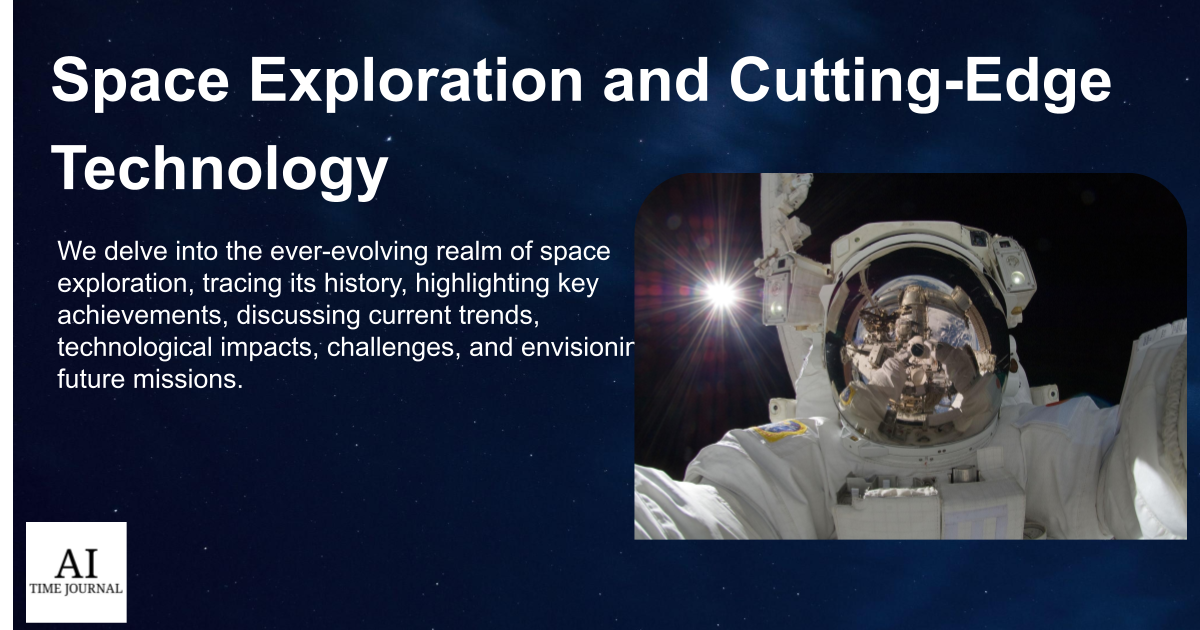
In the vast belt of the universe, where boundaries of human knowledge meet the endless possibilities of the universe, humans have adventured into innovation, ambition, and the relentless pursuit of the unknown of our galaxy. Space exploration is a testament to humanity's curiosity about what exists outside our planet we dwell upon and has consistently pushed the envelope of what is technologically possible. Here in this article, we are going to embark on a journey through the ever-changing landscape of space exploration.
From the historic achievements we have completed, such as the Apollo mission, to the seminal missions of today, like the Perseverance rover's search for signs of life on Mars. We are going to take a dive into the incredible accomplishments that have shaped the course of space travel. We also look at the technological advances that have made it possible for us to study distant planets, distant galaxies, and even the very beginnings of the universe. As pioneered astronautics and Soviet rocket scientist Konstantin Tsiolkovsky once said about space exploration "Earth is the cradle of humanity, but one cannot remain in the cradle forever."
Historical Context
Space exploration has always been a curiosity within the human race dating back for generations, to start things off we will talk about some of the pioneering examples that help guide the way for space exploration and innovation. For example, the brilliant creation of the Hubble telescope was first proposed in the 1940s, but substantial planning and development of the Hubble Space Telescope project didn't start until the 1970s. Its iconic launch occurred in 1990. The Hubble has observed galaxies billions of light-years away, providing insights into the early universe's formation and evolution. It has helped scientists understand how galaxies formed and changed over cosmic time.
Another historic event was when tensions were high during the USSR and US space race starting in 1955. The USSR launched its own satellite in response to the US statement that it would be the first artificial satellite to orbit the Earth. Or in 1957, the year that the USSR successfully launched Sputnik 1, the first satellite to orbit the Earth. Finally, leading up to the flights under the Apollo program in an effort to put people on the Moon and return them safely to Earth. Six successful lunar landing missions—Apollo 11, Apollo 12, Apollo 14, Apollo 15, Apollo 16, and Apollo 17—were part of the program, which spanned from 1961 to 1972. Each mission had distinct scientific and exploratory goals, and they all contributed significantly to our growing knowledge of the Moon and space travel.
Here is a list of the key milestones of our time in space exploration:
- The Launch of Sputnik 1 (1957): The space era and the US-Soviet space race officially began with the Soviet Union's Sputnik 1 satellite launch, which also marked the beginning of the space age.
- The First Human in Space (1961): Yuri Gagarin, a Soviet cosmonaut, became the first human to travel into space aboard Vostok 1 on April 12, 1961.
- The First American in Space (1961): Alan Shepard drove the Freedom 7 spacecraft on a suborbital flight in May 1961, and he became the first American in space.
- Apollo 11 Moon Landing (1969): On July 20, 1969, The Apollo 11 crew of Neil Armstrong and Buzz Aldrin became the first humans to walk on the Moon, while Michael Collins orbited above.
- Skylab (1973-1974): This was the first American space station, known to be Skylab, that allowed astronauts to carry out long-term space missions and conduct research.
- The Hubble Space Telescope (1990): The launch of the Hubble Space Telescope revolutionized astronomy by providing unparalleled views of distant galaxies and stars.
- The International Space Station (2000-present): The International Space Station (ISS) is a global space station that acts as a hub for international cooperation in space and scientific research.
- Landing of the Mars Rovers (2004-present): NASA's “Spirit, Opportunity, Curiosity, and Perseverance” are some of NASA's Mars rovers that have studied the Martian surface in search of indications of past or current life.
- Commercial Spaceflight (2010s-present): Commercial space travel has advanced thanks to the creation of spacecraft by organizations like SpaceX and Boeing for crewed flights to the ISS.
- NASA's Artemis Program (current): The current NASA Artemis Program seeks to bring back humans to the Moon, including the first woman and the next man, and to establish a lasting presence there.
Current Trends
Space exploration is continuing to trend forward in directions that we couldn't even imagine a century ago, like NASA and other space agencies' Mars missions. Space agencies have been sending robotically controlled rovers onto Mars in order to find out more information about our neighboring planet, like its history and its current status. There have been [7 rovers] that made it too Mars it to Mars successfully since NASA started this project, Most recently NASA's rover "Perseverance" landed on February 18, 2021. Perseverance is one of NASA's most advanced robotic explorers designed to study Mars' geology, and climate, scout potential for past microbial life, and most importantly gather and preserve rock and regolith samples. Significant discoveries had previously been discovered by persistence. For instance, it has discovered minerals and organic molecules that would have indicated the presence of water in the past, potentially revealing information about Mars' past and potential for habitability.
Another trend in space exploration has been a plan to head back to the moon, this is the Artemis program. The goal of this program is for NASA to establish a sustainable presence on the moon, and to better prepare for future Mars missions. One cool advancement that has been talked about in the Artemis project is the Orion space craft which is planned to take humans to the Moon and back. Orion underwent further development after Artemis I, and work on getting it ready for crewed missions continued. Next is the Space Launch System (SLS) a rocket that is a critical component of Artemis missions. Significant progress was being made on the SLS, with multiple test firings and preparations for Artemis missions. A recent discovery though found that rocket planned for this use would be “unaffordable”, which is an interesting discovery for the future of this mission, and would be great to see how NASA responds to these claims.
The emergence of private companies like SpaceX and Blue Origin have made significant contributions to space exploration and have been actively involved in advancing the capabilities of human spaceflight and space exploration in many ways. For example, the Falcon 9 rocket, SpaceX established the idea of reusability in the rocketry industry. Reusable rockets lower launch costs and increase space accessibility. Or what Blue Origin has done with the development of a future space habitat known as the "Orbital Reef." This is a planned commercial space station that might facilitate manufacturing, research, and space tourism.
Something, we are seeing more of in the space industry is government-private collaboration. A great example of this could actually be seen from the company we just talked about Blue Origin. The project "Blue Moon" is a lunar lander that is actually for NASA's Artemis program as a way to aid NASA's lunar exploration objectives, Blue Origin plans to send cargo and perhaps even humans to the Moon's surface.
Technology's Impact
Over the years, technology has had a significant impact on the development of spacecraft technology. A great example of this is seen with increased the efficiency and dependability of solar panels. Providing new spacecraft with more plentiful and reliable sources of power. This advancement is important for missions that operate far from the Sun.
Robotics and AI have also played an integral role in the advancement of humans exploring the solar system. Here are three examples of Robotics and AI advancing the way humans do space exploration:
- For spacecraft, advanced robotic arms and manipulators have been constructed to carry out tasks like collecting and sustaining satellites, gathering samples from celestial bodies, and putting together buildings in space. For example, the Canadarm2 arm is used on the ISS.
- [Artificial intelligence AI and machine learning algorithms have been integrated to enable spacecraft to carry out autonomous operations, make decisions in real-time, and adapt to changing environmental conditions. For operations that call for quick decisions and navigation in challenging environments, this autonomy is essential.
- The Mars rovers use AI for activities like autonomous driving, rock/terrain analysis, and sample collecting. These robots are using AI to assist in making important choices about where to go and what to examine.
When it comes to Data collection and analysis the advancement of tech is instrumental in completing these tasks effectively. Advanced data analysis tools like deep learning algorithms are being used to process and interpret vast amounts of data collected by spacecraft instruments. Furthermore, leading to new discoveries and insights in astronomy and planetary science. For example, deep learning algorithms were successfully trained on computer simulations of galaxy formation before being used to analyze Hubble Space Telescope photos of galaxies.

Stars Png at Creative Fabrica Challenges and Considerations
Like any human undertaking, space travel brings ethical and environmental issues that need to be carefully considered.
Here is a look at environmental and ethical considerations with space exploration:
Environmental:
- Nuclear Propulsion - Future space missions may rely on nuclear propulsion or power sources. The environmental impact of launching and using nuclear materials in space must be carefully managed.
- Rocket Launch Emissions - Rocket launches release greenhouse gases and other pollutants into the Earth's atmosphere. Reducing the environmental impact of space launches is an ongoing challenge.
Ethical:
- Data Privacy - The collection of vast amounts of data from space missions, including Earth observation satellites, raises concerns about data privacy, security, and the potential misuse of information.
- Tourism in space - The emerging industry of space tourism raises questions about equitable access to space, safety, and the environmental impact of suborbital flights.
Due to the harsh conditions of space human spaceflight presents numerous health challenges. It is pivotal to consider these challenges to ensure the safety and well-being of astronauts during missions. For example, an astronaut is exposed to way higher levels of radiation when they are in outer space, increasing the risk of cancer as well as other health issues. We try our best to combat this by using shielding systems that are used to minimize radiation exposure like a metal shell and an insulating layer of lunar water helps to protect our astronauts.
International cooperation in space exploration presents different challenges and considerations because of how it involves coordination among multiple nations with varying interests, capabilities, and resources. International treaties and agreements govern space activity, but how these accords should be read and implemented can be strenuous. Space law, property rights, and liability issues may come up. This leads to other problems like how it can be difficult to provide the necessary funds and personnel for cooperative missions, especially when different nations have varying levels of financial commitment and technological capacity.
This takes us to the challenge of funding constraints in space exploration, which affects the size, pace, and success of missions and programs. Due to the complexity of spacecraft, launch systems, mission operations, and safety regulations, space exploration is naturally expensive. It is costly to carry out research, maintain infrastructure, as well as building and deploying the spacecraft. As seen with the latest NASA rocket which we talked about earlier the SLS, currently costs about $2-4 billion per launch.
The Future
Some teased upcoming missions in space exploration is the ambitious goal of sending crews to Mars. SpaceX’s ambitious starship program has a plan to launch a “super heavy rocket” which they refer to as a starship, to be able to carry a crew and other cargo to Earth's orbit, the Moon, Mars, and back. This plan wouldn’t be able to be seen carried out until the late 2020s or more realistically 2030s. Another bright light for the future of space exploration is space tourism. A number of commercial businesses are currently engaged in space tourism projects.
The New Shepard suborbital vehicle from Blue Origin and SpaceShipTwo from Virgin Galactic are notable examples. With the intention of providing commercial suborbital spaceflights to paying customers, these businesses are performing test flights.
Travel beyond the boundaries of our solar system or Interstellar travel, represents one of the most challenging and ambitious goals in space exploration. As seen in the famous Christopher Nolan film "Interstellar", interstellar travel would give humans the ability to travel between galaxies to explore the never-ending vacuum of space. This traveling method is largely theoretical because it faces significant technological, engineering, and logistical hurdles.
Another trend in space exploration has been a plan to head back to the moon, this is the Artemis program. The goal of this program is for NASA to establish a sustainable presence on the moon, and to better prepare for future Mars missions. One cool advancement that has been talked about in the Artemis project is the Orion space craft which is planned to take humans to the Moon and back. Orion underwent further development after Artemis I, and work on getting it ready for crewed missions continued. Next is the Space Launch System (SLS) a rocket that is a critical component of Artemis missions. Significant progress was being made on the SLS, with multiple test firings and preparations for Artemis missions. A recent discovery though found that a rocket planned for this use would be “unaffordable”, which is an interesting discovery for the future of this mission, and would be great to see how NASA responds to these claims.
Conclusion
All things considered, one of humanity's most amazing endeavors is space exploration, which is motivated by human curiosity and technological ingenuity. We have entered the universe with a persistent quest for the unknown, from the early days of the space race to today's cutting-edge missions.
In this article, we've journeyed through the constantly evolving field of space exploration, looking at its historical background, significant accomplishments, present trends, technological implications, difficulties, and prospects for the future.