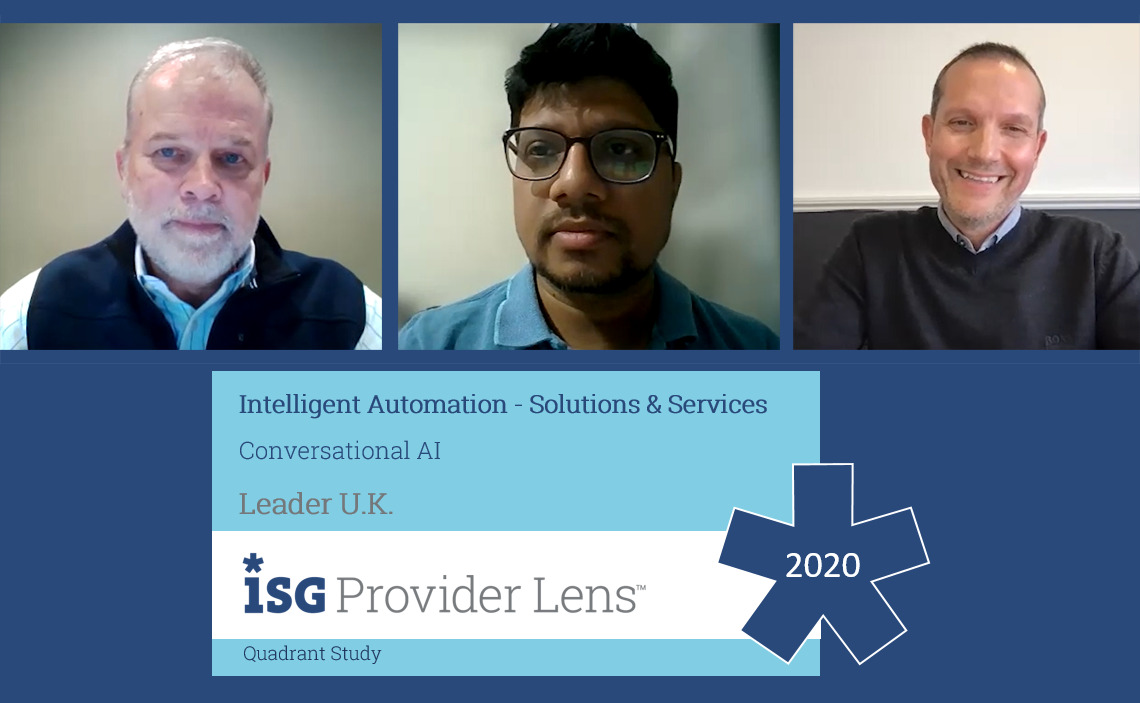
In February ISG (Information Services Group), a leading global technology research and advisory firm, published their ‘ISG Provider Lens™ Intelligent Automation – Solutions & Services’ report. This Quadrant Study provides business leaders and decision makers with an overview of the market and an analysis of vendors’ product capabilities, industry expertise, and strategic partnerships. The report includes a comparison of 19 conversational AI vendors against a robust set of market-driven criteria.
Implementing conversational AI is an important piece of an organisation’s digital experience strategy and partnering with the right vendor is key. Independent reviews, like this one from ISG, can help companies with their vendor selection process.
Following from this report, I recently sat down virtually for a discussion with Mrinal Rai, Principal Analyst at ISG and author of the Conversational AI Quadrant, and Jan Erik Aase, Partner and Global Head – ISG Provider Lens. We explored the findings of ISG’s conversational AI research as well as the following questions:
- What current trends and developments in conversational AI are important when evaluating virtual agent and chatbot management platforms?
- With conversational AI now being a key part of omnichannel support strategies, how are the roles and responsibilities of contact centre agents and customer service professionals evolving?
- What are the biggest barriers organisations face when it comes to building, deploying, and maintaining successful projects?
- What impact has the pandemic had on the implementation and usage of conversational AI tools?
- When setting project goals, what KPIs should organisations identify and what results should they expect?
A few key takeaways from ISG’s analysis of the conversational AI market and our discussion:
- When evaluating conversational AI, it’s not just about the solutions themselves but also how they blend machine learning with human intelligence.
- Integrating virtual agents and chatbots with other systems and information sources is essential for creating a positive experience and achieving long-term success.
- Contact centre agents are becoming conversational designers, helping to train the chatbot or conversational AI system and keep self-service solutions updated and accurate.
- Organisations attempting to take on a conversational AI project internally without the right knowledge, skills, and toolset is a common barrier to project success.
- When it comes to designing and implementing conversational AI projects, knowing what doesn’t work is just as important as knowing what does.
- Having a human-in-the-loop combined with machine learning gives organisations the ability to change responses within their virtual agent quickly, safely, and securely so they can deliver reliable, up-to-date information.
- About five years ago, there was a big focus on contact deflect when implementing these tools, but now that has shifted more to improving the customer experience (CX) as companies recognise this as a competitive differentiator.