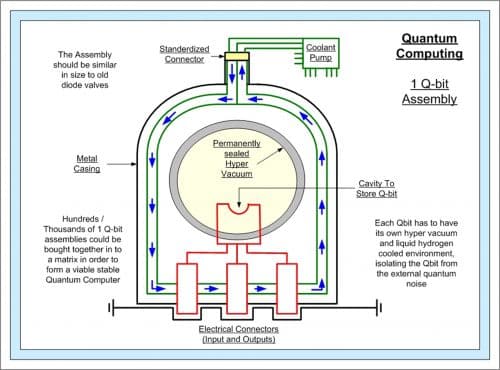
The current attention trade shows, media outlets, and (more and more) vendors are devoting to quantum computing is far from transitory. This form of computing is almost certain to play an integral part in the most meaningful future developments of Artificial Intelligence—if not in those for today.
The bifurcation of quantum computing’s applicability to AI is clear. On the one hand, “Quantum computing is necessary to reach Artificial General Intelligence,” denoted *Kyndi* CEO Ryan Welsh.
On the other, quantum computing is able to solve a critical problem related to AI that is a vital steppingstone to actually achieving Artificial General Intelligence. According to Welsh, quantum computing methods have a definite capacity for “fusing the gap between continuous mathematics and discreet mathematics,” which is at the crux of the dichotomy between statistical AI and symbolic AI for Natural Language Processing applications.
Even a cursory overview of the advantages of quantum computing for both of the use cases Welsh articulated illustrates it will soon become indispensable for either one, which will greatly behoove AI as a formal discipline.
Artificial General Intelligence
The *concept of Artificial General Intelligence* is oftentimes contrasted with that of Artificial Narrow Intelligence. The former involves intelligent systems that are fully interactive with their environments in much the same way that humans are and, to a certain extent, have a degree of autonomy along with their automation. Artificial Narrow Intelligence applications—such as the gamut of natural language technologies and common use cases like cognitive search, for example—typically focus on a limited subset of AI’s capabilities to complete specific tasks.
The much greater Artificial General Intelligence capabilities require the classic quantum computing boons of tremendous compute and rapid processing times at hyper scale. “AI is really a science about taming complexity,” Welsh reflected. “So everything we do is heuristic to get around our inability to compute in a way that really would be done by a quantum computer: this massive computational power.”
That power’s suitability for Artificial General Intelligence is beyond doubt. “If you think about Artificial General Intelligence and you’re trying to build these systems, the problem is you’ll have to question this large knowledge structure and you won’t get an answer back before the heat death of the universe,” Welsh mentioned. “It would be computing for thousands of years before it gives you an answer. But a quantum system would be able to obviously arrive at that answer in a much faster way.”
Reasoning and Learning
The divide between AI’s knowledge base for machine reasoning and it’s statistical base for machine learning can be effectively bridged by *quantum computing* approaches. The scope of true AI, of course, involves both of these methodologies. “Among AI researchers there’s a very famous graph from Marvin Minsky when he was at an AI conference where he has a 3x3 chart and he’s showing all the different things that AI can do,” Welsh recounted. “But, at the top right he’s got this arrow that points out we need to find a better representation to be able to do them. He believes that representation is actually a quantum representation.”
In practical terms, the foregoing quantum representation could enable single systems to rely on connectionist and rules-based methods for natural language technology deployments. There aren’t limitations to how quantum mechanics could assist these endeavors; a particularly convincing way is to allow users to employ unsupervised learning techniques to build a knowledge representation that’s the output of supervised learning models.
That representation would involve vocabularies, hierarchies, entities, and other staples of symbolic reasoning. However, it would effectively be completed without knowledge engineers taking months (or longer) to manually produce this information by hand. The result is a timely resolution of the two types of math implicit to what many regard as oppositional approaches to AI—the discreet math required for graph theory and rules-based techniques, as well as the continuous math for vector-based approaches of machine learning. “You can resolve that by borrowing math from quantum mechanics,” Welsh added.
Quantum Field Theory
Quantum computing is the key to producing Artificial General Intelligence and Artificial Narrow Intelligence deployments for real-time question asking and answering of data. It makes AI much more effective for enterprise deployments of NLP by allowing firms to couple AI’s two distinct branches for learning and reasoning.
The quantum representation Welsh alluded to earlier typifies the latter construct, and is “specifically based on quantum field theory, where the concepts within that field, which would be a quanta in a quantum field, are actually concepts and terms for other things that you would typically relate and put into a knowledge structure. But it’s actually represented in a quantum field versus a hierarchical formal representation in discreet math.”
Featured Image: *NeedPix*