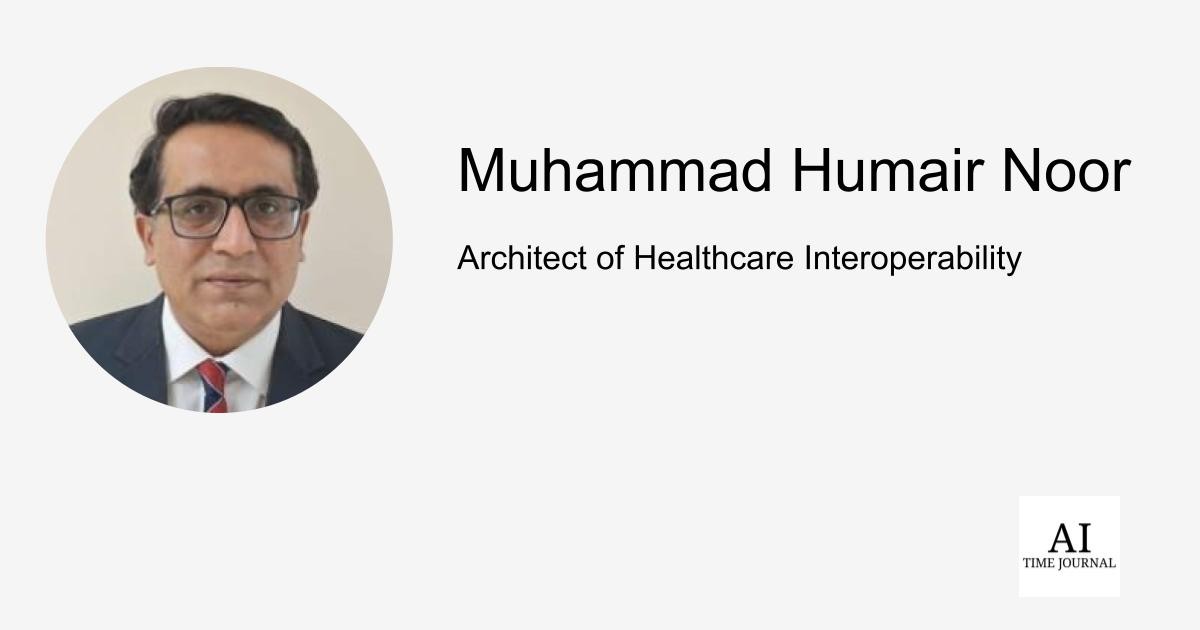
In a world where healthcare systems struggle with fragmented data and evolving regulations, Muhammad Humair Noor emerges as a visionary leader. With over two decades of experience, Noor has transitioned from a software developer to a pioneering architect of healthcare interoperability. He leads innovations that integrate AI, cloud computing, and regulatory compliance to revolutionize global healthcare systems. Fresh out of university, he quickly mastered programming languages like.NET and Python, but it was his transition into healthcare IT that unlocked his true purpose.
“I realized technology could save lives, not just automate tasks,” he reflects.
In this exclusive interview, he shares his journey, insights, and vision for the future.
Mr. Noor, you have an extensive background in healthcare IT and AI-driven integrations. Can you share how your journey began and what inspired you to specialize in this field?
Certainly, my journey started in the late 1990s as a software developer, but I soon realized the potential of technology in transforming healthcare. Regulatory challenges, fragmented data systems, and clinician burnout were critical pain points I wanted to solve, which became the driving force for me to become a specialist in this field. My focus has always been on bridging the gap between regulatory compliance and practical healthcare solutions, ensuring that technology enhances rather than complicates patient care. Over the years, I’ve worked on projects ranging from electronic health records (EHRs) to AI-driven healthcare solutions, always with the goal of improving efficiency and patient outcomes. My work at firms like F3 Technology, a subsidiary of Valentia Technologies and MTBC (CareCloud) solidified my focus on bridging compliance with innovation.
What is a typical day in your life like?
My days blend strategic planning with hands-on problem-solving. I start by reviewing ongoing projects, ensuring interoperability frameworks align with HIPAA and the 21st Century Cures Act. A significant chunk of time goes into optimizing distributed databases and real-time data processing systems, which are critical for projects like AWS HealthLake integrations. I also mentor startups at Punjab Information Technology Board Plan9 and aspiring entrepreneurs through ETL (Empowering through leadership) where I serve as the mentor and conduct AI and healthtech based events.
So you actively mentor startups and young professionals. Why is this important to you?
Technology evolves rapidly, and the best way to future-proof an industry is by fostering talent. At PITB Plan9, I mentor startups navigating AI and cloud solutions in regulated industries and I love spending time with aspiring entrepreneurs who have the energy to conquer the world. Through ETL Online, I guide IT professionals in mastering data engineering and security. Mentorship isn’t just about sharing knowledge, it’s about empowering others to innovate and lead. One of my mentees recently launched a telehealth platform in rural areas of Pakistan. It is moments like these that reaffirm why mentorship matters.
Integration remains one of healthcare’s biggest challenges. How have you tackled this issue in your career at F3 Technologies?
At F3 Technologies, I spearheaded critical projects, such as the CanShare initiative in New Zealand, which streamlined oncology data exchange, and HL7/FHIR-based integrations for COVID-19 reporting. These experiences solidified my ability to drive real-time data accessibility and compliance on a global scale. Additionally, F3 Technologies’ recognition at the prestigious APICTA Awards 2022 for its INDICI platform highlights the company’s leadership in healthcare IT—an area I am committed to expanding.
Looking ahead, the healthcare IT industry will witness increased adoption of blockchain-inspired security models to reduce PHI breaches by up to 90%. Furthermore, global interoperability efforts will grow, particularly in underserved regions where 45% of health data remains untapped. I plan to continue innovating in this space by developing AI-powered integration solutions and strengthening compliance frameworks to shape the future of digital health.
AI and cloud computing are transforming industries. How do they intersect with healthcare IT and what unique perspective do you bring to healthcare technology??
AI is no longer an emerging trend in healthcare, in fact it’s a necessity. I approach healthcare IT with a balance of deep regulatory understanding and hands-on technical expertise. Many professionals specialize in either compliance or development, whereas I bridge both worlds. I’ve been deeply involved in using machine learning for automated FHIR data mapping, which could reduce clinician workload by 70%. In my senior roles at various organizations I have leveraged AWS HealthLake to integrate structured and unstructured EHRs, reducing data processing times from hours to seconds. This real-time analysis empowers clinicians to make faster, more informed decisions.
What are some of the notable career highlights and accomplishments you are most proud of?
One of my most significant achievements was laying the foundation of MTBC’s (now CareCloud) software department. As a leading healthcare software solutions provider, CareCloud serves thousands of clinics across all 50 states and is the only Pakistan-based healthcare service company listed on NASDAQ, the world's second-largest stock exchange by market capitalization.
I was among the first four employees in this domain, starting my journey as a Web Developer. My role rapidly evolved, progressing to Lead Web Developer, Manager Web, Manager Client Relations, and ultimately, Manager IT—heading the software department. In this capacity, I led a team comprising eight managers, team leads, and developers, driving innovation and operational excellence.
During my tenure, I played a pivotal role in the development of MTBC’s first online provider portal, enabling seamless access to daily, weekly, and monthly billing activities. Additionally, I spearheaded the creation of a multi-practice, multi-provider online scheduler and laid the groundwork for the company’s first Electronic Health Record (EHR) system, significantly enhancing the platform’s efficiency and usability.
You also developed a mental health EMR used in several clinics worldwide. What was your motivation for this?
Mental healthcare often suffers from inefficiencies in documentation and compliance. I built a HIPAA-compliant EMR platform that streamlined scheduling, e-prescriptions, and secure data storage, ensuring that mental health professionals could focus more on patient care rather than administrative tasks.
What obstacles have you faced in your professional life, and how did you balance innovation with strict regulatory frameworks like HIPAA?
One of the biggest challenges I faced was pushing for interoperability in a traditionally slow-moving healthcare industry. Providers were often hesitant to adopt new technologies due to regulatory and security concerns. To overcome this, I focused on educating stakeholders by demonstrating tangible benefits through case studies and real-world success stories. Additionally, regulatory compliance, such as HIPAA, was another major hurdle. However, I approached compliance not as a barrier but as a core design parameter. For example, in developing a mental health EMR platform, I ensured that HIPAA-grade security was embedded from the start while incorporating user-friendly features like e-prescribing and patient portals. By anticipating regulatory requirements instead of retrofitting solutions later, I was able to balance innovation with compliance effectively.
How do you plan to leverage your expertise for future innovations, and what trends do you foresee shaping the industry?
I want to focus on bridging compliance and innovation to redefine healthcare data management. I believe that by the end of 2025, AI-driven FHIR automation will streamline workflows, reducing manual data processing by a significant margin, while blockchain-inspired zero-trust security model is set to cut PHI breaches by 90%. Looking ahead, the industry will rapidly shift towards AI-powered interoperability, predictive analytics, and decentralized data security. Now given the opportunity of expanding globally by partnering with NGOs to implement interoperable systems in underserved regions like Sub-Saharan Africa and Southeast Asia, where 45% of critical healthcare data remains untapped, I see a big leap for my skill set where my role can be critical in leading this innovation.