Recently, the IEEE Standards Association held a session at the UNGA78 Summit focused on marine environmental sustainability - discussing technologies for carbon dioxide removal from the oceans, electrification of port infrastructure, and decarbonization of shipping. This agenda received widespread attention, as the oceans play a crucial role in climate processes, and the transition to sustainable solutions has become an urgent priority.
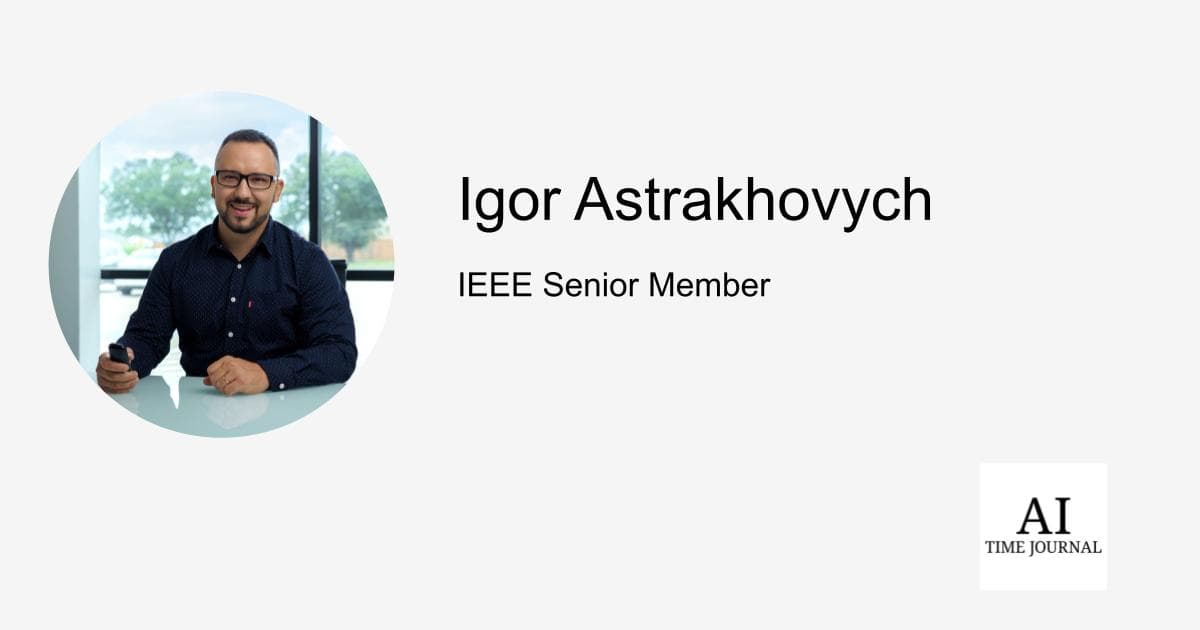
In a world where science and technology are increasingly aimed at preserving the planet, the presence of leaders who not only manage large-scale projects but also share responsibility for the global future is especially valuable. Among such leaders is IEEE Senior Member and marine engineer Igor Astrakhovych. His status and deep technological expertise lend significant weight to his words and projects, opening opportunities to integrate advanced engineering solutions with sustainable practices.
Igor’s journey began in marine engineering: holding an unlimited First Class Engineer license and a PMP certification, he has accumulated over fifteen years of experience in marine and offshore engineering. For the past eight years, he has actively worked on vessels equipped with DP2 and DP3 dynamic positioning systems, responsible for technical support, maintenance, and staff training. His expertise covers highly complex inspections, compliance with international standards including DNV, ABS, and Lloyd’s, as well as the execution of comprehensive projects.
Looking back at late-2024 into 2025, he highlights a run of ultra-deepwater upgrades that brought AI-assisted monitoring, advanced automation, MPD-readiness, red-zone management, and secure remote diagnostics to 7th-generation drillships and DP3 platforms. Several large, strategic modernization programs were delivered to plan, with measurable reliability gains and no HSE incidents. A 2025 thruster-drive and PMS upgrade on a 7th-generation unit generated material cost efficiencies, and he is currently steering one high-impact upgrade while preparing a landmark capital initiative focused on tighter station-keeping, lower energy intensity, and stronger safety performance.
Another highlight of his career was a 2023 mobilization of one of the world’s largest offshore wind installation vessels. Staged in Atlantic Canada, his team oversaw equipment commissioning and coordinated port-infrastructure upgrades that enabled a successful U.S. offshore campaign. Earlier, from 2017 to 2022, he delivered long-cycle projects in the North Sea for a leading offshore operator. His engineering solutions and project leadership contributed to multiple contract extensions and sustained operational performance.
His achievements are not merely a collection of projects but a testament to how engineering insight, technological progress, and sustainability can unite in concrete solutions. In this context, Igor’s value as an IEEE Senior Member takes on special significance: his expertise is deeply connected with IEEE’s mission to advance technologies that serve humanity and the planet.
Igor, in your opinion, what is the main challenge when implementing 7th-generation drillship projects, and what gives you the greatest sense of pride?
It is the combination of drilling depth, complex automation, and safety considerations - everything must work flawlessly, and the atmosphere of responsibility and team cohesion becomes a decisive factor.
Your experience covers both merchant fleets and offshore vessels with modern DP systems. What key differences and challenges do you see between these directions?
Indeed, I’ve had the opportunity to work across both traditional merchant fleets and highly advanced offshore vessels - including DP2/DP3-class drillships and semi-submersibles. While both require a deep understanding of marine engineering, the technical complexity, operational risk, and regulatory requirements in offshore projects are significantly higher.
In the merchant fleet, operations are generally linear: propulsion, navigation, and routine maintenance are well-structured. The engineering focus is on efficiency, reliability, and fuel optimization over long voyages.
Offshore vessels, however, especially dynamically positioned units, operate under far more complex and often extreme conditions - including deepwater drilling, subsea operations, and real-time positioning in high-risk zones. Engineering systems on these vessels must integrate redundancy, real-time diagnostics, and autonomous safety responses.
For example, in my offshore projects, I’ve overseen the upgrade of thruster drives, power management systems, and the integration of AI-based safety tools, where even milliseconds of delay or minor sensor misalignment can create critical failure or safety risks.
Another major difference is the project-driven nature of offshore engineering. It requires interdisciplinary leadership, coordination with international teams, compliance with ABS, DNV, IMO, and client-specific standards, and the ability to adapt rapidly to evolving conditions and technologies.
In short, the offshore field demands a higher level of precision, innovation, and engineering foresight - and that’s where I’ve focused my efforts in recent years. It’s also where I’ve had the greatest opportunity to lead high-impact, high-value engineering programs that directly contribute to safety, efficiency, and environmental performance.
What enabled significant cost savings during the upgrades on your last offshore project?
Process optimization, deep knowledge of the systems, and effective resource management allowed us to achieve results far more efficiently than expected.
The right approach and attention to detail saved $800,000 during planning, plus a further $200,000 through early delivery. Proper preparation consistently leads to better-than-expected results.
How has your experience working in the wind energy sector influenced your approach to marine projects?
It broadens the engineering perspective - adding an emphasis on ecosystem interaction and sustainable design, which is especially important in today’s era of climate challenges.
Can you tell us about your most challenging project as a Senior Marine Engineer and how you managed the issues that arose?
While serving as a Senior Marine Engineer at Solstad Offshore ASA, I encountered a critical emergency that could have led to the loss of a multimillion-dollar contract with an oil & gas client. We were operating a modern DP2-class offshore support vessel on a time-sensitive drilling support mission when we began experiencing instability in the load-sharing system between the generators and thruster drives.
The load sharing was behaving erratically under DP mode, which created a dangerous fluctuation in thrust control. This jeopardized the vessel’s ability to maintain position - a direct risk to both personnel safety and the ongoing offshore operation. I immediately initiated a live diagnostic procedure, during which I identified a malfunctioning thruster electric motor drive encoder and signs of wear on the NDE bearing housing in one of the critical thruster units.
Working under extreme time pressure, I led the onboard disassembly and realignment of the encoder system, supervised a temporary retrofit of the bearing system, and recalibrated the load-sharing software manually - using a custom workaround that allowed us to re-balance electrical loads in real time.
Thanks to these measures, the vessel maintained station, completed the assignment, and avoided any downtime or charter penalty. The client acknowledged this success, and the company retained the contract without delay.
This incident reflects my ability to apply complex engineering judgment under pressure, solve high-risk failures involving automation and propulsion systems, and safeguard the operational and financial interests of the company - qualities that are essential for advancing the marine engineering and energy infrastructure.
Demonstrated complex engineering judgment under pressure, resolved high-risk automation/propulsion failures, and protected operational and financial interests - critical to progress in marine engineering and energy infrastructure.
How does your IEEE membership and participation in its events contribute to your professional growth?
Being a member of IEEE is much more than just a prestigious recognition; it is an active community dedicated to the exchange of ideas and knowledge. It provides access to cutting-edge research, industry insights, and emerging technologies that keep me at the forefront of innovation.
Participating in IEEE events allows me to connect with experts worldwide, fostering collaboration and opening opportunities to contribute to the development of future standards. This engagement not only enhances my technical expertise but also broadens my perspective on how technology can be responsibly applied to solve real-world challenges, supporting both my professional growth and the advancement of sustainable engineering practices.