As artificial intelligence continues to expand its reach across industries, AI agents – particularly versatile ones capable of handling diverse tasks – are solidifying their role as essential tools for tomorrow. These sophisticated agents operate across various contexts, moving beyond basic data analysis to manage complex user interactions, understand context, utilize different software tools, and generate actionable insights. Microsoft's Copilot exemplifies this trend powerfully. Integrated broadly across the Microsoft 365 suite, Windows, and other platforms, this AI assistant helps users draft content, analyze complex data, summarize information, and automate a wide array of routine digital tasks.
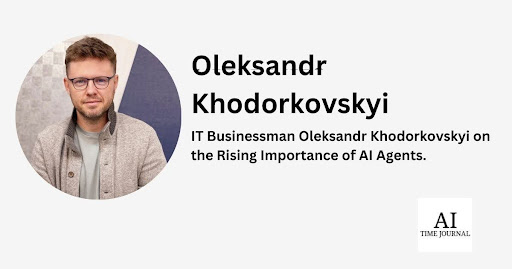
This clearly demonstrates the potential of AI agents to significantly optimize workflows, enhancing productivity and simplifying user experience. According to Statista, the global artificial intelligence market surpassed $184 billion in 2024 and is projected to exceed $826 billion by 2030. AI technologies are reshaping work processes, making them more effective and adaptive. But what’s next? We discussed this with Oleksandr Khodorkovskyi, an expert in artificial intelligence and the founder of QuantumCore, a company developing next-generation multidisciplinary AI agents.
Oleksandr, you've been integrating various technologies for over 15 years – from creating Livein.ua, which unified real estate, auto, and tourism marketplaces, to developing gaming and AI at Argentics. What prompted you to create multidisciplinary AI agents?
You know, it feels like my entire journey was a preparation for this project. In 2008, with Livein.ua, we created one of Ukraine's first comprehensive online web projects, where we learned to unite different services into a single ecosystem. This is exactly what we're doing now with AI agents, just at a new technological level. We're creating the Swiss Army knife of technology. If we compare traditional AI assistants to musicians, they're like soloists – they perform one piece very well. Our multidisciplinary agents are like an orchestra. They create a symphony of data analysis, project management, and customer interaction.
In 2018, at Argentics, you developed an innovative system for creating dynamic NPC dialogues in games. How does this experience help in developing new AI agents?
It was an invaluable experience! In the gaming industry, we learned to create AI systems that maintain meaningful dialogue within a complex context. Imagine an NPC that doesn't just follow a script but adapts its behavior to player actions, considering the game world and backstory. Now, we're applying these approaches in a business context.
Could you explain how this works in practice?
Let me give you a simple example. Take a typical company where the HR department wants to improve employee engagement. Our AI agent acts as a smart assistant: it analyzes how people work, what motivates them, and provides recommendations for better communication with each employee. Then the same agent switches gears and helps the finance team plan budgets. Think of it as a universal consultant who understands all departments in the company and sees the big picture.
What technologies make this possible?
Simply put, we've created a technological cocktail: We combined advanced language models for natural communication, added powerful tools for data analysis, and enhanced it with seamless integrations with various systems. But the most critical feature is that our agent can learn on the go, adapting to each company's unique needs. And, of course, we take data security very seriously.
You have an interesting experience with the ShodennikUA educational platform, which you successfully scaled internationally. I understand you implemented a smart performance analysis system long before remote education became a trend. How does this experience help with current projects?
Indeed, with ShodennikUA, we were ahead of our time! We created a system that didn't just collect performance data but analyzed learning patterns and adapted the program for each student. Back then, it seemed innovative, and today, personalized learning has become the standard. This experience taught us the main thing: any technology must solve real human problems. In working on AI agents, we follow the same principle – creating tools that truly help businesses develop.
Some experts argue that multidisciplinary AI agents are just a marketing gimmick and not actually more effective than specialized solutions. How would you respond to this criticism?
That’s a fair concern—and one we think about deeply. We fully agree that generic, one-size-fits-all AI often underdelivers. That’s why we don’t build general-purpose agents. Our focus is on creating specialized AI agents designed for specific professional processes. Think of them not as flashy demos but as trained digital coworkers—deeply embedded in a particular workflow, aware of its nuances, and able to make accurate decisions. We’re still in the early stages, but we already see promising results: our partners report a noticeable boost in efficiency after integrating our agents. That’s because we combine specialization with enough flexibility to handle real-world complexity. AI agents aren’t gimmicks—they’re force multipliers when built right.
Let's discuss another "tough" question. Many companies have burned their budgets on AI solutions that failed to deliver on promises. Why are you confident this won't happen with your agents?
This is a truly important question — and honestly, it applies to almost any business initiative aimed at innovation. Risk is simply part of progress.
One of the biggest challenges today is that technology is often developed for its own sake, without a real understanding of business processes.
But technology and innovation should solve real, tangible problems. That requires a clear plan, well-formed hypotheses, and a deep understanding of the goals.
Our approach is to start by studying real business problems — and only then build solutions based on what we've learned.
In which industries do you think these agents could bring about a real revolution?
When I think about this, the possibilities are enormous. In healthcare and wellness, for example, our agents could serve as intelligent consultants — helping interpret test results, suggesting treatment options, and supporting doctors in decision-making. In education, they could act as personalized tutors, adapting to each student's pace and learning style. And in business... imagine having an assistant who’s part analyst, part strategist, part consultant — all in one.
The most exciting part? This isn’t some distant vision of the future. It’s something we’re actively building right now.
Finally, how do you envision the future of AI agents in 5–10 years?
You know, I'm very optimistic about the future. AI agents will become like smartphones today — we won't be able to imagine how we lived without them. They'll be reliable partners who are always there to help. Not just executing commands but thinking and offering solutions. And the most important thing — they'll be so seamlessly integrated into our lives that we'll stop thinking of them as technology. They'll just be part of our everyday reality, like electricity or the internet today.