
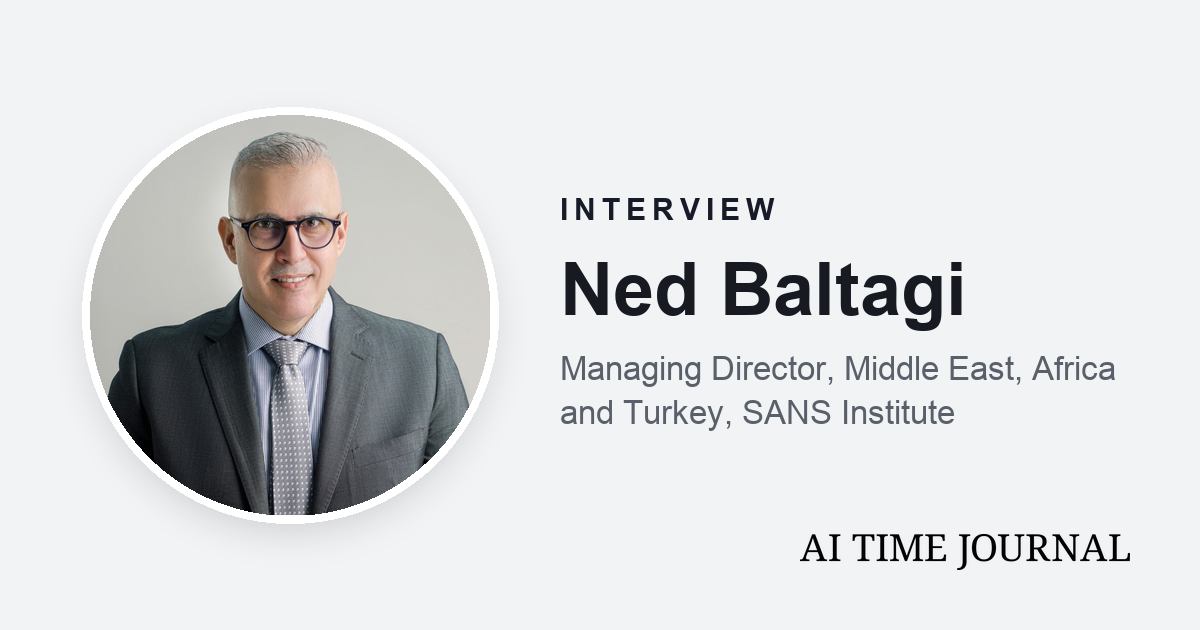
Ned Baltagi is Managing Director for the Middle East, Africa and Turkey at SANS Institute, where he leads the institute's regional programs, partnerships and skills development initiatives to strengthen the cybersecurity workforce. He has more than two decades of experience across IT, information security and business leadership. In this interview, he explains where Gulf organizations stand on AI security maturity, which AI-related risks are most immediate in the region, where AI is improving security operations, how to measure the AI security skills gap, and what boards should require in the first 90 days of a major AI deployment.
SANS's AI Security Maturity Model (Gulf Region Edition) assesses organizations across three pillars, Protect, Utilize and Govern, and five stages of maturity. Where are most Gulf enterprises sitting on each pillar today, and which pillar do leadership teams most consistently overstate when they self-assess?
Gulf enterprises are investing heavily in AI, but security maturity is not always keeping up with adoption. Our working assessment is that many organizations sit around Stages 2–3 (early to developing level) in Protect and Utilize, while Govern often remains closer to Stages 1–2 (the initial stages of AI security maturity) in terms of operational implementation. These are indicative assessments rather than published regional benchmarks. Companies are strengthening traditional security controls and experimenting with AI-driven defense, but it is a challenge to secure models, data pipelines and AI integrations consistently.
Govern is arguably the most frequently overstated pillar. Having an AI policy or governance committee does not necessarily mean a business can demonstrate effective oversight, continuous risk assessment or clear accountability. True maturity is when governance policies are implemented effectively, enforced consistently and embedded into day-to-day operations.
SANS reports that time-to-exploit has fallen from more than two years in 2019 to under 24 hours. As AI adoption accelerates across the region, which AI-related exposures are turning into real incidents in the Middle East, and which remain more theoretical than the headlines suggest?
The most immediate AI-related risks for Gulf organizations are data leakage, AI-enabled phishing and convincing social engineering. Employees using unapproved AI tools can expose sensitive information, while attackers using generative AI can produce credible, multilingual phishing campaigns. Deepfake impersonation adds another layer of risk, particularly for executive communications and financial authorizations. These are established threat patterns, although their precise prevalence in Gulf incidents requires regional evidence.
Unverified third-party models and insecure AI integrations are also important emerging exposures. More sophisticated attacks, such as model inversion and training-data poisoning, are technically credible but should not be presented as widespread regional incidents without supporting evidence. The priority is addressing the risks companies can already identify and control.
On the Utilize pillar, where is AI improving cyber defense inside security operations today, and where has adoption stalled despite investment? What separates the teams reporting measurable gains from those that are not?
AI is delivering practical value in alert enrichment, incident summarization, detection engineering and threat intelligence analysis. These applications help analysts process information faster and reduce repetitive work. The strongest opportunities are in workflows where AI supports human judgement rather than replacing it.
Adoption tends to stall when organizations invest in AI platforms without addressing poor data quality, fragmented security tools or unclear operational processes. Teams achieving measurable improvements establish baselines for investigation time, false-positive rates and analyst workload, then validate results against those measures. Success depends on effectively integrating AI technology into existing SOC operations to improve efficiency and deliver measurable security outcomes.
The AI skills gap in cyber is usually described in general terms. Concretely, which capabilities are missing in the region, and how do you measure that gap when you scope programs with governments and enterprises?
The challenge is more about specialized capabilities than general cybersecurity awareness. Priority gaps include securing AI models and data pipelines, testing systems against prompt injection and adversarial manipulation, implementing AI governance and applying AI effectively within security operations. These disciplines require professionals who understand both traditional security principles and AI-specific attack surfaces.
Skills gaps should be measured through practical assessments rather than certification numbers alone. Organizations can evaluate whether practitioners can identify vulnerabilities in AI applications, secure inference APIs, conduct adversarial testing and investigate AI-related incidents. Mapping these capabilities against the NIST NICE Framework and organizational requirements provides a clearer basis for targeted workforce development.
When an AI system used in security operations or critical infrastructure produces an outcome that is technically defensible but institutionally risky, who should own that decision? How should accountability be split between the CISO, the business and regulators?
AI can inform security decisions, but accountability must remain with people. The CISO should own the security assurance and technical risk assessment, while the business owner remains accountable for operational decisions and their consequences. Regulators establish requirements and provide oversight; they should not become substitutes for organizational accountability.
Frameworks such as the NIST AI Risk Management Framework and ISO/IEC 42001 provide useful structures for defining responsibilities, documenting decisions and monitoring AI risk. These principles also support the UAE's broader national cybersecurity objectives. For critical infrastructure, mature governance requires clearly defined human intervention points, escalation procedures and the authority to override AI-generated recommendations when safety or operational continuity is at stake.
Programs such as the Bahrain Cyber Reskilling Program with Tamkeen, the Cyber Academies in Kuwait and the December 2025 MoU with the UAE Cybersecurity Council are designed to fast-track certified practitioners. What retention and on-the-job performance data have you seen 12 to 24 months after cohorts graduate, and what have you changed in program design as a result?
Programs such as the Bahrain Cyber Reskilling Program with Tamkeen, Kuwait's Cybersecurity Leaders Program and our collaboration with the UAE Cybersecurity Council demonstrate the importance of developing practical, industry-ready cybersecurity talent. In Kuwait, our 2025 program, delivered in partnership with the Central Bank of Kuwait and the Kuwait Institute of Banking Studies, achieved a 97% first-attempt certification pass rate, with participants earning 87 GIAC certifications across GFACT, GSEC and GCIH. These results show strong learning outcomes, while participant feedback highlights improvements in technical confidence and the ability to apply cybersecurity skills in the workplace.
Long-term success requires looking beyond certification to assess career progression, retention and on-the-job performance. This is why programs emphasize hands-on simulations, real-world attack scenarios, employer-aligned training and professional skills development. These elements help bridge the gap between classroom learning and operational readiness, ensuring practitioners can contribute meaningfully to their organizations' cyber resilience.
If a Gulf board were approving a major AI rollout this year, what should it require on AI security in the first 90 days, which single metric should it ask the CISO to report each quarter, and where do you see peers most commonly wasting security budget on AI?
Boards approving major AI deployments should require three things within the first 90 days: a complete inventory of AI systems and their data access, a risk assessment covering models, suppliers and integrations, and clear accountability for AI security decisions. High-risk applications should undergo security testing before production deployment, with monitoring and incident response procedures established from the beginning.
The single quarterly metric should be the percentage of high-risk AI systems operating with verified security controls and documented risk ownership. This provides a more meaningful view of exposure than AI spending or the number of policies created. The most common budget mistake is investing in additional AI security tools before establishing visibility, governance and the workforce capabilities needed to use them effectively.