
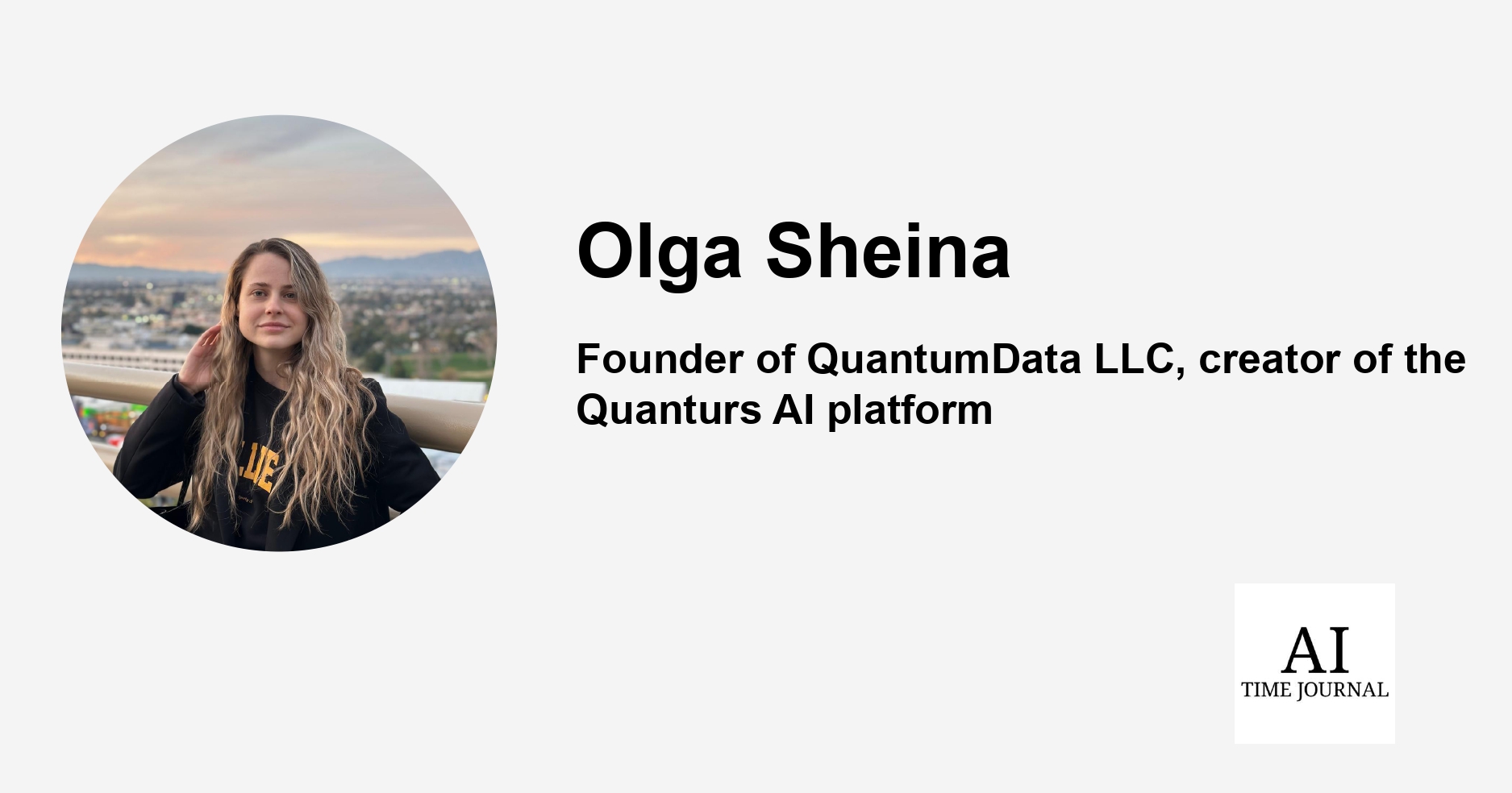
In an era of rapid artificial intelligence development, specialists capable of integrating technological innovations with a deep understanding of human behavior are particularly valuable. Olga Sheina, founder and CEO of QuantumData LLC and creator of the Quanturs AI platform, works at this interdisciplinary intersection, combining data science, behavioral analytics, and sustainability principles. In an interview, Olga shared how artificial intelligence can make travel not only more personalized but also more environmentally conscious.
Olga, your career path began with economic sociology and led to the creation of the Quanturs AI platform for sustainable tourism. Tell us how your education at the Financial University under the Government of the Russian Federation and your Master's degree at Freie Universität Berlin, one of the world's leading centers for sociological research, helped shape your unique approach to data analysis? How exactly does your sociology background enrich your work with artificial intelligence and behavioral analytics?
My academic path was indeed quite interesting. Sociology gave me a fundamental understanding of how people make decisions, form habits, and interact with the world around them. Even during my bachelor's studies at the Financial University, I began applying quantitative methods to study social phenomena, which served as an excellent bridge to working with data. My Master's program at Freie Universität Berlin allowed me to delve deeper into the analysis of behavioral patterns and work with large datasets. In my master's thesis, I researched how social capital influences Europeans' attitudes towards climate change, using regression analysis and visualization methods. It was then that I realized how powerful the alliance of sociological knowledge and technical skills could be.
A sociological mindset gives me an advantage in working with artificial intelligence because I look at data not just as numbers, but as reflections of real human stories, motivations, and contexts. I understand that behind every user action lies a whole complex of social, economic, and cultural factors. This allows me to create technological solutions that truly resonate with people, rather than just optimizing abstract metrics.
You are an expert at the intersection of data science, behavioral analytics, and sustainable AI solutions. What is the synergy between these fields when developing innovative solutions for tourism?
These three areas work like parts of a single organism and help me create truly unique solutions in tourism. Data science provides the toolkit for processing and analyzing data, behavioral analytics helps understand the underlying motivations and preferences of travelers, and sustainability principles set the ethical and environmental framework.
In our work, we apply a comprehensive approach. We start with deep behavioral analysis — studying how people make travel decisions, what influences their choices, and what barriers prevent them from making more sustainable choices. Then, we use machine learning methods and neural networks to create predictive models that can anticipate user preferences and generate personalized recommendations. Collaborative filtering and topic modeling algorithms are particularly important, and we have adapted to consider not only consumer preferences but also the environmental footprint of each recommended option. For example, we are currently working on enabling our system to suggest the optimal route with the minimal carbon footprint or select local eco-friendly restaurants considering the user's dietary preferences.
The Quanturs platform, which you are developing within your company, QuantumData LLC, offers truly unique personalized travel recommendations. Could you tell us about the technical side of this solution? How does artificial intelligence analyze user behavioral patterns and generate individual recommendations?
The technical foundation of Quanturs is built on a multi-layered system for data analysis and recommendations. At the first level, we gather information about locations, attractions, restaurants, and other points of interest using specialized algorithms that analyze multiple sources, from official tourism websites to traveler reviews. This allows us to create a rich database with detailed characteristics of each place. The next level is user behavior analysis. We study not only explicit preferences (e.g., when a user indicates they like certain places or cuisines) but also implicit behavioral signals: how much time a person spends exploring different categories, which filters they apply, and how they interact with content. Based on this data, our algorithms create a multidimensional behavioral profile.
The core of our recommendation system is a hybrid approach, combining several types of algorithms. We use collaborative filtering, which finds similarities between users and suggests places liked by people with similar preferences. Meanwhile, content-based filtering matches place features to the user’s profile. Importantly, we use reinforcement learning models that continuously improve based on user feedback, adapting to changing preferences and context. The architecture of our recommendation engine is currently under development. We are finalizing the structure of its core algorithmic components and integrating behavioral profiling modules.
Thank you for such a detailed answer! Interestingly, your platform emphasizes not only personalization but also sustainable development. How exactly do artificial intelligence algorithms contribute to promoting a more sustainable approach to tourism?
Indeed, integrating sustainability principles into recommendation algorithms is one of the key differentiators of our platform. As I mentioned earlier, we are currently working on enabling our system to suggest the optimal route with the minimal carbon footprint. To do this, our algorithms will calculate the approximate carbon footprint of various route options and activities. Additionally, we pay special attention to supporting local communities. AI can easily be trained to prioritize local businesses that follow sustainable practices — using local products, employing energy-saving technologies, and offering seasonal menus. This not only reduces the environmental impact but also supports the local economy. According to Booking.com’s 2023 Sustainable Travel Report, over 70% of global travelers expressed a desire to book more sustainable accommodations, but many cited a lack of transparency or difficulty in identifying such options. This is precisely the kind of gap Quantur's aims to close by making sustainable choices more visible, accessible, and tailored.
Behavioral 'nudges' (Nudge Theory) also contribute — subtle prompts that encourage users to make more conscious choices. Our algorithms mustn't limit the user, but rather broaden their horizons, showing diverse options with an emphasis on sustainability. We aim to make travel not a sacrifice or compromise, but a deeper, more authentic, and ultimately more enjoyable experience.
Olga, in your work, you combine technological innovations with a humanistic understanding of human behavior. How important do you think it is for modern AI solutions to consider the social context? How does this approach affect the quality of recommendations and the overall user experience?
I am convinced that considering the social context is not just a desirable addition to AI solutions, but a fundamental necessity. Technologies that do not understand sociocultural nuances, human values, and behavioral specifics in different contexts will always be limited in their usefulness and user adoption. My experience working at FREENOW with multi-country research demonstrated how much user behavioral patterns vary across various cultural contexts. For example, attitudes towards ride-sharing or electric vehicles vary significantly between European countries. What works perfectly in Berlin might be ineffective in another city.
Integrating social context into AI radically improves the quality of recommendations. First, they become more relevant — the system understands that different motivations can underlie the same actions. Second, recommendations become more nuanced and consider implicit social norms and taboos. Third, it becomes possible to adapt communication to the user's values — for example, one person might prioritize economic benefit, while another focuses on the environmental aspect.
Regarding the user experience, considering the social context creates a feeling that the technology truly understands the person, rather than simply processing them as a set of data points. It helps people trust the product and feel more connected to it. In our Quanturs platform, we strive for algorithms that can 'reason' like an experienced local friend who knows your preferences and can suggest interesting places considering your context and values. In the long run, socially aware AI has greater potential for positive societal impact, as it can subtly guide users towards more sustainable practices without coercion or a top-down approach.
You also developed the Sign Language Project — an AI gesture recognition system for people with hearing impairments, using 3D network technologies, OpenCV, and integration with the OpenAI API. This is a very impressive, socially oriented project! Tell us more about your experience creating this system and how it helps address inclusivity challenges.
The Sign Language Project was a particularly significant experience for me because it showed how artificial intelligence technologies can solve meaningful social challenges. The project originated from the realization of the communication barrier faced by people with hearing impairments in everyday life. Technically, the project is a computer vision system that recognizes sign language gestures via video stream and translates them into text. We used 3D convolutional neural networks (ResNet-3D) to analyze the sequence of movements in space and time. The OpenCV library helped us with image preprocessing and extracting key points of the hands and face. The project is hosted on the Hugging Face platform, making it accessible to the developer and researcher community, who can use our work as a starting point for their solutions in the field of inclusive technology.
Regarding the social aspect, the system aims to address two key problems. First, it helps people with hearing impairments communicate more freely in situations where a professional interpreter is not available. Second, the technology can be used for learning sign language, making it more accessible to a wider audience. Working on the Sign Language Project reaffirmed my conviction that artificial intelligence should serve not only commercial purposes but also become a tool for creating a more inclusive and equitable society.
Thanks for sharing! Olga, observing current trends in Data Science and AI, you note growing attention to sustainability, algorithm transparency, and deep personalization. How are these trends transforming the tourism industry, and what new opportunities do they open up for innovators like you?
These trends are radically changing not only the technological landscape but also the entire paradigm of tourism. We are witnessing a gradual shift from mass, standardized tourism towards more conscious, personalized, and environmentally responsible travel. The trend towards sustainability or 'green' technologies is particularly noticeable now. Travelers are increasingly thinking about their carbon footprint and impact on local ecosystems. For the industry, this means the need to rethink the entire value chain — from transportation to accommodation and activities. For developers like me, it opens up opportunities to create tools that make sustainable tourism more accessible and convenient. For example, algorithms that optimize routes considering environmental factors, or recommendation systems promoting local eco-friendly businesses. Algorithm transparency is a response to growing user concern about how AI 'black boxes' work. People want to understand why they are being recommended something, based on the data decisions that are made. This is especially important in tourism, as travel is often a significant investment of time and money. In our work, we strive for Explainable AI (XAI), which can not only provide a recommendation but also justify it in a way that is understandable to the user.
Personalization is evolving to an entirely new level. Whereas personalization in tourism used to be limited to basic preferences like budget or hotel star ratings, algorithms can now account for subtle nuances — travel style, aesthetic preferences, dietary restrictions, cultural interests, and even emotional state. These trends create space for the emergence of entirely new types of travel services. For instance, AI assistants that don't just suggest places but curate a holistic experience tailored to a person's deeper needs. Or sharing economy platforms that use artificial intelligence to connect people with similar interests for more sustainable and authentic trips. For innovators like me, these trends open a unique window of opportunity to create technological solutions that not only optimize the existing industry but also shape its future in a more sustainable and human-centric way.