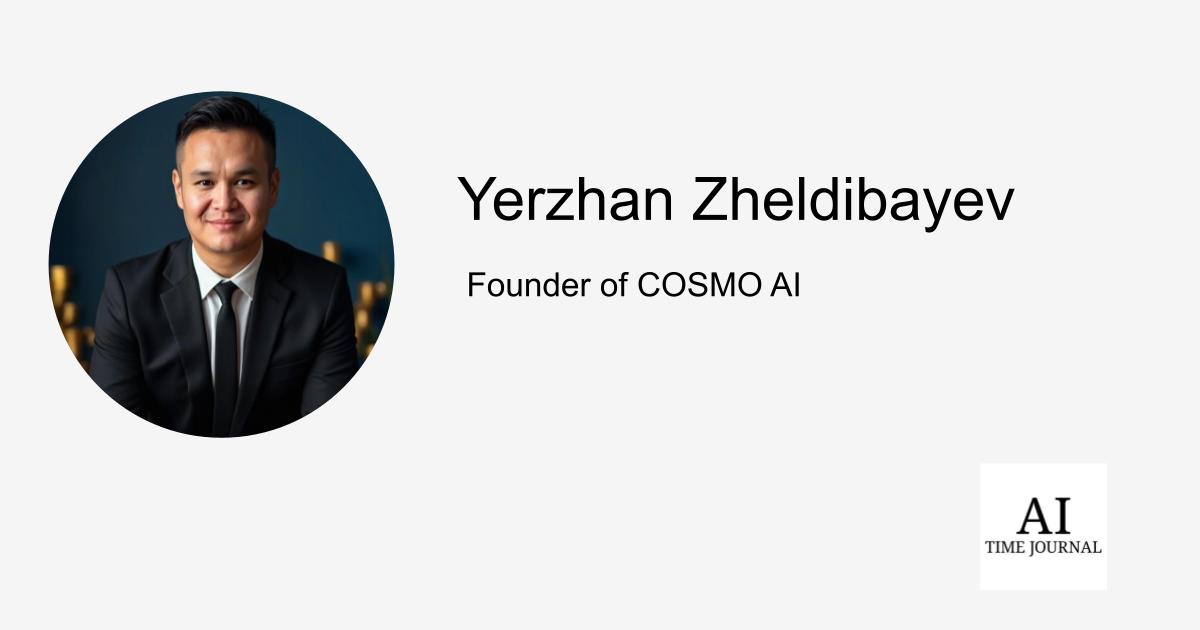
In Q1 2025, global investments in AI startups reached $84 billion, a 22% increase compared to the first quarter of 2024. According to researchers, AI adoption could boost global GDP by 15% by 2035, effectively adding one percentage point to annual growth. As technology evolves at a radical pace, it’s also reshaping how we think. Kazakhstani entrepreneur Yerzhan Zheldibayev has developed a unique methodology that brings these two transformations together — unlocking a new level of business success.
Yerzhan Zheldibayev is an internationally recognized entrepreneur and AI strategist with a proven track record of building and scaling multimillion-dollar businesses across emerging markets and beyond. With over 15 years of hands-on leadership experience spanning telecommunications, retail, advertising, and AI consulting, he has successfully launched and exited ventures generating up to $280K monthly revenue. As the founder of Cosmo AI, he now empowers SMEs and entrepreneurs to leverage cutting-edge artificial intelligence for operational efficiency, automation, and scalable growth.
Yerzhan is an active member of leading global AI associations, including ACM and AAAI, reflecting his commitment to innovation and ethical technological advancement. A published thought leader and invited judge at international startup competitions, he has personally mentored over 100 clients worldwide, helping them transform their businesses through mindset shifts and strategic AI integration. His proprietary frameworks and cross-continental expertise make him a sought-after voice in the future of business and technology.
Your career spans over 20 years. Which achievement or milestone stands out the most or became a turning point for you?
Over the past fifteen years, I’ve been involved in many projects and received various awards and recognitions. But what truly impresses me the most isn’t the diplomas or certificates, it’s the moments when my work genuinely changes someone else’s life. For example, I once helped a small team from an educational startup restructure their business model, and within a year, they became leaders in their niche. Watching them go from uncertainty to success — that’s the real reward.
If we’re talking about personal turning points, one of the most pivotal moments was launching a major retail project in Kazakhstan, which eventually generated hundreds of thousands of dollars in monthly revenue. That’s when I truly realized I could build systems that function independently of me. It changed my entire perspective on business and pushed me toward what I do today.
Today, many people talk about integrating AI into business, but you also emphasize the importance of working with the right mindset. What does this actually look like in practice? How do technology and personal transformation work together?
At first glance, it might seem like technology and mindset are two entirely separate domains. But in reality, one doesn’t work without the other. When a company implements AI tools — like chatbots, automated analytics, or content assistants — they do reduce the workload. But if the business owner still holds onto outdated beliefs like “I have to control everything myself” or “tech is just not my thing,” the effectiveness hits a ceiling very quickly.
That’s why I always approach transformation on two levels. First, we automate key processes. Then we focus on mindset: breaking through the internal limitations that prevent a person from embracing a new level of structure and speed. Only when these two elements work in tandem can real transformation happen — when AI enhances the business and the entrepreneur stops “putting out fires” and begins to lead strategically, from a place of clarity and confidence.
Your project, Soul Evolution, focuses on mental transformation. Why, as a successful entrepreneur, did you decide to dive into mindset and consciousness evolution?
My shift toward exploring consciousness happened in Bali. During daily meditations, I kept asking myself a simple question: “What would truly make me feel happy and at peace?” Over time, the answer came — to share my experience and help others move beyond their habitual way of seeing themselves.
I realized that many problems can’t be solved at the same level at which they were created. We live within our patterns and beliefs, often unaware that by simply “rising one floor higher,” the solution becomes clear. That’s what I call the evolution of consciousness: the ability to see yourself and your life from a new perspective.
For me, Soul Evolution is a way to merge entrepreneurial experience with deep inner work. I help people the same way I once helped myself — to look beyond their day-to-day worries and feel a sense of real freedom.
You’ve mentored at startup competitions. What’s the most unexpected but critically important criterion you use when evaluating promising projects?
When I assess a startup, of course, I look at the product, the market, and the business model. But there’s one less obvious factor that I always prioritize — the team’s energy and adaptability.
You can have a world-class idea, but if the founders can’t adapt quickly, take feedback, or pivot their strategy, the project won’t last. On the other hand, even a modest idea in the hands of a flexible and persistent team can grow into something huge.
That’s why I always try to “read” people: how passionate they are about what they do, how open they are to new approaches, and whether they’re prepared to go through inevitable challenges. For me, that’s the true indicator of a startup’s potential.
In your approach, there’s a strong focus on “consciousness evolution.” How do you help clients overcome fear when facing AI integration and major change?
When people first consider integrating AI or changing long-standing business processes, it’s not the technology that holds them back; it’s fear. Fear of losing control, of making mistakes, of feeling incompetent. I understand that well because I’ve been there myself.
In my work, I don’t just present tools, I help clients shift their perspective. We explore their limiting beliefs and doubts: where they come from, what’s underneath. Then we take small, practical steps, simple experiments that deliver quick wins. The client sees: “This works, and it’s not as scary as I thought.”
That internal shift is what I refer to as consciousness evolution. When an entrepreneur stops seeing technology as a threat and starts viewing it as an ally, everything changes. And that’s the moment when they become truly open to transformation, not out of fear, but out of curiosity and inspiration.