
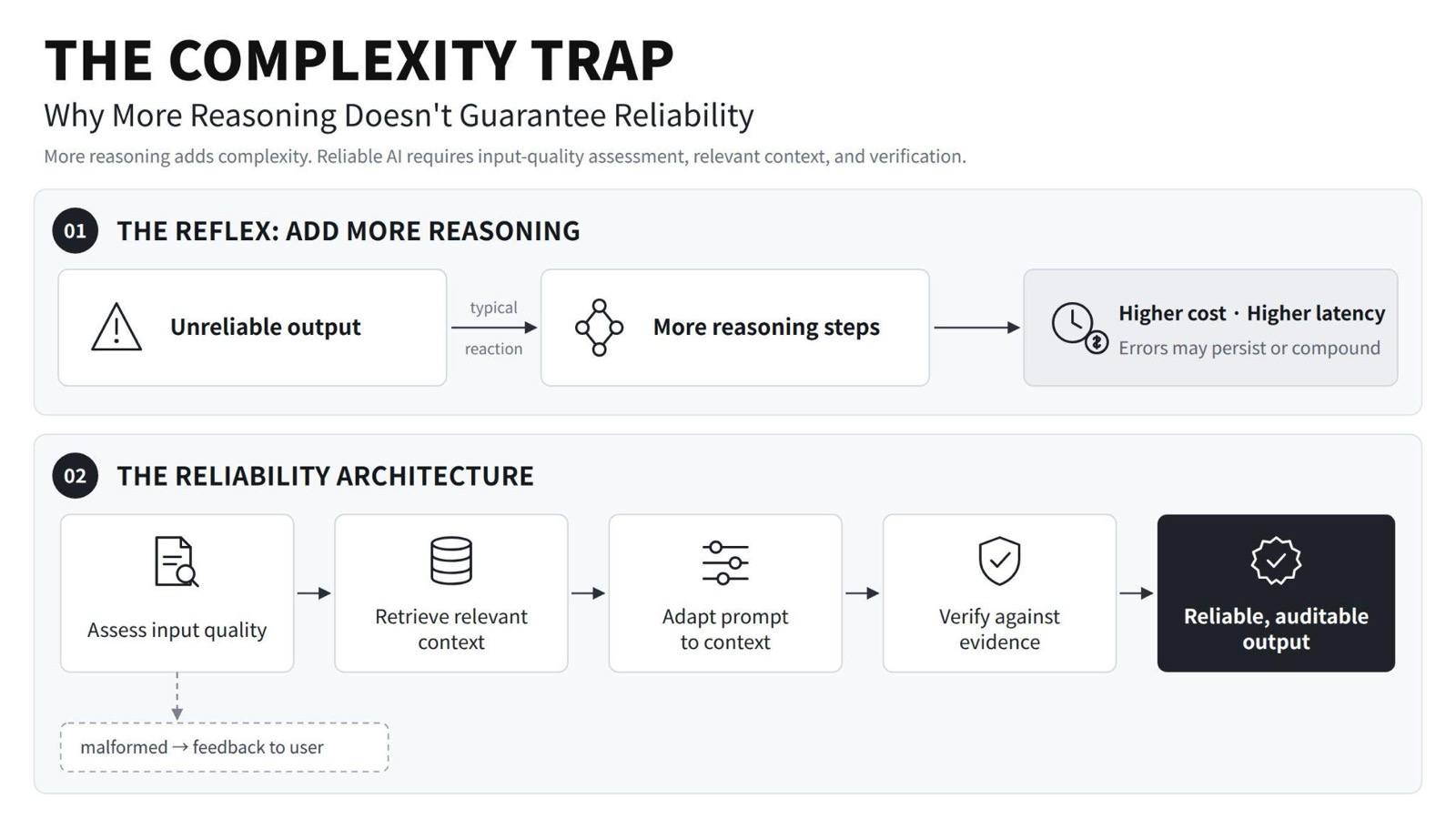
The market's reflex to unstable GenAI output is added complexity: longer instructions, deeper reasoning chains, more agents in the orchestration graph. When a system produces an answer nobody can defend, the standard remedy is to make it think harder. Drawing on enterprise GenAI deployments I have led at scale, I want to argue that the research base does not support this instinct. Prompt sophistication and system reliability are not monotonically related, and across some ranges they move against each other. Reliability comes from the architecture surrounding the prompt: verification, retrieval quality, adaptive structuring, and assessment of the formulation itself before it reaches a model.
The deployment data is unambiguous. Gartner reported in 2026 that at least 50 percent of generative AI projects were abandoned after proof of concept, citing poor data quality, inadequate risk controls, escalating costs, and unclear business value. MIT NANDA's 2025 State of AI in Business report found that 95 percent of enterprise generative AI pilots produced no measurable return on the income statement. McKinsey's 2025 global survey confirmed that while 88 percent of organizations now use AI in at least one business function, fewer than 10 percent have scaled AI agents to deliver tangible value. These are not capability failures. They are architecture failures, and the architecture in question begins at the prompt.
The prompt layer as an architectural tier
A prompt is not text preparation. It is a component of a managed computational architecture, because query structure determines how the model interprets the task (Aljanabi et al., 2023) and therefore governs the entire reasoning chain that follows. If interpretation fails at the point of entry, no amount of downstream processing recovers it.
Enterprise requirements make this consequential in a way consumer applications do not. Reproducibility, auditability, and interpretability are conditions of operation in a regulated environment, not features. An output that cannot be explained cannot support a decision carrying financial or compliance exposure. In the production systems I oversee, prompt quality is therefore assessed at the input rather than inferred from the output: checks for context completeness, task clarity, and structural coherence are cheap relative to a confidently wrong answer propagating through a workflow. That shift, from user input to governed infrastructure, is the first principle of reliable enterprise GenAI, and most organizations have not made it.
In a December 2025 column for TechTimes, I argued that prompts, models, and integrations should be treated as versioned infrastructure. This column extends that argument into a different dimension. Versioning is a necessary condition, but not a sufficient one. The prompt layer must also sit alongside data schemas, access policies, and retention rules in the organization's compliance architecture, because prompts encode business logic, define acceptable output boundaries, and shape user-facing behavior. When prompts change without governance review, the organization's risk posture changes silently. In the enterprise AI systems I have architected, prompt changes follow the same approval and audit trail as schema migrations.
Five useful families of strategy, and what each controls
One useful way to group prompting techniques (Sahoo et al., 2024) is by the failure mode. Reasoning expansion (Chain-of-Thought, Tree-of-Thoughts, Graph-of-Thoughts) supports multi-step reasoning. Grounding and checking methods address different failure modes through retrieval (RAG), tool-mediated reasoning (ReAct), or staged self-verification (Chain-of-Verification). Prompt and example automation (APE, ECHO, Active-Prompt) reduces some manual construction work, while adaptive prompting adjusts structure to the situation. Other methods optimize a particular task or formulation: Chain-of-Density targets information-dense summarization, while OPRO iteratively searches for higher-performing instructions.
The taxonomy matters less as a catalogue than as a diagnostic, because organizations routinely apply a tool from one family to a problem belonging to another. I have watched a customer-service team spend three months optimizing a reasoning chain for product recommendations, only to discover that the real problem was stale catalog data in the retrieval layer. No prompting technique addresses a stale index. What the situation required was correct problem classification, and that took ten minutes once someone asked which family the failure belonged to. Misallocation of this kind is common because reasoning expansion is the most visible family and the easiest to attempt: no infrastructure change, no data work, no coordination with another team.
Why more reasoning does not guarantee reliability
A more elaborate prompt does not guarantee fewer logical errors. When the model's initial approach is flawed, additional reasoning can entrench the error (Sahoo et al., 2024) by supplying intermediate justifications. In other cases, decomposition or explicit verification can improve performance.
In a simple independent-error model, five steps that are each correct ninety percent of the time yield an end-to-end success rate of about fifty-nine percent. This is a toy model, not an empirical description of LLM reasoning: later steps may detect earlier mistakes, and step errors need not be independent. It nevertheless illustrates why adding steps should not itself be treated as a reliability mechanism. Additional reasoning also imposes latency and cost, so its value has to be measured rather than assumed.
Underlying this is a property that enterprises consistently underestimate: sensitivity to formulation is systemic, not an edge case. Different prompt configurations produce measurable differences in document-extraction performance (Chen et al., 2025). This variation complicates the idea of a stable output contract: reliability has to be enforced at the system level rather than assumed from the prompt.
Why templates become fragile at scale
Prompt performance does not transfer uniformly across models or task configurations. Controlled comparisons of single-task against multitask prompts across open-weight models find no general rule governing which performs better (Gozzi & Di Maio, 2024); the relative result varies by model and task. That makes a portable template an assumption to test rather than a reliable default. A legal-summarization template applied to technical specifications, for example, may produce plausible but unsupported content; a customer-service template used for financial analysis may omit required disclosures.
Organizations build prompt repositories expecting value to grow with volume, but that assumption breaks down in both directions. The hundredth prompt adds less than the tenth, because coverage of common cases saturates early, while maintenance load grows faster than the library itself, because every model update and policy change touches a widening set of entries. A centralized library without an adaptation mechanism has a hard scaling ceiling, and organizations typically locate it only after crossing it.
I have encountered this ceiling in every enterprise deployment I have led. The solution my team designed is context-aware prompt adaptation: rather than maintaining a static library, the system selects and modifies prompt components based on the specific task context, user authorization level, and data characteristics of each request. This moves prompt management from a catalog problem to an orchestration problem.
Three ceilings automation keeps hitting
The obvious response is to automate the prompt layer. Automation is useful, and it stops at three limits that all sit outside the prompt.
The first is specification. Automated instruction selection cuts labor but retains dependence on the accuracy of the initial task definition (Colangelo et al., 2025). If a user asks for a summary when what they need is a list of action items with owners assigned, no optimization bridges that gap. The second is data quality: retrieval and verification are bounded by the material they extract, and a well-structured query does not guarantee reliable content. The third is context economics, which academic work rarely confronts. Research designs assume sufficient context; production systems balance retrieval quality against latency and cost on every call, and the operational problem is identifying which fraction of available context actually carries the decision.
In the enterprise AI platform experts lead, context economics is a first-order design constraint. They process millions of interactions globally with heterogeneous data sources, languages, and compliance requirements. The cost of retrieving everything is prohibitive. The cost of retrieving the wrong subset is a failed task. They designed the context-selection layer to score relevance against task requirements before retrieval, reducing both cost and error rate. This is an engineering problem that no prompting technique solves, and it is invisible in academic benchmarks that assume context is free.
Scoring the formulation, not just the answer
Black-box prompt-optimization methods evaluate candidate prompts against task-specific performance metrics and iteratively search for better formulations (Sabbatella et al., 2024). In production, a related but distinct control is to assess incoming queries for completeness, clarity, and structural coherence before execution. This shifts the control point toward the input, and the organizational effect is larger than the technical change suggests. System reliability can become less dependent on user skill: a novice with a well-formed query may outperform an expert with an ambiguous one, and the system can return actionable feedback rather than a poor answer. Continuous improvement becomes possible without redesigning model architecture, because the improvable surface is the input specification.
While much of the industry concentrates on fine-tuning and post-processing guardrails, pre-submission quality control is the prompt architecture equivalent of shifting left in software testing: catch defects before they propagate, while they are still cheap to fix. I have implemented this principle as an input-quality assessment layer in the enterprise systems I lead. Every prompt is evaluated for context completeness, task clarity, and structural coherence before it reaches the model. In production, this single architectural decision reduced downstream hallucination rates and cut rework cycles for human reviewers, because the system stopped confidently answering malformed questions.
The chain, not the prompt, is the unit of design
Combining natural language with symbolic and tabular structures reduces the probability of traversing a reasoning chain incorrectly, because a prompt specifying its output shape constrains the space the model can wander into.
The consequence is that the unit of design becomes the chain. A financial analysis prompt sits inside a composite sequence: retrieval of figures through a structured query; identification of trends in natural language, where judgment is the point; verification against filings through symbolic comparison, where judgment is the risk; and correction, which flags discrepancies for human review. Each stage uses the representation best suited to it, deterministic where precision matters and flexible where interpretation does. That is why optimizing the prompt in isolation produces diminishing returns. The prompt is a component, and components are optimized within systems.
Quality is a property of the system
The enterprise GenAI market is converging on a recognition that has already transformed data engineering: quality is a property of the system, not the artifact. Data quality became a governed discipline with standardized metrics, dedicated tooling, and named ownership. Prompt quality is following the same trajectory, and the organizations leading it treat prompt formulation with the rigor applied to API design, accept that reliability emerges from the environment around the prompt, and build quality infrastructure before scaling volume rather than after.
The evidence that this is not yet widespread is in the deployment statistics. Only a minority of generative AI prototypes reach production, and abandonment after proof of concept (Gartner, 2024) has become a common outcome; attributed, in survey after survey, to data quality, inadequate risk controls, and unclear business value rather than to model capability. Gartner's 2026 data shows that at least half of generative AI projects do not survive proof of concept. S&P Global Market Intelligence found that AI-initiative abandonment before production rose from 17 percent in 2024 to 42 percent in 2025. Gartner predicts that 40 percent of agentic AI projects will be canceled by the end of 2027, citing escalating costs, unclear business value, and inadequate risk controls. Those are governance failures at the layer where inputs are formed.
Expect standardized prompt-quality metrics within eighteen months, much as the industry settled on data quality frameworks a decade ago. The complexity trap is a symptom of architectural immaturity: organizations add reasoning steps because they lack the infrastructure to measure prompt quality, and elaboration is what remains available when measurement is not. The organizations that build input-quality assessment, context-aware adaptation, and chain-level governance into their architecture now will reach production and stay there. The rest will continue to build impressive prototypes that never ship.
Literature
Aljanabi, M., Yaseen, M. G., Ali, A. H., & Mohammed, M. A. (2023). Prompt engineering: Guiding the way to effective large language models. Iraqi Journal for Computer Science and Mathematics, 4(4), 151–155.
Chen, L.-C., Weng, H.-T., Pardeshi, M. S., Chen, C.-M., Sheu, R.-K., & Pai, K.-C. (2025). Evaluation of prompt engineering on the performance of a large language model in document information extraction. Electronics, 14(11), 2145.
Colangelo, M. T., Guizzardi, S., Meleti, M., Calciolari, E., & Galli, C. (2025). How to write effective prompts for screening biomedical literature using large language models. BioMedInformatics, 5(1), 15.
Gartner. (2024, July 29). Gartner predicts 30% of generative AI projects will be abandoned after proof of concept by end of 2025 [Press release].
Gozzi, M., & Di Maio, F. (2024). Comparative analysis of prompt strategies for large language models: Single-task vs. multitask prompts. Electronics, 13(23), 4712.
Sabbatella, A., Ponti, A., Giordani, I., Candelieri, A., & Archetti, F. (2024). Prompt optimization in large language models. Mathematics, 12(6), 929.
Sahoo, P., Singh, A. K., Saha, S., Jain, V., Mondal, S., & Chadha, A. (2024). A systematic survey of prompt engineering in large language models: Techniques and applications. arXiv:2402.07927.
About the Author
Abhinav Kasliwal is a senior AI product and technology leader who has architected and shipped enterprise-scale generative and agentic AI systems serving millions of users. He is a Fellow of the Institution of Engineering and Technology (IET) and serves as an academic peer reviewer for journals and publications. He has delivered keynotes on AI product leadership. He writes on AI governance, prompt architecture, and the operational realities of deploying AI at enterprise scale.